Thursday, August 13, 2020

The Convenient Racist


The big news on the international stage is the choice of Ms. Kamala Harris to be the Democratic Party’s choice for Vice-President. Ms. Harris, who is currently the junior senator from California will be the first “woman of colour” (her father is black Jamaican and her mother is Tamil) to be on any primary ticket. Of the four running for office this November, Ms. Harris stands out as something refreshing (the other three being crusty white men) and she’s helped electrify the campaign with Donald Trump calling her mean (she won’t sleep with him) and she’s made the elections interesting beyond America’s borders:

https://www.bbc.com/news/election-us-2020-53750619

While Ms. Harris has proved herself to be a capable politician in her own right, the truth is that she was chosen because of her gender and bi-racial roots. The Biden Campaign’s strategy in choosing a “woman of colour,” is obvious. If the Trump-Pence Campaign is all about getting old white men out to vote, the Biden-Harris campaign is going to be about getting women and “people of colour” to vote.


Ms. Harris isn’t the only politician in the world to be “helped” by her gender and race. Like it or not, the world is simply not colour blind and what you have between your legs counts when it comes to the polling booth. As much as we like to think of ourselves as “progressive” and being blind to colour and ethnicity, we’re not. It took America, the land that gave us a constitution based on individual happiness and liberty took more than two hundred years to elect a man who was slightly darker than pink (and let’s not forget his mother is white) and then promptly reversed that by electing his successor who decided that America needed to be more White than White and while it’s taken two hundred years to elect someone darker than pink, America has more famously never elected a woman to be president or vice-president (by contrast, the more “sexist” societies of the Muslim parts of South Asia have put four women into power).

People generally like people they are comfortable with. Unfortunately, comfort usually means people who are most like them and in a democratic society that happens to be ethnically and religiously homogeneous, leaders tend to look pretty much like the rest of the electorate. However, in diverse societies, the politics like business becomes a question of target markets. In American Presidential Campaigns, a presidential candidate looks for a running mate who can compliment him (most of them being men). The most striking example being the young and black Obama choosing an old white man called Joe Biden.    

If the divisions in a society are particularly deep, you might find a case of certain political offices being reserved for certain communities. In Lebanon it was understood that the President would always be a Maronite Christian, the Prime Minister a Sunni Muslim and the Speaker of Parliament being a Shia Muslim.

Singapore did have something similar in its presidency. Lee Kuan Yew states very clearly that he needed to show the government in KL that a Malay could rise up in Singapore and so he chose Yousof Ishak to be Yang De Pertuan Negara (Malay for Head of State, a title conferred on the Malaysian Sultans, though Ishak was to be a non-Royal head of state. The title was changed to President once we became an independent republic).

In our early days it was understood that the Presidency would be reserved for ethnic minorities as it was understood that as the Chinese were the majority, it was more than likely that the government and Prime Minister would be Chinese.

The rationale for reserving the presidency for ethnic minorities was clear. This was to preserve ethnic and religious harmony and it was a valuable symbol for ethnic minorities.

However, by 1985, it was obvious that the government felt that race was no longer a thorny issue and Mr. Wee Kim Wee (obviously ethnic Chinese) became our President. Then towards the end of Mr. Wee’s term, the Presidency moved from being about racial harmony to being about looking after our savings. The Presidency became an elected office in its own right (even if two Presidents have had their elections fixed).

The evolving nature of our presidency should be the story of our progress in race relations and this was a government that felt the need to reserve the head of state role for ethnic minorities. This is a government that is known to read the ground and plan carefully. So, when Mr. Wee Kim Wee was appointed to be President in 1985, they must have felt that it was no longer necessary to reserve the office for ethnic minorities because our race relations must have improved.

Singapore’s government also acts tough of “racist” or “acts that disrupt racial harmony.” I, like many Singaporeans grew up with the message drummed into our heads that racial harmony was something special.

Yet, while successive Singapore governments have done so many right things in the name of promoting racial harmony, they’ve also been playing the “race card” in a rather ingenious way.

The first step was to return the presidency to being about race and the rather clumsy attempt to arrange the winner (fix being an ugly word). The most embarrassing moment came from our Minister of Trade and Industry, Mr. Chan Chun Seng, who said “An Indian Muslim is a Malay,” which any half-educated Western Expatriate could tell you is not true. The nicest thing you could say about the Ministers comments is that our management of race relations must have been so successful that he couldn’t tell the difference between an Indian Muslim and a Malay.

One has to question why the government felt it was necessary to play the race card with the presidency when it had felt it was no longer necessary to do so back in 1985. Are we to say that race relations have worsened in this supposedly more “liberal” age and if the rights of ethnic minorities has become worse or at least so much so that you have to make the presidency about race again, what does that say about the government’s management of race relations since the 1980s?

Instead of having a candidate that could appeal to all (Malay, Muslim Lady), what we got was a presidency that lost its legitimacy before it even began.

The other point of convenient racism came when the party kept insisting that “Singapore is not ready for a Chinese Prime Minister.” This is despite the fact that the most popular member of government happens to be from an ethnic minority. While, Senior Minister Tharman Shanmugaratnam has said that he’s not interested in the job, one has to ask which part of Singapore is not ready for an ethnic minority to be Prime Minister when the Senior Minister is considered a “dream candidate” for so many.

To make matters worse, the newly appointed “Leader of the Opposition” or leader of the only other party to win seats happens to be an Indian. If the electorate is willing to support “non-Chinese” party leaders, where does the government get the idea that the nation is not ready to be led by a non-Chinese? Is the government still stuck in the politics of the 1960s while the electorate has moved on?

A government that has worked so hard to create a society that is “regardless of race” has to understand that it cannot no longer micromanage race relations or impose yesterday’s fears on today’s population. Talk to many local Chinese and you may find that they’re more comfortable with their Tamil and Malay buddies than they are mixing with Mainland Chinese. You need to address current issues rather than dig up old wounds. When the incident with Ramesh Erramalli broke out, Singapore’s Tamil population sided with an old Chinese security guard rather than with their “own kind.”

When the electorate gives a party led by an Indian more seats after you’ve said that they’re not ready for a “Non-Chinese” Prime Minister, the message is clear – Stay Out of Race Politics.”


Monday, August 10, 2020

Can You Think?


You have to hand it to Singapore’s Ruling party for having a sense of impeccable timing when it comes to releasing information. It waited a month after the General Election to release the news that Singapore had entered a double-digit recession and more crucially there was an announcement that 47 employers had been put on a watch list for unfair hiring practices. The report can be found at:

https://www.channelnewsasia.com/news/singapore/job-hiring-practices-discrimination-watchlist-pmet-foreigners-12993100

The report was focused on the PMET (Professional, Manager, Executive and Technicians) class and it focused on the financial sector, where it found that there were remarkably few local Singaporeans occupying top jobs. There was as the report states quite clearly that in many cases there was a concentration of a certain nationality (since I don’t need to be politically correct, the report meant Indian national).

As a matter of full disclosure, my main benefactors have been Indian Nationals and if I look at my three proudest moments in what I have as a career, two of them were as a result of dealing with Indian Nationals. I’ve also taken the view that being a “professional” is not what it’s cracked up to be. I am happy to talk about cricket, find it perfectly natural to eat with my hands, understand that Diwali and Deepavali are the same festival and appreciate the beauty of spoken Hindi and Bengali. For years we were happy with expats that were white and accepted being told what to do by that lot and only changed our tune when the said expats were a little darker.

Having said all of that, this report is rather striking. I cannot think of any other country where there is an issue of discrimination against the local people. In most places laws on discrimination are aimed at protecting minorities. The “native” born is usually the one with the advantage. In America, affirmative action is designed to ensure that women, blacks and Latinos can get jobs and that companies don’t turn into exclusive places for white men. In India, the discrimination is based on cast and Indian law makes it such that certain jobs are reserved for people for “Dalits” or “Untouchables.” Our laws by contrast are there to protect the “native” born Singaporean from being discriminated against. Isn’t there something wrong here?

The next question is why do we need laws to protect our locals in the job market? Is it because the job creators are inevitably from elsewhere or is it because our locals don’t have the skills for the jobs available? If the answer to either of these questions is yes, the government has some explaining to do. This is after all a government that prides itself in being much better at planning life than anyone else. As I was once told, “Why worry so much, the government will take care of you?”

When it comes to the first question, the answer is that Singapore has inevitably positioned itself as a haven for foreign companies. We are often told that our economy is dependent on foreign investment and with that, we were to understand that a god part of our economy would be run by foreigners from elsewhere. Things were relatively comfortable when the expats were primarily the white variety. Companies had to pay extra to move people from the West and there were simply not that many professionals from the West that were willing to move for love of money. As a result, the multinationals had to hire and promote locals.

This was comfortable (both materially and psychologically) for all as everyone knew their place. The expats got the life they’d never get back home and the locals were happy to rise up to the level that didn’t require them to be expats elsewhere. The government also made a point of drilling it into the minds of the locals that it was bad to be a “quitter” and good to be a “stayer” (even if they were happily getting other people to quit other places).

Things were a little different when it came to the Indians, who had more than enough people who were willing to relocate out of India and the natural balance of things got upset.

Leaving aside the multinationals from elsewhere, there are the GLCs or government linked companies, which are the local and increasingly regional behemoths. Many are looking at expansion in the region and this means increasingly looking at top management from elsewhere. DBS Bank started hiring former members of Citibank. Piyush Gupta, the current CEO is an Indian National and former CEO of Citibank’s Southeast Asia, Australia and New Zealand operations. He succeeded Richard Stanley, an American who ran Citibank in China. His predecessor was Jackson Tai another American who had previously worked for JP Morgan. The only Singaporeans who seem to get hired in the GLC sector are the former military men. Think of the SMRT Corporation which famously did a global search and conveniently found that the most talented replacement for the former Chief of Defense Force that was the CEO of SMRT to be – his successor as Chief of Defense Force (they were probably telling the truth; the global search may have involved spinning a globe).

So, if the multinationals and the GLC’s are closed for our local PMET’s, who will create jobs for them? The obvious answer is in the SME sector. While the government has been more generous in the name of promoting entrepreneurship (for disclosure sake, I am working with a government linked institution to promote a start-up accelerator), the truth is that SME enterprises are regarded as inconvenient insects and should the SME enterprise have the audacity to take market share from either a multinational or even worse, a GLC. As far as officialdom is concerned start-up enterprises are acceptable to meet quotas but unacceptable should they take a sliver of a market that a GLC takes for granted.  

As such, Singapore’s start-ups need to understand that government help will be of minimal use and they will need to work in consortiums with other SMEs from Singapore and beyond if they are to survive. Then, as my favourite data analytics entrepreneur (who is incidentally an Indian National) said, “You’d get better returns if you gave some of the money that you spent on foreign investors to local start-ups.” Unlike the multinational, the local enterprise has no choice but to operate in the country and hire and promote local.

The second question relates to the skill set of the locals. In the report, it was said that the employers found that the locals did not have the right skill set. Apparently, the government has told them that they need to “cast their net wider” (that’s coming from an organization that cast its net so wide it inevitably finds the same people).

The main question here is what exactly are the skills that our locals seem to be lacking? Our local universities are highly regarded and with the exception of particular technical skills, its hard to think of our locals lacking any real technical skills that most jobs would require. So, why aren’t they getting hired?

The answer might come from a reader of TRemeritus, who made the point that most workers in Asia are still factory-workers at heart. The entire Asian continent built its prosperity on the floor of the sweats shop and this particular reader pointed out that our workers are still thinking like sweat shop floor workers.

This mentality needs to change particularly in the more developed economies like Hong Kong and Singapore. Unfortunately, to move away from the sweat shop floor, you need a worker with a different type of mindset and that mindset doesn’t gel well in a social system that requires you to question the status quo. Unfortunately, Asian governments find it easier to pay Westerners more to move here and do the thinking that to train their own people to think.

There are some positive signs. China, which had positioned itself as the “workshop of the world” has produced technology innovators like Jack Ma. There is more worry about China Technology than China manufacturing these days.

If a communist dictatorship can produce people who think, why can’t Singapore? Unfortunately, the thinkers are usually brought in to work for the government and the need to think is removed. For example, Ministry of Education Scholars are sent to schools where the kids will succeed regardless of what you do. They didn’t get sent to schools where the kids barely show up. Our most notable ones, the military ones, are inevitably placed in war games centres to play chess rather than being in places that might see anything resembling combat. This needs to change. If you can spot intelligent people and spend money on sending them to the world’s best universities, surely you can utilize those brains by setting them to solve complex problems.

I don’t believe in shutting borders and as a small trading nation, Singapore needs to be open the world. However, expecting foreign investors and foreign “talents” to get our economy and society moving is not a long-term solution to anything. Building a competent local core is the real backbone of building a strong society that will endure. The answers are clear, its now up to the powers that be to decide if this is what they want.

Sunday, August 09, 2020

Who Are We?

 It’s my National Day today and I spent the better part of the morning watching the parade, which thanks to Covid-19 was substantially subdued but never the less well executed and then the afternoon was spent catching up with old friends that I hadn’t seen for a while. It didn’t occur to me that I would have a topic to write about for National Day.

It was only later in the evening when I was browsing through a friend’s Facebook page that I stumbled on a recording of Lee Kuan Yew reading out the proclamation of our independence that it occurred to me that there was something that needed to be said about National Day. The recording can be found at:

https://www.straitstimes.com/singapore/mr-lee-kuan-yews-reading-of-the-proclamation-of-independence-kicks-off-national-day?&utm_source=facebook&utm_medium=social-media&utm_campaign=addtoany&__FB_PRIVATE_TRACKING__=%7B%22loggedout_browser_id%22%3A%227b78fa7e0adc941009a232db0164e11461e0e48f%22%7D&fbclid=IwAR1cFSx0yujyS0hjjJIKWOdngXUzEIbKLZWi7s3ZRb6roI4yzIWf3MFR6PE

I don’t want to demean the efforts of those who marched in the parade and I am thankful for having a public holiday every August 9 but I do feel that National Day in Singapore tends to obscure one crucial fact – namely the fact that Singapore was not supposed to be a nation let alone a successful one.

If you watch enough of our National Day messages, you’re bound to get the impression that Singapore was a swamp that was dragged into being the successful ultra-modern metropolis that it is today by an all knowing and all seeing sage.

While Mr. Lee Kuan Yew was well known for his intellect and much of the success that is Singapore is due to his vision and execution, the official version isn’t quite accurate. OK, in fairness, every country does pump itself up on its national day but the problem with the official version of history is that it becomes something of an excuse for official high handedness. Whenever I’ve said something about the government being like that or that, I’ve had people from developed countries tell me off for being ungrateful to the all wise and all-knowing sage that set the tone for this country.

The first truth is that Singapore wasn’t quite the shit hole that the PAP government makes it out to be. While we had little in the way of natural resources or a hinterland, we had a port, which was the very reason why Raffles took interest what we call Singapore in the very first place.

The second truth is that Lee Kuan Yew was not exactly all knowing. He was in his early days the ideal leader for a democratic society. He recognized the genius in others (they in return recognized that the key to survival was not having eyes on his job) and letting them get on with it. One of my first shocks was his admission during the funeral of his old colleague, S. Rajaratnam in 2006, that there were, in his words “furious” debates. I grew up thinking that the old man never tolerated dissent. The key to success was this simple, he took care of the politics and allowed Rajaratnam, who was more ideological to get on with building symbols like our pledge and Goh Keng Swee, a pragmatist with a heart for the people, to get on with building the institutions such as our military and education system. Dr. Goh was in turn smart enough to listen to the likes of Dr. Winsemius, the Dutch Economist who led the United Nations Mission to Singapore.

The most important point is the fact that Lee Kuan Yew’s greatest success, namely the prosperous Singapore that we know today, came from his greatest failure, namely our ejection from the Malayan Federation. In his book, Lee Kuan Yew describes an “Independent Singapore” as a “Ridiculous Notion,” and what he fought for was a “Malaysian Malaysia.” The late Mr. Lee was an early champion of “Merdeka Malaysia.” The people of what we call Singapore, our British overlords who were planning to get out of the place and the Federal Government in KL didn’t want Singapore to be part of the Federation of Malaysia and yet, he somehow made it happen.

Again, this is not to take away anything from the man and how the nation that has given me so much was built up. What I am saying is let us look at the real success story and celebrate that instead.

Singapore was not a swamp that was brought into the modern age by a perfect sage. Our nation was built by a very clever man (and admittedly ruthless one) who knew how to read the situations not just on the ground but also in the larger nations around him. He was a man who respected talent in individuals and allowed them to challenge his views and when a consensus was reached, he gave them his backing. More importantly, he was a man who knew how to bounce back from failure.

My hope for a National Day celebrated in the midst of a global pandemic is that we don’t get blinded by our success and instead we look to the reasons why we were successful. Mr. Lee’s ability to build a consensus and to back talented individuals and build from failure are the very traits that our society will need in order to continue being successful.

What Do You Get for a Million Bucks?

 If you ever wanted to talk about something that never goes out of style, you could do no worse than to approach the topic of ministerial salaries. Tiny Singapore takes pride in the fact that it has the world’s highest paid ministers. The Prime Minister of Singapore, a nation of six million very obedient people and 721 square kilometres) earns more than twice his nearest competitor, Hong Kong’s Chief Executive (1,016 square km and 7 million who like to demonstrate in the streets) and four times more than the US President (world’s largest economy, third or fourth largest country by land area, filled with Covid-19 cases and rioters). A list of the world’s highest paid heads of government and state can be found at:

https://www.usatoday.com/story/money/2019/04/21/20-highest-paid-world-leaders-president-trump/39352195/

One of the key things to note about this is list is the fact that it is talking about “World-Leaders.” Hence, to get onto the list, one has to be either a head of state or head of government to be on this list. If one were to open up the list to normal cabinet ministers, the top ten would be from Singapore (the lowest paid minister in Singapore is paid S$935,000 a year or 681,936 US dollars, which would put them ahead of the next highest paid head of government, Ms. Carrie Lam, Hong Kong’s Chief Executive). The other thing to note is these figures are after a pay cut, which ministers took in the wake of the 2011 election, high ministerial salaries were a bone of contention.

There are two reasons for having the world’s most highly paid ministers. The first rationale for having the world’s most highly paid ministers was to prevent corruption. The late Mr. Lee Kuan Yew was a fierce proponent of clean government and while he was famous for using the stick (including giving one of his ministers the option of suicide or public humiliation), he also used carrots, which came in the form of very attractive salaries. The rationale is simple, pay people well enough so that they don’t have a need to steal from the public coffers.

The second rationale for paying public servants well is simple, you need to attract talent. While much has been made of how much our ministers are paid when compared to other world leaders, the government has argued that it needs to compete with the private sector for talent. Singapore sees itself as a corporation and when it is stated that the Prime Minister earns four times when the US President does, the counter is that when compared to General Electric’s CEO, he is still a pauper.

So, given that we are currently in an economic meltdown, one of the key questions that we, the tax paying public need to ask is what exactly are we getting for a million bucks per minister, per year? The late Lee Kuan Yew argued that $100 million a year was a good price to pay for people to run a $100 billion economy. Is he right and are we getting the best value for our tax dollars?

Believe it or not, I do believe that the government has a point. Why can’t public servants enjoy comparable pay to their private sector counterparts? One should also accept that while it is wrong to steal, one should remove all temptation to do so. Having said that, one should ask if the world’s most expensive government is also the most honest and most competent.

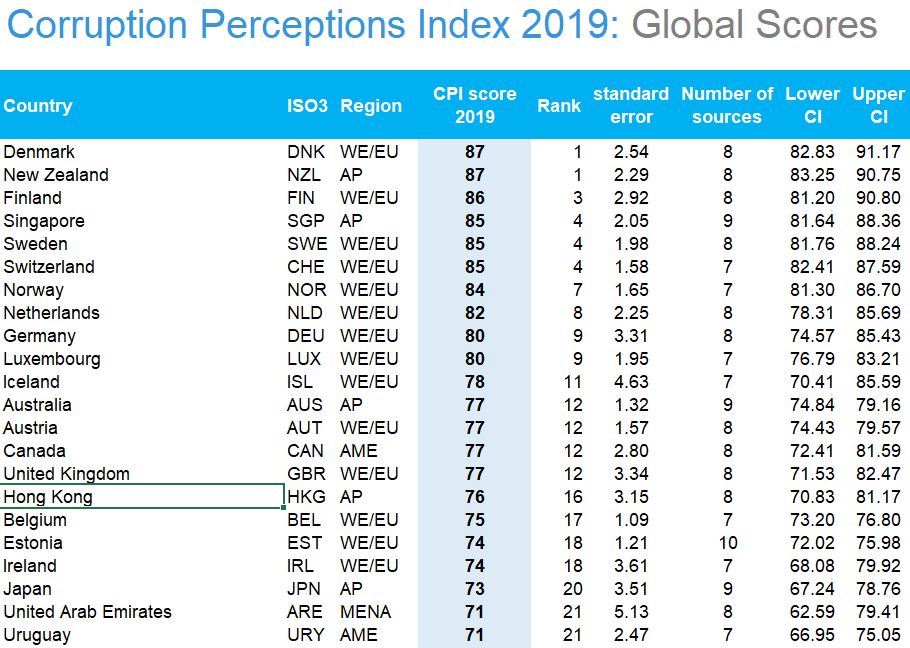
According to Transparency International, Singapore does relatively well in terms of corruption. Based on their 2019 Corruption Perception Index, Singapore is the fourth least corrupt nation, behind Denmark, Finland and New Zealand, countries which are known for having a culture of honest governance.


One has to look at this ranking with a critical eye. One of the most detailed analysis of how our ministerial salaries compare can be found at:

https://international.thenewslens.com/article/102993

Coming in fourth is not a bad position. We are the only Asian nation in the top ten of the lists of most honest governments and as a prominent Middle Eastern Businesswoman says, “Singapore washes the face of the Oriental.”

Having said that, we need to be a little more critical of our position in order for us to continue and improve. The main point that we need to hammer home is the fact that given that our ministers are paid exceedingly well in order to ensure honesty, we should be number one on the list. Let’s not forget that the Prime Ministers of the Nordic Countries and New Zealand are paid considerably less and Jacinda Arden has famously refused a pay raise stating that she’s already at the upper end of the salary scale.

The other point one should note is that there is that corruption is mainly defined as the “money” variety. Singapore has “no” money corruption in as much as you’re not going to get very far in bribing government officials and so on. However, one should note that Singapore has plenty of people willing to do you favours when it comes to working with government departments and if you look at the top jobs in Singapore, you’ll notice that they inevitably go to the same people. This has to lead you to the conclusion that Singapore’s talent pool is either incredibly small (one of Lee Kuan Yew’s mistakes. He encouraged the talent pool to bread within itself not realizing that inbreeding is bad for the gene pool) or Singapore has an abundance of itchy backs that need to be scratched.

The second point about the high salaries was the fact that government needs to attract talent. On the surface, this is not an unreasonable argument. Why should the nation’s best and brightest automatically head for finance houses to serve the proverbial one percent of the global elite, when they can just as easily be running a government department and serving a larger segment of the population. The saying of “You got to pay if you want talent,” applies to the public sector as much as it applies to the private one.

The Singapore government also seemingly obsessed with grooming talent, particularly that of the public sector. Our scholarship system enables the government to pick out the guys who get top notch results and bind them to the government. It’s a comfortable life with a well-defined career path. It gives the government bragging rights to say that the best and brightest are running the show. However, is that really the case.

While Singapore still does measure up pretty well in many aspects, our well-oiled machinery has been showing signs of serious disrepair. The most famous incident came in 2007 when a man labeled as “worst terrorist” managed to walk out of a highly secure facility and he remained hidden for well over a year until he was caught by the Royal Malaysian Police (Ministry of Home Affairs would insist that I add the sentence – with assistance from the Singapore Police Force). The result of a man with a limp walking out of a highly secured facility was the sacking of two Gurkhas and the demotion of the man running the facility and the passionate defense of why the head of the police and the Minister of Home Affairs needed to keep their jobs.

As Covid-19 showed, there were plenty of examples of how our very well-paid civil servants and ministers who running into blunder and after blunder.

Let’s use an automobile analogy. The Singapore tax payer is asked to pay for a Rolls Royce. You expect the car to run perfectly and when things go wrong, the workshop will fix it immediately. Rolls Royce is about the service as much as it is about the car. There is an urban legend that says that when Ogilvy wrote his classic tag line of “At 60 miles an hour the loudest noise in the new Rolls-Royce comes from the electric clock," the head of the workshop is reputed to have said, “Damn, I’ll now have to get the electric clock fixed.”

Singaporeans are not unreasonable. We understand that the government will mistakes along the way. However, we’re paying for Rolls Royce standards so, we expect the government to react like Ogilvy’s Rolls Royce engineer and fix the problem. However, this isn’t what we’re getting. What we’re getting is angry responses and libel threats. Then, there’s Fawning Follower and his ilk lecturing you on the values of being screwed by the government.

OK, our ministers to stack up pretty well against their regional counterparts. However, our brethren across the causeway are paying for a “Proton Saga” and when the Malaysian government behaves like a Proton Saga, it’s a case of getting what you paid for. By contrast, Singaporeans are paying for a Rolls Royce, getting a Toyota and when they complain, they’re told to be grateful that they didn’t get a Lada. I don’t know about you but I don’t think this is how someone who is paid a million plus a year from my taxes should behave.

Since the government is so fond of comparing itself with the private sector, we should use private sector analogies. The heads of multinationals, particularly the American ones are paid astronomical sums. However, shareholders expect them to perform and customers expect not just the maintenance of high standards but a constant improvement. Look at John Flannery who succeeded Jeff Immelt as CEO of General Electric. The share price did not improve within a year and Mr. Flannery got the boot and that’s even if you can argue that he was merely trying to solve problems that came from his predecessor.

Shouldn’t we apply the same standards to government ministers? We can entertain the argument that we need to pay our ministers the same as top level executives. However, in return why don’t we have an election once every two years instead of once every five. High pay needs to be matched with high performance, which is admittedly stressful. However, isn’t a million dollars a year worth the stress of a bi-annual job appraisal instead of every half a decade? The public is paying a million per minister per year. It has a moral obligation to demand what it is getting for what it is paying.  

Wednesday, August 05, 2020

“Not competitive at all.”

One of the highlights of my working life in corporate insolvency came from a meeting which involved one of Singapore’s foremost insolvency and restructuring practitioners. I was part of a team bidding for a case that was being held up in the American courts and my employer felt that it was necessary to rope in a “brand” name practitioner and so got this particular practitioner into the coalition that we were trying to assemble. Towards the end of the meeting, the solicitor who was trying to build the team turned to this practitioner and asked, “Are your fees competitive.”

At that very instant, the practitioner said, “I’m NOT competitive at all,” and he said so with a certain amount of pride.

I think of this moment and the way this man took so much pride in being “NOT competitive at all,” because it underlines one of the most fundamental aspects of doing business – price. One of my favourite clients said it best when he told me – tell me:

  1. 1.      What can you do?
  2. 2.      How quickly can you do it?
  3. 3.      How much will be cost me?

As someone who was inevitably desperate for the job, the answer to these questions were as close as one could get to the following:

  1. 1.      Anything you want?
  2. 2.      It was done before you even thought of it?
  3. 3.      Nothing at all.

Quite often, the most important factor in deciding who got the job, often boiled down to the third point. It is in the buyer’s interest to get away with paying as little as possible and the seller will inevitably try to show that he or she can give the buyer the price that he or she wants.

If I look back at my freelancing days, I realise that I had one key advantage over my competitors, who were inevitably sizeable companies – price. I could do the job at a certain standard at price that my competitors could not do. When I took my last big job in the industry, I was presented with a quote that the client had gotten from a multinational and was told – “It’s yours if you can do it at half the costs.”

I was hungry enough to agree and we ended up settling at around 40 percent of what the competitor had quoted. However, while I had won the job on the third point, the client had high expectations about the first point. I was expected to deliver coverage on a multinational level without the multinational team (which would have required a budget). I managed to deliver the expected results at the expected budget (so much so that they told me to invoice and paid on the spot) by working through a relationship that are not commonly used by conventional practitioners.

Business is inevitably about balancing points one and two with point three. The adage is that success inevitably boils down to being able to be “good, fast and cheap.”

I’ve noticed that national economies, particularly the Asian ones do something similar. Japan, the most advanced economy, built itself up by being able to make things cheaper and better than the West. Gradually, as prices rose in Japan, manufacturing moved to South Korea, Taiwan, Hong Kong and Singapore.

Being able to work cheap has done wonders for Asia. Millions have left poverty because we were able to give the multinationals a cheaper alternative. This went into hyperdrive when China started becoming the world’s workshop and India the back office.

However, while price is often an important factor, I have to ask if this is sustainable, particularly for the mature economies like Hong Kong and Singapore. Our politicians are particularly fond of reminding us that in order to stay competitive in the global economy, Singapore needs to be competitively priced.

I don’t think they’re wrong to suggests to say that Singapore needs to be “competitive.” We are a pipsqueak island with no domestic market or resources. Our larger neighbours have more to offer and so we got to be on our toes and constantly find things to offer the world.

While I do understand that we need to be competitive in the global economic arena, I do question if the “need to be competitive,” is becoming an excuse to justify unacceptable practices, especially when it comes to making life better for the poor and needy. Just think of the two most common instances when the need to stay competitive is brought up to stop a discussion. They are inevitably:

1.      Having a minimum wage – common argument is that this will make us less competitive (read cheap) and therefore our economic system and well being will collapse;

2.      When it comes to slave labour from South Asia. Once again, the common point is that if we gave the slaves a dollar an hour more (and actually gave it to them) and got them to spend an hour less in the sun, our infrastructure costs would sky rocket and our economic system would collapse (believe it or not, even when Covid-19 was showing us very clearly that slave hovels were endangering the rest of us, there were people fretting that improving the lot of slaves would endanger our economic survival).

Shouldn’t it be clear by now that a mature economy like Singapore’s can no longer compete on being cheap and we need to reinvent our focus on being good instead of being cheap. This is not to say that price will not be an important factor – merely that we need to compete on something other than price.

I go back to my freelancing experiences and the insolvency practitioner who is proudly not competitive. I competed on price because I went to look for my customers. The insolvency practitioner has reached the stage where customers look for him. He does not need to be cheap. He does not need to do every job to stay alive – merely the ones that pay very well.

There are examples of this. The most famous example of Apple, which designs products and reinvents the way we do things. Apple is an example of a company and business that creates our need to need their products. This is an example of what type of business Singapore Inc needs to aspire to.

Unfortunately to be good, you need to pay and this where Singapore needs to get away from its obsession with “cheap.” Let’s face it we will never make things cheaper than China or 3D printing or do back office work cheaper than India or AI and that’s even if we give away factory land away and exempt foreign multinationals from paying CPF contributions to locals.

Our economic role models can no longer be other developing countries. I think of the German model as an example. Germany has one of the highest hourly wages in the world:

https://worldpopulationreview.com/country-rankings/minimum-wage-by-country


Yet, at the same time, Germany is also the third largest exporter in the world. Germany with one third of the population of the USA and not even 10 percent of China’s, competes in the global market.

https://en.wikipedia.org/wiki/List_of_countries_by_exports


What does Germany export? It exports good quality products. The ones that come to mind are Mercedes and BMW, which are known as some of the best cars in the world rather than the cheapest:


However, there are others. The German economy or Europe’s largest and the world’s fourth largest, is driven by SME enterprises that specialize in unique goods for very niche industries. I think of the Rational Combi-Oven that every chef I’ve worked with used to drool over as an example.

Isn’t it time we moved away from trying to be the world’s cheapest for the world’s big boys? Why can’t we be proud of being good and not being embarrassed of getting the world to pay for Singapore Inc’s products what it pays for that of the West.

We’re a small economy but in the interconnected world we live in, there’s no reason why we can’t do big things on the world stage? Surely this is something the government should drive us towards.


Monday, August 03, 2020

“I’m not a rich man – everything I make is reinvested in the Company.”

I remember my Dad and I once had a discussion about money. I was still at school and he wasn’t happy with how I was spending things. He made the point that despite the good things we had around us, he was not a rich man with infinite resources. Everything he had was reinvested into his business.

This conversation summed up the importance of money. While money is not everything, it plays a vital part in most of what we do. Money is not the root of all evil – it is the root of most things and business people, including the ones that are doing well, will always remind you that whatever surplus they earn has to be invested back into the business. Hans Hofer, the founder of Apa Guides once said that he only made money from his business when he sold his business and did other things.

I remembered these conversations and as I started freelancing in an industry where people are expected to work for foreign multinationals, I learnt two valuable lessons. The first lesson was the fact that money is power. The guys with the money will inevitably squeeze those without. The guy who has the advantage in a business negotiation is inevitably the guy with money in the bank. It is, as they say, easier to tell someone to f** off when you have enough money to worry about not having that job or project.  

The second lesson I learnt was that there was a clear difference in attitudes towards money between those working for someone else and those who were employed. Big ticket items like posh meals, fancy wines, swanky hotel rooms and business class tickets were inevitably bought by those on expense accounts. The self-employed, including the successful ones, tended to be a little more conservative with their spending. It is inevitably easier to spend someone else’s money.

These lessons I took from the world of business seem to apply to electoral politics. The winner of any given election is inevitably the party that has the resources to spend. American elections are particularly well known for this. Candidates need to raise hundreds of millions to get past the finish line.

It isn’t much different in the Westminster System, where its often said that elections are lost by governments rather than won by opposition parties. Singapore’s government, for example is pretty good at dishing out goodies before an election.

It has also has been particularly good at buying over potential opponents. Our scholarship system is designed to bring bright and potential trouble makers onside. Two of our more prominent ministers (Tharman Shanmugaratnam and Vivian Balakrishnan) are examples of two bright sparks, who had

However, Singapore’s ruling party has run into a few challenges recently. The first one is the fact that potential opponents in the opposition are increasingly financially independent like former Worker’s Party Member of Parliament, Chen Show Mao, who was a partner at David Polk & Wardwell, a law firm with over a billion in revenue. Telling someone they can afford a condominium in a few years of working for you just doesn’t quite have the same effect on a man who is already living in a condominium.

The second challenge comes from an attitude towards resources. At the end of the recent election, the Prime Minister announced that Mr. Pritam Singh, leader of the Worker’s Party would be given the title “Leader of the Opposition,” which would be recognized office in the apparatus of the state which comes with a salary and staff.

This is office is found in other Commonwealth Jurisdictions like the UK, Australia, New Zealand, Canada and India. However, in the Singapore context this was revolutionary in the sense that it was official recognition of “opposition” parties as a legitimate force. The cynics also argued that it was a sign of taming the Worker’s Party with an effective bribe.

However, Mr. Singh threw a wrench into the works by donating half of his salary increase. This announcement instantly brought him into the cross hairs of one of the ruling party’s most prominent trolls, Mr. Calvin Cheng, who complained that the Prime Minister’s donations didn’t get the good press that Mr. Singh’s was getting:

http://theindependent.sg/calvin-cheng-asks-why-pm-lee-doesnt-get-the-recognition-pritam-does-for-donating-half-his-lo-salary/

To make matters worse, Ms. Ho Ching, the Prime Minister’s wife, CEO of Temasek Holdings (Singapore’s Family Office), and the only person whose salary is a state secret joined in the fray:

https://www.asiaone.com/digital/ho-ching-and-calvin-cheng-take-pritam-singhs-donation-declaration-netizens-respond

Mr. Singh has clarified that he wasn’t giving away half his salary but half his salary increase:

https://www.straitstimes.com/politics/wp-chief-pritam-singh-clarifies-that-he-will-donate-half-his-salary-increase-not-half-his

Why are people associated with the ruling party getting upset by Mr. Singh’s donation? The obvious point would be that it doesn’t make them look good. The act of forgoing the salary increase (which is considerably less than the lowest paid political office holder) has started what the Malay Mail described as a potential charity war and made Mr. Singh look better than the ruling party office holders:

https://www.malaymail.com/news/opinion/2020/08/02/singapores-opposition-leader-launching-a-charity-war/1890250

The less noticed and talked about point is that Mr. Singh probably had no choice in donating his new salary increase. If you look carefully at what Mr. Singh has said he would donate to, you’d note that it is primarily towards grassroots causes in the areas that his party controls.


The Worker’s Party is playing a long-term game. Strategy is simple – win seats, keep taking care of constituents to stay elected and then challenge for seats when you have enough strength. Unfortunately for Mr. Singh, his options of executing that strategy are particularly limited in as much as the main source of funding comes from the government, which is controlled by the ruling party, which unashamedly works on the principle of delaying funding to wards that it does not control.

Hence, Mr. Singh has to find different ways of funding the programs that his constituents need. The donation of his salary increase can be seen in the same light as a small shop keeper investing a windfall back into the business.

It’s different for the ruling party in as much as it controls official purse strings. Ruling party members of parliament (MPs) can afford to behave like executives on a generous expense account because getting the money is simply a question of following official rules on accountability.

Someone who comes from a position where he does not have to find ways and means of creating a budget will not be able to understand the motives of someone who is operating in a system where he or she has to get creative about raising the money.

While it will be sometime before the Worker’s Party will be in a position to fight for the government, the lack of resources is inevitably good for it. Its MPs will be trained to think of their wards like microenterprises with limited resources. This mindset will produce people who should be able to come up with creative solutions to the more complex problems of the modern age.

Hopefully, a stronger opposition will also help improve efficiency in the government. One can only hope that the increase in dissenting voices will get ruling party MP’s to think more creatively in order to get things past parliament. In business, big conglomerates like General Electric have started to work on the principle that they need to behave like smaller enterprises. Hopefully the same will happen in politics.    


Wednesday, July 29, 2020

Winning Loyalty

I am, what you’d call a late entrant in the area of watching Korean dramas.  With the exception of a few meals at Korean restaurants and enjoying the odd bit of eye candy of Korean girl groups, I was never into Korean soft culture until the circuit breaker, when I found myself with sometime and easy access to Netflix.

One of my most recent discoveries was a series called “Whisper,” which tells the story of an honest judge and policewoman who team up to bring down a very corrupt but very powerful law firm that has built up its business in the arms trade. The most interesting character in this drama is the head of this law firm - main villain. He is the son of a “slave” who built an empire through brains and hard work. The man is a spider in a web of connections with those with power. If he wasn’t a character in a Korean drama, he’d probably be on the cover of Forbes Magazine.

The crux of the entire series is the scene when he teaches his daughter how to gain the loyalty of person to the extent that the person will do literally anything for them. His advice is as follows:

  1. Take Away EVERYTHING they have;
  2. Help them climb up when they reach rock bottom

If you look at this advice, you’ll realise that the man in a genius. Who wouldn’t want to be loyal to the people who helped them when they were down?

Every bit of “feel-good” and “self-help” wisdom tells you that the people who really care about you, are the ones who are there for you when you are down and out and are unable to offer yourself, let alone anyone else anything of any possible value. The human brain is such that once we get out of the proverbial doldrums, we’re bound to think better and act more favorably to those who bothered speaking to us when we were down.

The villain in Whisper is correct in his second point. We are inevitably loyal to those who helped us when we were down. What most of us tend to don’t do is to question the first piece of advice, especially when it comes to our “friends” who are in positions of power and influence. I mean, who on earth would even question the person who was there for us when we were at our lowest point?

Yet, its an important piece of advice, especially when you apply it to the current global economic disaster caused by the current pandemic. Most of us have reached or are reaching low points in our personal finances. Jobs and other sources of income are hard to come by, yet bills like mortgages need to be serviced. Nobody has any clue as to how when an economic recovery will happen and even then, it will be sometime before any of us see a recovery in our personal finances.

In such situations, we’re bound to accept a helping hand regardless of where it comes from. If you look at “talking points” and conversations that people had before the circuit breaker in April, it was on the topic of government assistance.

Singapore’s government was perhaps one of the more sophisticated in dealing with this. The government announced in February that was preparing for an economic slowdown and proceeded to make sure that the public knew that it was asking the president permission to draw down from the reserves (which is a “given” in practice as the president is “selected” by the government). There were also great pains to announce there were an unprecedented four budgets, which were designed to help us get through the economic storm.

It was only at the end of June, when the government decided to call for a snap election and it was only after the election that the government announced that the economy had been in a double-digit recession. You have to hand it to the government to timing things well.  The first payout came in April, while we were getting used to life under lockdown. The second was in June, a month before the election.

In fairness to the Singapore government, it’s not the only one to try and pull this off. Donald Trump’s biggest political stunt was to try and get the stimulus cheques sent out to have his signature. Think about it – you can say what you want about the man prescribing medications he has no business prescribing and mismanaging things because the feelings that matter are not the ones that you talk about but the ones you have when you look at that cheque and then look at your bills.

Politicians know that we’re less critical towards our “benefactors” in downturns. We’re in no position to start questioning sources of money, when the need to pay bills remains pressing and money is a scarce commodity. Who in their right mind is going to question the motives of the guy offering something that you need most?

The saying that we should always remember the people who helped us in hard times rings true. However, at the same time, it’s also important to remember how we got into the hard times and the role that our benefactors may have had in putting us there.


Monday, July 27, 2020

Don’t Cancel "Cancel Culture"


One of the most amusing things to come out of the Singapore General Election, comes from Singapore’s most (in)famous blogger, Ms. Wendy Cheng, who blogs under the name of Xiaxue, locked the blog that made her so famous. The story and the reasons for locking the blog that made her so (in)famous can be found at:


You could say that I have jealousy issues when it comes to Ms. Cheng. Her daily readership is probably more than what I’ve achieved in a decade and while I struggle avoid being turned into a digit in office land so that I can blog without worrying about advertisers, Ms. Cheng earns from advertisers what I can only dream of from winning the lottery. It goes without saying that she is significantly better looking and I guess people would rather look at a young girl with a halfway decent figure than a tubby bald man. Call me a snob, but despite her “success,” she writes drivel designed to turn on the lowest common denominator or white men (who as a rule of thumb have strange taste in Asian Women)

Just as my fellow writers on TRemeritus and Independent Singapore take on the Singapore Government and its supporters, Xiaxue has famously taken on foreign workers for having the audacity to be on Orchard Road (because they might molest our girls – which in this case should read the Chinese variety) and the disabled (especially those who have the audacity to take issue with the able bodied taking what is theirs – things such as specially reserved parking lots. – Ms. Cheng even got herself published in the Today newspaper by writing a piece on the joy she got taking a piss in toilets reserved for the disabled.).

In short, Ms. Cheng is a little like a non-political version of Trump – awful but strangely addictive.  Even people who loath her can’t help reading the stuff she writes. Her commercial success is in part thanks to her awfulness. It draws people to her blog like flies to shit and traffic in turn leads to greater interest in advertisers.

Having said everything that I have just said about her, I think of Xiaxue as I do of Donald Trump -chemotherapy. Her very existence is actually representative of something good in Singapore – namely greater participation in the public discourse. When Xiaxue says something, people react – even if it is to take a view that is contrary to hers.

In Singapore, we’re a little obsessed with “harmony.” Sure, harmony is on balance, wonderful. However, when officialdom is given the power to define harmony, it becomes open to abuse. Harmony is often described as anyone who disagrees with the official version of what life should be – no matter how mild that disagreement may be.

I take myself as an example. I’ve been bashing out pieces for public consumption for the last decade or so. I don’t consider myself particularly extreme in any shape or form. Nor do I consider myself anti-establishment. I am, on the whole, quite OK with PAP as the government. I don’t think they’ve done enough to “lose elections.” However, I have disagreed with policies that various governments have come up with. I don’t think the government’s handling of Covid-19 was a disaster (immediate comparisons being with the US and Brazil) but I took issue with their handling of issues involving home based businesses and more importantly their refusal to take a closer look at foreign manpower.

Yet, despite not being terribly political, I have been told by close friends whom I’ve worked with that I am a “political writer” and “anti-establishment.” Why would that be? The problem here is the fact that I’ve disagreed with certain policies, made my stance relatively clear and therefore disrupted “harmony.”

The second problem with harmony is that it leads to complacency. When you don’t have problems to deal with, you don’t think. Life will be fine. I think of Mike Tyson, once the most fearsome boxer on the planet. In his biography, Mike Tyson admits that he took winning as the natural state of affairs to the extent that he never bothered to train. Buster Douglas on the other hand trained like a madman and so, Buster Douglas won. The same applies to harmony. Too much of it has unintended and unhealthy side effects.

Xiaxue is funnily enough healthy because she disrupts us from our harmonious slumber. She says something about migrant workers and we react. Suddenly, we start thinking about the issue, because she’s said something about it.   

While I generally don’t encourage mob rule, I also think that there’s something positive about cancel culture. I see cancel culture as a sign that people care enough to react to something. I know that there are arguments against cancel culture:


However, I believe that cancel culture helps brands think. In Singapore, its been too easy for big brands to disregard opinions as irrelevant to the larger picture. I remember the Straits Times once ran a piece on how big brands didn’t need you the insignificant consumer. Cancel culture shows that this is not true. Consumers have the right and the power to tell brands who they want them to associate with. People do buy according to values and this can only be a force for good it forces brands to behave.

Xiaxue, will no doubt find a way to survive. While there are advertisers who will abandon her, there will be those who continue to support her.  While she may not be pleased with being on the wrong end of cancel culture, its clear that the good that she’s done for Singapore is being enhanced by her being part of cancel culture.

Thursday, July 23, 2020

Where Do You Draw the Line when it comes to Basic Needs?

I’ve just blocked a former girlfriend from texting me. We had gotten along well enough and then Singapore’s Covid-19 circuit breaker measures came in. I could not keep in touch and then for reasons best known to her, she thought it was appropriate to send my daughter inappropriate messages. The kid told her to stop and after running into her, I told her to stop harassing the kid. Despite that, she persisted in sending me messages about how she would invite my daughter to her office for drinks and would come to the house to meet the kid. At that point, both the kid and I thought enough was enough and so she was blocked.

I’m made to think of this incident because of the recent arrest of Ghislaine Maxwell on the charge of providing underage sex-slaves to the disgraced financier, Jeffrey Epstein. As well as being excessively rich and having a preference for young girls, Mr. Epstein and Ms. Maxwell (I’m old enough to remember the yacht that was named after her) counted the rich and influential, including the current Occupant of the White House and the Duke of York, as part of their social circle.

https://www.forbes.com/sites/lisettevoytko/2020/07/21/heres-every-time-donald-trump-and-ghislaine-maxwell-have-been-photographed-together/#66f4691a183d 


The case of Mr. Epstein and his associates raises one of the oldest and most common issues faced by people all over the world – namely the issues of sex, power and money and in the pursuit of sex, power and money, are there any issues of where we draw the line.

As I’ve confessed in previous postings, I’m a self-professed cad. I hate the idea of being exclusive to anyone (a case of why stick to one when there are so many) and I can’t help to look at the nubile things that walk past me when I’m in the office area (Singapore’s financial district). Looking at a woman’s body and being able to enjoy a woman’s body is like getting to look at a piece of art and enjoying a tasty meal at the same time

My only defense to saying everything that I’ve just said is that I’m probably no different from most heterosexual men. The need to get laid is one of the few recognized human needs that transcends race, religion and so on (as a Jewish architect said – “My dick isn’t racist”).

However, human nature is such that the simple male need to release sperm is complicated. While the male brain is wired to release sperm, the female brain is wired to ensure that any offspring she produces are well taken care of. Hence, while men look for nubile young things, women tend to look for signs of strength and stability or as my mother would argue – you want the guy who will be hanging around once the kid comes out. Hence, the history of the human sexual experience has been about women trading their bodies in return for men providing for the well being of them and their families. In prehistoric times, this meant the guys who got laid were inevitably those who could bring home the biggest share of the kill.  These days, it inevitably means the guys who earn big bucks.

It is socially acceptable and many cases a status symbol for an older man to have a much younger companion. Say what you like about Donald Trump but having Melania by his side has not harmed his social standing. By comparison, Emanuel Marcon gets a few funny looks for the fact that he married a much older woman and has stepchildren who are his age. My Uncle Richard, who was a cad of the highest order, used to tell me, “No such thing as a good-looking woman over 25 and make sure your next wife is half your age.”

It’s even more acceptable in Asia, where levels of poverty are high. Asia’s red-light districts are filled with young girls hopping to escape poverty and a girl who marries a much older (and often Western) man is considered a hero for finding a route out of poverty for her family.
I get the attraction trade off here. Which man doesn’t want to wake up next to a hot bod? Which woman wants to reject the guy who can provide a good home for her? As an old friend used to say of Prince Charles, “What man kicks out a beautiful blonde for an old hag?”

Yes, I get the attraction and the trade-off. Yet, despite that I also believe that there have to be limits. There needs to be mutual respect and both parties need to be able to able to understand what they’re getting into.  Hence, I get repulsed when I hear of a “trade in children.”

I take myself as an example. As I get older, I notice physical attraction more and the issue of “age-appropriate” seems to matter less. My main defense is usually, I’m not the first 40 plus something to look at young nubile things with a certain amount of lust.

Yet, I remind myself that I am first and foremost a father of a young woman and my initial thoughts always go back to the question of who do I want her to find in life. If she’s meant to find love and happiness with an older man, then I won’t stop it but do I want her to be the plaything of an old man? The answer is clearly no and that always brings me back to normalcy. I become conscious that my behavior might affect her perceptions on what a man should be. Hence, while I might find a younger girl attractive at a glance, I remember that I’m dad before anything else.

Mr. Epstein, the Occupant and the Duke crossed a line in their pursuit of young, underage girls. There’s something not quite right about people with power, money and influence using children for their own needs. I understand the need to get laid, I’ve been guilty of succumbing to that need on too many occasions. However, a line has to be drawn and people who have said no and are unable to give consent should be protected with the full extent of the law.

Tuesday, July 21, 2020

Tapping on the Diaspora

I mentioned that I met Professor Yu Wei Shin, nearly a month ago in my piece “I KNOW I AM ATTRACTIVE – I JUST DON’T KNOW WHO I AM ATTRACTIVE TO.” (15 July 2020), via my Linkedin feed. Professor Yu had mentioned that he had read my pieces on TRemeritus and that he was an ex-Singaporean. My brief acquaintance with Professor Yu got me thinking about who these ex-Singaporeans are and whether we as a nation could tap onto people like him. I’ve invited him to give us a glimpse into his life and his feelings towards Singapore. In the brief glimpses that I’ve had of the man, it is clear that Singapore is failing to make the full use of our diaspora. Here is a well-educated man, who is building a high-tech product in his later years (A point I stress as Singapore is a place that considers you ancient and useless after 45).
The Professor has given me a short blurb, which I hope you will enjoy.
Tang Li – Singapore 20 July 2020


According to reports in Singapore’s Parliament, there are around 1,000 Singaporeans give up their citizenship every year. Many of those who have given up their citizenship and moved elsewhere are well-educated and found success in their new homes. Many also yearn to return to Singapore to share their accumulated knowledge, skills and experience, to semi-retirement, which they would do so at no cost to the tax payer.

Unfortunately, our current immigration system does not recognize that there might be a diaspora out there who could do many things for Singapore. Once you leave and renounce your citizenship, you are deemed to be like every other foreigner and if you wish to return to Singapore to work, you need to apply for an Employment Pass. In my experience, this is a discriminatory process. Ex-citizens are regarded as “traitors” for having the audacity to give up their citizenship and the system seems to prefer those who never had ties to Singapore coming in. I take myself as an example, despite have two PhD’s and conducted ground breaking scientific trials, I was advised twice “Do not apply, and if you do, your application will be rejected.”

This is sad. I think of other countries that have prospered because they tapped on the skills, experiences and even capital of their diaspora. China, for example, tapped on the diaspora in its early stages of development. India has a system known as the “Persons of Indian Origin” (PIO) card, which makes it easier for anyone of Indian origin, regardless of passport to come and contribute something to India.

Why do most of us give up our citizenship? We do so for a variety of reasons and I believe that most, if not all, of us give up our citizenship as a last resort. However, our heart is still very much anchored in Singapore- a little red dot of their forefathers, and where they were born and spent many years growing up. 

In my case, my father is Singaporean, though he returned to China to die. I was born and grew up in Malaysia, went to New Zealand to study, worked, then immigrated to Australia to work, before coming to NTU to teach in 1984.   You could say Singapore got a good deal from me. None of my education was paid for by the Singapore tax payer and I came with a PhD and with 10 years heavy engineering industrial experience. Apart from my 19 years of lecturing, I was very active as town councilor (in charge of environment matters), presidents of learned societies and consultancy to SME's, PSA, Philips, Seagate, Mobil Oil, Mindef, MFA, CleanSeas,

I only applied for Australian citizenship because of my mother's dying wish and my wish is to return to SERVE SINGAPORE UNINTERRUPTED!

While I may have renounced my Singapore Citizenship, I’ve been able to contribute in the following ways:
1.     At 56, I studied Master of Occupational Therapy at the University of Sydny and then PhD (Medicine) at University of New South Wales, graduating at 60 years, so that I can help solve some of the chronic disorders of the elderly in Singapore (-- stroke, elderly falls, etc).
2.     Even before I graduated, I returned and conducted a major clinical trial for hip fracture prevention together with Tan Tock Seng Hospital, for several hundred HDB residents, under a Government grant, using Prof Cameron's hip protector invention (USyd).  He is the internationally renowned "Father of Hip Protector".
3.     From 2012-2016, I returned as Visiting Consultant at Nanyang Polytechnic, and conducted 3 major clinical trials with TTSH using my invention: Robotic Lower Limb Rehab System, for sub-acute and chronic stroke patients, and elderly falls prevention -- all very successful!
4.     Now, together with my PhD university mate Dr Wong (www.apppliedrobotics.com.au), and Nanyang Polytechnic, I am inventing a revolutionary wheelchair system that even the Brits have no solution. It will solve many of the social economic problems in Singapore and beyond, ease the manpower shortages in nursing homes and hospitals and create many skilled jobs in Singapore!
5.     Going forward, we plan to establish a virtual Disabled Mobility Technology Research Centre, combining the expertise of University of Wollongong in Australia and NYP. 

Singapore spends millions on educating and nurturing "foreign talents" in its education system. We work hard to attract expatriates from the West and India.  We should also not overlook people like me. We have the talent and the desire to serve. Why can’t you make it easier for us, people who have the established emotional connection to come back to contribute?

Incidentally, my father served in the British Navy to defend Singapore during the war and suffered PTSD, which lead to family violence and divorce! Also, two of my children were born in Singapore, and three of them attended primary and secondary schools in Singapore. It hurts to be told on twice, "do not apply, and if you do, your application will be rejected"???

Prof YU Wei Shin
PhD(Medicine)(UNSW), PhD(Mech ENgg)(Canterbury, (BE(Hons)
Sydney

Sunday, July 19, 2020

The Value of a Token

During Singapore’s recently concluded General Election, I received a few notes from friends commenting about the lack of diversity amongst the ruling party’s candidates. While the ruling party did field candidates with Muslim sounding names, there were no noticeable Indian faces. To compound matters, the Deputy Prime Minister (or Prime Minister in-waiting) had said that the public was “not ready for a non-Chinese Prime Minister.” These words were repeated endlessly thus portraying the ruling party as a bastion of racial privilege.

Having lived as an ethnic minority in the UK for my formative years, I get the criticism of the ruling party’s lack of diversity in its candidates. When you are part of a minority, there’s something strangely appealing about being with and speaking with your own kind. In nearly a decade of living in the UK, London’s Chinatown always felt like a comfort zone. Although English is to all intents and purposes “my language” and my friends from that era of my life were all white Anglo-Saxons, there was something comforting about being with people who looked like me and hearing and communicating in something other than English.

However, as I’ve grown older and moved around more, I’ve come to question the value of having a “token” minority around. Do people of a different colour with a seat in a national legislature or on the board of directors make a country’s minorities more comfortable or business more appealing to different customers? If I take myself as an example, I was told that by my Western friends that I should brush up on my Chinese and become a bridge between East and West. However, if I look at myself objectively, I have to ask what type of bridge would I be. The only thing I have in common with most Chinese is the colour of my skin. While I can communicate in verbal Mandarin and Cantonese, I do so badly and I am Chinese illiterate (I communicate with Chinese via Google translate).

Instead of being a “bridge” between East and West, my real value was the fact that I was once an ethnic minority. The only time I get obvious delight from people is a professional setting is when I meet English lawyers and speak to them in a recognizable accent and understand that London is not the only part of the UK. Instead of being the bridge between the Occident and Orient, I gel most easily with people who don’t look like me – being able to discuss the value of Wasim Akram as a fast bowler or Sachin Tendulkar’s batting has proved to be invaluable from a commercial relationship building exercise.

If I look at my own experiences as an example, I have to question the value of tokens. What does the token this or that in the cabinet or on the board of directors actually done for their community that they are supposed to come from? Sure, there is an extreme of people feeling most comfortable with their own kind. Hence you have Chinese hiring Chinese, Indians hiring Indians and as an Australian friend pointed out, short people preferring to hire short people. I am a bald man who got hired by another bald man.

However, with tokens, the opposite is true. Chances are, they become so grateful to be part of what they perceive to be a “selective” group that once in the group, they do their best to ensure their own kind don’t get in. One merely has to observe how immigration officers of South Asian decent treat South Asians trying to enter the UK. It is, as one Englishman put it – a case of “drawing up the drawbridge.”

The most famous example of how a “token” ethnic minority has worked against her own community can be found in the form of Priti Patel, the British Foreign Secretary. The nicest thing about Ms. Patel is that she is pretty to look at.

Pretty but Not by Policy.

However, if you look at her actions, you will notice that they are anything but pretty. Ms. Patel, who is the daughter of Gujurati migrants, who came to Uganda after they were thrown out of Uganda (the people who made the Ugandan economy tick and would later reward Britain for generosity by doing for the British economy what they had done in Uganda), has famously been part of the “hard line” Brexit faction of the Conservative Party and has supported the scrapping of various human rights and environmental protection policies. Ms. Patel’s career in both the private and public sector have involved speaking up for the unsavory. She has helped her husband, a marketing consultant to the tax payers kitty and as Home Secretary, she has notoriously come up with the most hardline immigration policy the UK has ever implemented. By her own admission, her own parents would have never have been allowed to enter the UK.  A concurrence with my views on Ms. Patel can be found at:

https://www.quora.com/Is-Priti-Patel-the-most-attractive-UK-MP 

I am admittedly racist in favour of South Asians trying to enter the UK. In the years that I lived in the UK, these were the most hard-working group who created businesses and made a better life for themselves. The guys begging me for small change were never people of colour, they either opened corner shops or hustled to get you into a mini-cab. It was inevitably the native-born whites who hustled you for small change and got uppity when you refuse to give over the pennies that had been worked for. When someone like Ms. Patel comes with a hardline immigration policy and bleats on about “taking control of OUR borders,” I read it as “Enhancing racial superiority of the lay abouts who would happily murder people who look like me.” I think of a talk given by the British High Commissioner at a law firm that I’ve worked with. For the better part of the talk, she went on about how Brexit was great because we were “taking control of OUR borders.” Then, a White Anglo-Saxon asked her about the “Weaponising of Racism” and described how his wife, who is “non-white” was frightened about returning to the UK. Her Excellency didn’t seem to think that policies set by Ms. Patel were in anyway damaging to this man’s family.

In fairness to Ms. Patel, she isn’t the only ethnic minority who has made a career screwing her own kind. There’s Nikki Haley (Real Name - Nimrata Nikki Randhawa), former US Ambassador to the UN, who is the daughter of Sikh Immigrants (read – people who set up businesses and go to work). While Ms. Haley has been significantly more calculated in her policies than Ms. Patel, she’s also supported hard line policies on immigration, particularly those of the Trump Administration (read – tough fighters who run away when it comes to fighting people who can fight back)

Closer to home, there’s the example of Mr. Samy Velu, who was chairman of the Malaysian Indian Congress for 30-over years. Mr. Velu was very good at staying in public office. He was very good at ensuring that he and his cronies got very rich of public contracts (he was famous for collecting tolls). He was rather less good at doing anything for Malaysia’s Tamil population, who continue to be a kicked upon minority.

In Singapore, we have token ethnic minority ministers who have become very prominent for being, well good spokespeople for the establishment. I think of our often law and home affairs (apparently there’s no conflict of interest between making and enforcing laws), Mr. K. Shanmugaratnam, who accused to rappers from an ethnic minority of stirring racial tensions because they had the audacity to call out a tasteless add which involved someone from the ethnic majority painting his face brown.  It takes an ethnic minority to tell ethnic minorities to stay in their place – you are not allowed to get upset when the majority makes offensive remarks about you.

This isn’t just at the minister level. It’s always visible at immigration. Think of the South Asian immigration officers at any British port waiting to humiliate potential migrants from South Asia. I think of the time when I had a US Green card and wanted to snap it in half and fling it at the immigration officer. It was no coincidence that the officer in question was …..Chinese. In all my years of traveling to the US, I’ve never had a problem with anyone else.

It’s not just about race. It also applies to sex. For all of Donald Trump’s obvious sexism and bragging about sexual assault (grab them by the pussy), he was actually supported by an alarming number of women, who didn’t want another woman in power. Think about this, men will help women, particularly attractive ones. Put it crudely, we’ll do anything to have a woman consider us worthy as bed partners. The worst enemy of woman on the rise (particularly an attractive one), is another woman, who will inevitably view her as competition.

I believe in diversity. I think of places like London or New York, which stand out for economic vibrance, innovation and artistic creativity. Places like these tend to be diverse in more than one way. However, you can use tokenism to create diversity. You have to grow it from the bottom up. The token black, white, Asian, Latino, woman, homosexual etc, tends to do the opposite of create diversity. They’re there to ensure nobody takes their place as the only this or that in that position. Rather than worrying about more brown faces during an election, I’d prefer to hear more Yellow faces talking about giving Brown faces a fairer deal. Rather than a token woman on the board, how about more men promoting women. Tokens exist to enforce the status quo.

I remember an Indian security guard at my Dad’s condo many years ago. He actually took pride in explaining why it was correct that the company he worked for had a policy of not hiring Indians. If that doesn’t say it all, what does? 


© BeautifullyIncoherent
Maira Gall