racism
Showing posts with label racism. Show all posts

Monday, December 21, 2020

There is No Racism in Singapore

So, if You’re Dark Skinned You Better be Grateful for Your Lot

Around eight-years ago, I befriend and Englishman who had moved to Singapore. Half way through our conversation he asked me what I missed most about England. My reply was “The intrinsic decency of people.” His reply was “There’s a lot more of that in Singapore.” My reply was “That’s because you’re white – try being a dark skinned labourer from the Indian Subcontinent.”

I’m reminded of this incident because I had the strange fortune of stumbling into an article in the Independent Singapore, which was about a post from the Singapore Government’s favourite white-skinned boot polisher, “The Fawning Follower,” who goes by the name of “Critical Spectator,” who proved the point I made to my English friend so many years ago:

https://theindependent.sg/critical-spectator-says-he-doesnt-think-racism-exists-in-singapore/


If you read the argument of the Fawning Follower, it runs along a pretty simple line – Singapore is a wonderfully multiethnic place and although a few derogatory terms are used in between the races, everyone gets along and there isn’t the equivalent of a Holocaust against anyone so, what racism is there?  To make matters more interesting, the fawning follower then goes onto argue that there is no racism in Singapore and therefore anyone who gets offended by a “blackface” portrayal is just a namby-pamby left wing cry baby who can’t take being called a name.

To be fair to the Fawning Follower, he has a point. On the surface, things look good. People of different races live harmoniously and unlike our neighbour across the Causeway, there are no laws that discriminate in favour of one ethnic group in things like employment. Singapore also compares well in as much as you’re not going to get beaten up in certain parts of Singapore for being who you are. Our political leaders also make plenty of the right noises about the need to have multiracial harmony.

However, as in his posting on migrant worker conditions, the Fawning Follower misses the point completely. Just because it is worse elsewhere it doesn’t mean that the problem does not exist here nor does it make it right.

The Fawning Follower also misses the point that all humans have their intrinsic nasty prejudices. It’s merely a question of whether they control them and acknowledge their “dark side” and make the effort to create a nice place to live. By saying that “there is no racism” in Singapore, the Fawning Follower is actually saying that Singapore does not exist on earth – it’s the celestial kingdom ruled by God himself.

Unfortunately, that’s not true. While racism is for the most part not overt, it does exist in subtle ways. My English friend discovered this at his workplace, which is a shipyard. He found that there was a clear “colour correlation.” The darker your pigmentation the more you did the “shit” work and the less you got paid. After going through this, his stance of decency in Singapore changed – when we met again after eight years, he described our labour policies as being based on “slave labour.”

My English friend is a decent man who, despite a comfortable existence in Singapore, sees the ugly side and calls it out. Its people like him who drop ideas that will hopefully get people to make the world a more decent place.

The Fawning Follower is different. Instead of enjoying the good side but acknowledging the ugly side, he actually promotes the ugly as beautiful. According to him, Singaporeans should keep migrant workers in shit-shacks that have killed people through unsanitary conditions (this happened before Covid-19) because it is the reason why Singapore succeeds. Now, he says that the unspoken “colour bar” in parts of Singapore don’t really exist.

Interestingly enough, it’s always the expats who have pointed it out to me. One of my favourite English families made the point that when F1 was first brought to Singapore and kids volunteered for holiday jobs, it was somehow a coincidence that White and Yellow skinned people were awarded catering jobs, while anyone black or brown was shoved into cleaning.

I think of how it works in immigration. I think of my friend, an Afrikaans dental technician, a highly skilled man, who was denied a visa. Then, when he went to see them, they were stunned and suddenly approved his visa when he explained that there are “white” people in South Africa.

Racism here isn’t the overt kind. It’s subtle and what makes it more worrying is that it’s become acceptable. Tokenism is used so successfully that ethnic minorities end up being the biggest proponent of things that are discriminatory against them. I always remember a discussion with one of the security guards in my dad’s condominium. He’s an Indian chap who was defending a policy of not hiring Indians. If Hitler need a reason to gas Indians in Singapore, this man would have provided it. I’m also told a local Tamil Minister didn’t quite understand why the local Tamil community was upset over “blackface” portrayals.

Singapore has done well in many ways on the race-relation front. However, we are not perfect and we need to do more to ensure that whatever discriminations our ethnic minorities face are quashed. We prospered because to a large extent worked on “regardless of race.” However, more needs to b done and people like the Fawning Follower who tries to tell us that the ugly side doesn’t exist or that we should be grateful for the ugly have no place in a Singapore that I’d like to be a part of.

Thursday, June 11, 2020

Why Are You So Dark?


I’ve often argued that the human race has an incredible talent of finding areas of differences, there is one unfortunate factor that seems to unite the world. That unfortunate factor is the inability to view anyone of a darker skin tone as a normal human being.

Racism, particularly in the West, is currently a “Black-versus-White” issue. The murder of George Floyd, an African-American at the hands a “white” police officer on video ignited many years of pent-up anger that the Western world’s “black” population has had from years of laws that were designed to keep them down and when those laws were abolished, the fact that prejudices that lingered were for many parts accepted.

Unfortunately, the issue of racism is neither limited to a case of “blacks-versus-whites” nor is it limited to the Western world. In America, there is the undiscussed issue of “Asian-Black” relations. This was first seen in the 1992 LA Riots (caused by the beating of a black man by White Police officers and the subsequent acquittal of the police officers despite the evidence), when the city’s black population tried to loot stores owned by America’s Korean population. In the most recent incident, it was a cop of Asian decent who looked away while his “white” colleague murdered Mr. Floyd. More can be found at:


Like it or not, Asians who have settled in the Western world have not been helpful to the issues faced by the black communities. The reason for this is simple, the Asian inability to see the suffering of other minorities in the West is the very thing that makes Asians valued immigrants – material success.

In America, they’re known as the “model-minority,” or the poor migrants who arrive with nothing and within a generation are part of the educated professional class (so much so that the Old Rogue, used to say “If American universities really admitted by merit, there wouldn’t be a single round eye). In Britain, Asians, particularly the Chinese were well regarded as the group that stuck to its corner, prospered (no state handouts) and avoided contentious politics. My stepfather, who works in a hospital in Germany says that unlike many of the other minorities, the “Yellow People,” never went onto German welfare. This same sentiment was echoed by Finnish friends who stated that Japanese and Vietnamese were welcome because they worked hard and kept to themselves.

As an Asian, who grew up in the West, I felt proud that “my people” came to the West with nothing and built something. While this achievement of Asian communities in the west is a good thing, it blinds “us” to the realities to the harsh realities of other communities. When the Black talk about social justice after screwed by the history of slavery, the Asians shrugged with the “so what, we were once poor and made it out – what’s wrong with you,” mentality. Yes, we were fresh off the boat but we didn’t have the conditioning that many American blacks suffered. Contrary to what Ben Carson would argue – slaves were not immigrants.

Being a “model minority,” has given the Asian communities a false sense of security in the status quo and many Asians forget that they too once benefited from the struggles of the African American Community as this clip from the comedian Hassan Minhaj explains:


The situation that “dark-skinned” people face is not exactly prejudice free in Asia too. One of the biggest examples of how Asian people are proving to b as awful was from an infamous ad from China, which showed a black man approaching a Chinese girl, who then shoves him into a washing machine, where he emerges Chinese and therefore desirable;


With attitudes like these, it’s not surprising that the Chinese in Africa are often regarded as arrogant arseholes (sure, unlike the Western Colonial powers before, there’s no lecture on human rights, but the Chinese are far from liberating heroes).

Over here in Chinese majority, Singapore, we claim to be “multi-racial.” Unfortunately, beneath the lovely exterior, it is politically acceptable to endorse racism. The official line is that, “Singapore’s majority Chinese population is not yet ready for a non-Chinese Prime Minister,” even if the one politician with global credentials and accepted by all races is a non-Chinese.

While it was heartening to see many Singaporeans (including the Chinese ones) open up their hearts and wallets to foreign workers as cases of Covid-19 erupted in the dormitories, an unhealthy number thought nothing of denigrating dark skinned labourers who were doing the work they wouldn’t do.

The only salivation for the Chinese race in this respect is that it’s not the only race in Asia with an issue with the dark skinned. The Indians (many of whom are dark skinned, particularly in the South) also have a strange fixation with trying to get fairer. Take a look at this commercial, staring Bollywood icon Shah Rukh Khan, which while not as obvious as the Chinese detergent ad, isn’t exactly subtle in its messaging:


The message is clear. Fair equals handsome, hence if you’re a guy who wants to pick up girls, you invest in skin whitener. I think of one of my best friends, who is a good looking Nepali, who takes great pride in the beauty of his kids because ….they’ve got his colour.

I’d go as far as to argue that it’s almost worse than in the West. While the Western worlds are erupting into violence on the streets, the problems are clear cut. Blacks are clearly being screwed over by the system, particularly the police force. While America is the focus, I’m old enough to remember when the Algerians rioted in Paris and when the Stephen Lawrence Inquiry Found Police forces in the UK to have major issues with race. Sure, current leadership hasn’t helped. However, these are problems that can be solved with the obvious – i.e. legislation, money and so on.

In Asia, its almost as if the prejudice against the dark skinned is part of accepted culture. Let’s go back to “fair and handsome.” Think of it, it’s probably not meant to be racist against dark skinned people. It’s just an accepted fact that fair automatically gets equated with handsome. I remember my late grandmother telling me, “These Indian girls are actually pretty – it’s just that they’re dark.”

Changing culture will take time. I think the obvious is to encourage mixed race marriages (or as one Jewish guy said “My dick is not racist”). This will be particularly tough, especially when you consider that most Asian marriages are about families as much as the individuals. Yet, as the Western situation has shown, the prejudice against dark skinned people has to be eradicated to a level where dark skinned people don’t feel that it’s the natural order of things for them to be screwed.

Both the West and Asia need to re look at the way they treat the dark skinned. It’s not just a black and white issue but a human issue that needs to be addressed. Racism and ancient prejudices don’t have a place in the modern world.   

Tuesday, June 09, 2020

He Stung Like A Bee


Thanks to Covid-19, I’ve been consuming lots of Netflix moments. One of my most recent was to watch Ali, the 2001 film that depicts the life of boxing legend Muhammad Ali. This is perked my interest in boxing and the story of the man himself.

I could not have found a better time to get interested in the life of Muhammad Ali. Like most people, I’ve been glued to the TV, watching images of protest and riots caused by the murder of George Floyd, the black man, murdered by a white policeman. The Western world is going through a lot of angst about racism and police brutality. I’ve argued in a previous blog posting that Singapore, which, while geographically in Southeast Asia, has the same underlying problems that the Western World in terms of race relations, particularly with a dark-skinned underclass.

However, if you look at the life of Muhammad Ali, you’d find that there is a glimmer of hope. While his boxing achievements are well known, there are small, lesser well-known anecdotes from his life, which should inspire hope. What I found most interesting, came from the eulogy given by his fourth wife, Mrs. Lonnie Ali, where she told the story of how he got started in boxing:


Muhammad Ali or Cassius Clay as he was known before then, grew up in Louisville, Kentucky in the 1960s. This was during “segregation,” a period of American history that was pretty similar to apartheid in South Africa. Government policy was designed to keep black people poor and while slavery had been officially been abolished a century or so ago, the laws were designed to keep the black population down. Kentucky was one of the places where segregation was not just law but culture.

So, when you look at this era of American history, in which he grew up, the first great sign of hope was the fact that the man who got him into boxing was a white policeman called Joe Marten. Mr. Martin, who had a sideline as a boxing coach. As Mrs. Ali said the funeral, “Something is going on when a cop from the South gets along with an inner-city black kid.”

The main point here is that goodness is possible in culture that is racist and small acts of kindness can make a bigger difference than brute force. The comparison that comes to mind is the American military campaign in Vietnam, which involved lots of bombing and the British campaign against the Malayan Communist, which involved a hearts and minds campaign. Superior force only united the local population against the Americans. The hearts and minds campaign brought the locals onto the side of the British. In the current situation, the cities that have managed the riots best are places where the cops put down their batons and hugged the protesters. The places where the situation that got inflamed were places where the cops treated the protesters like they were part of the battlefield.

The next point from the life of Muhammad Ali was the fact that he was associated with the Nation of Islam, an organization that is effectively promoted black supremacy (the other extreme). His first political mentor was Malcolm X and in between Cassius Clay and Muhammad Ali, he was Cassius X.

As he grew in his boxing career, the man known as Muhammad Ali was particularly sensitive about his name. As far as he was concerned, his name was “Muhammad Ali,” and “Cassius Clay” was his “slave name,” which was thrust upon him by white slave owners (the original Cassius Marcellus Clay was a 19th Century Republican Abolitionist). One of the most vicious beatings he gave anyone in the ring was to an opponent who called him “Cassius Clay.” Legend has it that with each beating he gave, he’d yell “say my name.”

Eventually, like his political mentor, Malcolm X, Muhammad Ali moved away from the Nation of Islam’s more extremist ideology, towards mainstream Islam. He embraced people of all colours and faiths and was loved for it. There is a scene in the movie Ali, when his second wife tells him “Those brothers Xs and Ys are only there when you’re the champ and no longer there now you have no use to them.”

What does that say? I believe that this point of Muhammad Ali’s life shows us that going to the opposite extreme is not the answer. Extremist groups are only interested in themselves and you gain so much more when you cross lines of race and religion. At Muhammad Ali’s funeral, there was a point that religious leaders from all faiths would be present and acknowledged.

Muhammad Ali was not a saint. He was a philanderer (four wives and nine kids) and his “trash talking” which promoted fights did hurt. His rival, Joe Frazier, who had helped him out financially in the period where he was not allowed to box because of his opposition to the Vietnam War, grew very bitter towards him because Ali did insult him (called him a gorilla – didn’t help that Ali by contrast was very good looking in his youth).

However, he was a man of great courage, who overcame the circumstances of his birth and rose above the racism of his era. He gave back to the world. In an age where brutality towards the underclass and racist undertones are encouraged at an official level, his life story should inspire us to make a world of what it should be instead of what it is.       

Saturday, June 06, 2020

It Could Happen Here


As an Asian, particularly a Singaporean, the temptation to feel smug has never been greater, particularly when you look at events in the world’s most prominent nation, the USA. While Singapore has problems and has lost some of its shine from the explosion of Covid-19 cases, our problems remain relatively mild, when compared to say the hundred thousand odd Covid-19 cases in the US and the riots across America that were sparked by the murder of George Floyd, a black man who was murdered by white police officers on video. Our problems, as they say, are rather “first-world” when compared to the USA.

However, as tempting as it is to get smug, it’s probably best not to get smug at all. While Singapore’s apparent tranquility might give one the impression that all is well, many of the underlying problems that have exploded in the USA are present in Singapore. We’ve merely been better at applying the cosmetic dressing.

Like the USA, Singapore is an unequal society. The latest figures on inequality based on the Gini-coefficient (which measures inequality on a scale of 0 to 1, with 0 being perfect equality), Singapore hit a two-decade low of 0.452 last year. The report can be found at:


By comparison, the USA has a Gini-coefficient of 0.485. Singapore compares well to its main Asian rival, Hong Kong, which has a Gini-coefficient at 0.539 (joke being the tycoons control Hong Kong the way the government controls Singapore) and unlike top placed Lethoso (0.632), its not a case of a handful of people owning everything else. However, Singapore compares badly to the European nations, like Germany, which has a score of 0.27 and even some of our fellow ASEAN neighbours like Indonesia which has 0.368 (this being a country which has some of ASEAN’s richest people while having visible signs of poverty).

Whenever the issue of the Gini-coefficient is brought up, Singapore’s powers-that-be, inevitably argue that the Gini-coefficient isn’t the most accurate measure of anything in particular, rather like the way my old headmaster used to argue against school league tables (that being until the tables showed him something he liked to see).

What’s particularly interesting about the “inequality” in Singapore is that it is often colour related. You have the professional and executive classes, who are more often than not Westerners or well-educated local Chinese, and much to the dismay of many locals, a growing number of Indians from Mumbai and Delhi. At the lower end of the spectrum are the guys doing menial jobs like cleaning our streets, manning our ship yards and construction sites and looking after our kids. These guys are predominantly from what Donald Trump calls “Shithole” countries of the Philippines, Bangladesh and India (specifically the Southern Parts).

The wage differentials are staggering. While our CEO’s have yet to experience American style 100 million annual stock options, the pay at the higher end of the scale is not to be sniffed at. DBS’s CEO, Piyush Gupta famously had a salary of SG$9,000,000 a year. Our Prime Minister is the world’s highest paid head of government (US$1.61 million per year versus the USD400,000 for the US President) and the CEOs of our top companies are not doing too badly either.

At the other end of the scale are the labourers and maids who would be lucky to have a thousand Singapore dollars in their pockets. I still remember a labourer of a company we put into liquidation telling me that he earned a princely sum S$18 a day for a 12-hour workday.

What’s particularly interesting is the attitudes towards the pay differentials. When it comes to paying working professionals, it called “talent retention,” and we’re told that we’ll lose our competitive edge if we don’t pay better than first world salaries to people from the first world. It was always interesting to see the extent of our efforts to “retain” and “attract” talent, especially when it came to the vices. The police parked themselves across the streets so that working professionals could have their pick of prostitutes and overpriced booze without any interference (men, will be men).

By comparison, when it comes to anyone from “developing” Asia, the line of defense is – “they’re earning far more than they’d ever get back home.” This on its own wouldn’t be a major topic, but when you add the way law enforcement looks upon migrant workers, which is as a source of potential problems. Bored policemen on petrol inevitably cannot help questioning workers who are damaging the neighbourhood by sitting in a corner and having a cup of tea.

Just as there’s an economic defense for paying “talents” from New York or London well, there’s an economic defense for paying people from Dhaka and Manila badly. The argument runs like this, if we didn’t pay them badly, we would not be able to give you the Singaporean quality housing and infrastructure at affordable prices.

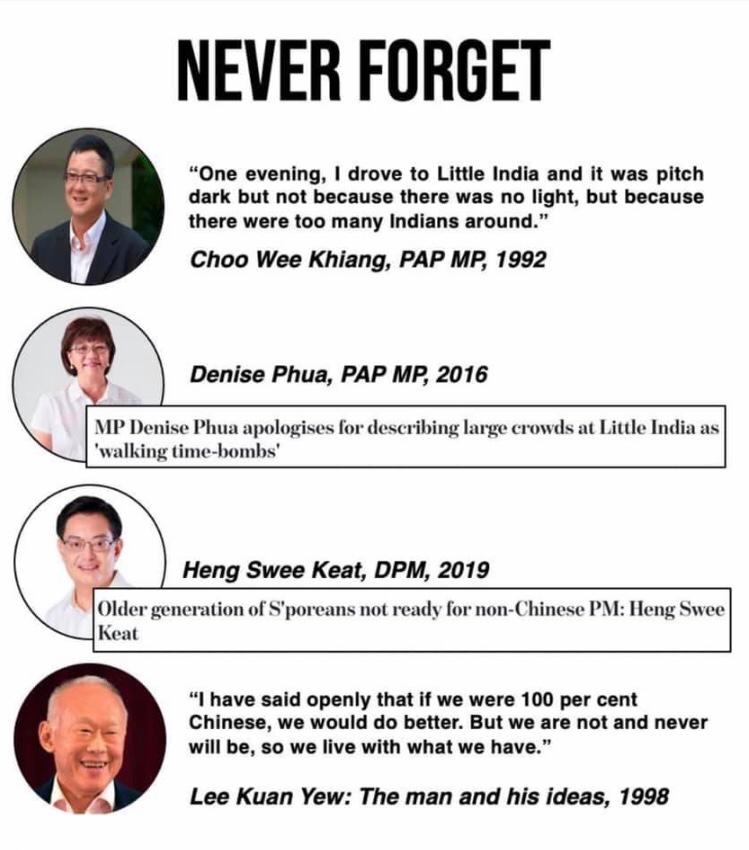
This argument is faulty. It enforces the idea that dark skinned people are less worthy of human treatment and places the profits of companies above that of basic human decency. What’s more shocking is that official attitudes seem to support this. There have been too many cases of senior politicians making blatantly racist statements in the public arena and keeping their jobs as the following illustration shows.


Furthermore, with the explosion of Covid-19 cases in worker dormitories, you’d imagine that people would finally understand that its in the national self interest to ensure the workers get better living conditions. Unfortunately, you have too many like the Fawning Follower aka Critical Spectator, who still insist that the downtrodden need to remain that way for everyone’s benefit.


The foreign worker population like the black population inthe USA have born a disproportionate amount of Covid-19 cases. They are generally law abiding and as stated on many occasions, what they want is to get what is due to them for their labour and some fairness.

To be fair to the Singapore government, its acted quickly to contain the spread of Covid-19 in the dormitories and been generous in giving welfare to the affected workers. However, this is only cosmetic and doesn’t solve the real problem.

Let’s remember that the cause of the 2013 riots came as a result of the police appearing to show more interest in protecting a bus driver who had killed a worker than in the welfare of the worker itself. While mild compared to what is happening in the USA, our system needs to be revamped to such a way where our “anti-racist” rhetoric actually means something and we don’t justify the exploitation of an underclass in economic terms.

Let’s start with this. Politicians who make “racist” remarks in public should pay with their jobs. It would show that we’re actually serious about combating racial discrimination. If our leaders can get away with making “racially insensitive” remarks in public, what type of example does it set for the rest of the population?

We’ve been lucky in our race-relationship management. However, we have underlying problems and let’s not waste a good crisis and use the time to take stock and reform the system for the better. The sooner we do it the better for the rest of us.

© BeautifullyIncoherent
Maira Gall