politicians
Showing posts with label politicians. Show all posts

Wednesday, September 30, 2020

Who Says We’re Not Creating Jobs?


The main and longest feature in Singapore’s portion of cyberspace is focused on one single issue – namely the issue that foreigners, specifically those from India have been unfairly allowed into to Singapore to rob our local population blind. The grouses on the net comes can be summed up as “This government cares about everyone except the local Singaporean.” If you explore enough websites in Singapore, you will inevitably run into someone with some horror story about this or that company discriminating against nice hard-working Singaporeans in favour of nasty, cheating foreigners from what Donald Trump would call “Shitholes.” The question that people inevitably ask is why is the Singapore government creating an economy that in turn creates jobs from people from everywhere else, except Singapore. The pressure has reached a stage where there is an equal amount of gibberish being sprouted about the importance of building a “Singapore-Core” in the economy.

I’ve described this as gibberish because, well, if you look at Singapore’s political system, you can’t accuse the government of not creating jobs for Singaporeans. The structure of our governmental system would indicate that Singapore has created a number of high paying and highly secure jobs, which can only be filled by Singaporeans.

However, given that I work in corporate restructuring and insolvency, the question that I would ask is whether these jobs are actually producing any value for the Singapore Inc as a whole and whether these jobs could be, well for want of a better term – better utilized. Let’s remember the basics – Singapore is a tiny island, or a small red dot. 

Let’s start at the top. We have a Head of State, who functions pretty much like a combination between the English Monarch and the House of Lords in as much as the President is primarily ceremonial but does have the reserve power to say no to the government, should the government choose to tap on the reserves. Our President was paid in excess of S$4,000,000 a year until 2011, when the public felt that there was no reason for a ceremonial figurehead to earn more than the “Chief Executive” or the “Prime Minister.” The salary of the President was slashed by three quarters, which is still a fairly respectable million plus a year and the question remains, what do we get for a million dollars?

Well, the president does wave on National Day and once in a while they do host a dinner or so for a visiting dignitary. Former President SR Nathan, did spend a good deal of time trying to organize charity events. However, that’s pretty much it. Can anyone think of a President who used their time in office to create nation wide projects? Mr. Nathan was criticized in some quarters for being a laky of the government. However, in fairness, he did initiate the President’s Star Charity, which raised money for charitable organizations.  As a prominent member of our local Indian business community (one of the few local Indians to have made it to a regional role in a multinational) said, “At least we knew we had a president.”

Then there is the management committee or the cabinet. Where we have a grand total of some 30 over appointment holders. To set this into context, we have a similar amount of people in the cabinet as some of our larger Asian neighbours, or should I say countries that are faced with issues like poverty and social unrest. By way of a quick comparison, Singapore (population of 5 million and few problems) than Japan (population of 120 plus million and nasty neighbours with nukes) and slightly less than India (population over a billion and an equal amount of problems). The links of the respective cabinets can be found at:

https://en.wikipedia.org/wiki/Cabinet_of_Japan

https://en.wikipedia.org/wiki/Union_Council_of_Ministers

https://en.wikipedia.org/wiki/Cabinet_of_Singapore

Furthermore, if you look at the Singapore cabinet list, you’ll notice a few interesting facts. We have two senior ministers. The post of senior minister was used to give Lee Kuan Yew a consultancy gig. The post was later abolished in 2011. So, why do we need to revive the post and give it to our two former deputy prime ministers? If memory serves me correctly, the senior minister was the second highest paid person after the Prime Minister.

Then there is the fact that our Ministries have one minister, a second minister (ministry of finance has two), and a minister of state (several grades) and senior parliamentary secretary. Let’s not forget Singapore is a small island with limited resources, so it’s not unfair question to ask why our ministries need so many appointment holders.

One might argue that there are a number of names that appear more than once. Josephine Teo is both Minister of Manpower and Second Minister at the Home Affairs Ministry. Mr. K Shanmugam is most famously in the “non-conflict” position of both Minister of Home Affairs and Law. The valid question here is, are they getting more than one salary per ministry or if they are only getting one salary, how do they divide their time between ministries (At a million dollars a year, exclusivity is a fair demand).

Let’s not forget that Singapore’s ministers are the world’s best paid. The lowest paid one gets a million a year. A cabinet of 30 plus ministers is 30 million a year.

Then if you go down the food chain, you’ll come to the interesting fact that Singapore has five mayors, each one earning around $600,000 per person per year. Mayors in the Singapore context run Community Development Councils (CDCs), which is a collection of several constituencies. Mayors are supposed to run social programs on the ground.

I stress the point that Singapore is a tiny place. We are like the “City-States” in Ancient Greece and our geographical size (or lack of) means that the most appropriate comparisons are not with countries but with cities, and even then, we’re still pretty small. Our Prime Minister’s job is not like his global counterparts, it’s more like the mayor of other big cities. Think of London, for example, as a separate from the rest of the UK. Sadiq Khan would then be called “Prime Minister” instead of Mayor.

Yet, the City of Singapore has five mayors and the question that should be asked is “Why?” What value do our mayors bring to the table. Are they doing something beyond the scope of ordinary members of parliament?

Covid-19 has screwed up the global economy. Companies round the world are downsizing to save costs.  Given that Singapore’s leadership likes to compare itself with the best of enterprises, isn’t it time we started looking at slimming down unnecessary layers of bureaucracy? Unless that is of course, this would ruin the chances of certain Singaporeans to stay in high paying and highly secured jobs.   


Wednesday, June 24, 2020

When David Became Goliath


Just received an op-ed from the New York Times in my email. The story is entitled “Tech Goliaths Act Like Davids,” and the main thrust of the story is that the tech giants like Google, Apple, Facebook, Uber and so on have become the corporate bullies that they once fought against. The story can be found at:


If one studies history, one will notice that this isn’t a new story. History is filled with examples of young, vibrant revolutionaries who fought to overthrow an overbearing power and once they had succeeded, they proceeded to behave as the power that they overthrew.

As an ethnic Chinese, I think of Mao, who lead a peasant army to overthrow a corrupt regime that was oppressing the poor. However, once in power, the communist proceeded to enforce an iron grip on power and proved to be as nasty if not more so than the nationalist that they overthrew. There are other examples. In the Middle East, there’s the example of Naser who overthrew a corrupt and repressive monarchy, only to replace it with another form of dictatorship that has stifled progress.

I think of Singapore, the country that has been my home for the last two decades. We’ve been run by the same party since our independence in 1965. While the party has delivered prosperity and done well by the citizens for the most part, they’ve moved a long way, as in a very long way, from the party that was a plucky upstart fighting to rid us from the yoke of colonial rule and later race-based politics of the Malaysian Federation. The part that once wrote a national pledge of “Regardless of Race, Language or Religion,” now stresses the fact that “The population is not ready for a non-Chinese Prime Minister,” and delightfully uses every trick in the book to ensure that it wins more than 60 percent of available seats in parliament (it remains an achievement for our rag-tag opposition to contest let alone win seats).

Why is this the case? The answer is as simple as this fact – power is exceedingly addictive. The people who get power tend not to want to lose it. Young idealist who become revolutionaries to get rid of entrenched powers becoming the very entrenched powers that they overthrew. This remains true in business and politics.

Some systems have found a way to survive this. In America, the political system was designed to limit the damage a bad leader could do. Presidents have to share power with Congress and a Supreme Court and much of the power over citizens is devolved to local governments. Furthermore, Presidents are limited to two terms of four years. Thus, you only put up with an incompetent leader for eight years at the most and no individual has to chance to hang on for years until they get drunk and senile with power.

This system works in America because there’s a reverence to the constitution and laws and there’s a press to keep the powers that be on its toes. In places that don’t have this, there is a real danger that the man in charge can merely change the laws. China is a case in point. Prior to President Xi’s ascension, it was understood that a generation of leaders would step down after a decade. While China didn’t have elections, it had some form of leadership renewal. Unfortunately, this is no longer the case and one cannot assume that President Xi, may enjoy his power a little too much, even at the risk of the wealth that the Chinese people have grown used to.

The same is true in business. The story in dynamic economies is that of plucky start-ups with a bright idea or a new technology taking on and taking market share from established firms. The problem is that once the start-ups become big firms with deep pockets, the game no longer becomes about coming up with new products that delight consumers but about enhancing market share and getting consumers to continue buying what you’ve been selling them. As I was once told, “Big firms don’t innovate, they just buy small firms that do.”

While the dangers of minimal competition for businesses are less obvious than that for political leaders, they are non the less very present. Businesses that become too interested in their market position tend to forget that consumers can find and will find alternatives. I think of Singapore’s media scene, which could not accept competition and kept peddling the myth that Singapore was too small for media competition. The established media powers were so busy defending their turf that they failed to see people moving away from printed newspapers and terrestrial television. They even got the government onto their side in branding online media as “anti-establishment.” There was one small problem. Consumers stopped reading newspapers and the advertisers noticed. Singapore Press Holdings (SPH) has had to diversify into old folks’ homes to keep shareholders happy and more recently had to suffer the indignity of being kicked off the stock exchange index.

Successful big firms are the ones that find a way of growing big but keeping their units running like start up enterprises. Big law firms are trying to do that, working as a big unit in the centre for things like branding and HR policy but getting their respective practices to compete for business like sole proprietorships. In theory this should prevent the groups from becoming immune to market forces.
The other factor for businesses is law. Laws that prevent companies from becoming monopolies should be made stronger.

Let’s go back to tech as an example. Microsoft was once a start-up that had a clear goal of having a desktop on every desk running its software. It became a monopoly and defended it tooth and nail. Unfortunately, Microsoft was late into the internet and thus lost ground to Google. Microsoft has only become a dynamic player under its current CEO, Satya Nadella, who moved it away from defending its old business market.

Limits on power are not just good for consumers or voters. They are actually good for incumbents as it keeps them on their toes and forces people to innovate. The Goliaths of the day should remember that they had their best victories as Davids and trying to crush today’s Davids will only lead to them sharing the fate of Goliath.    

Tuesday, June 23, 2020

Who Wants Transparency when You Can Have Magic? – Edward, Duke of Windsor – Netflix – The Crown


Thanks to Covid-19, I’ve been discovering a host of programs that I might otherwise not have watched. One of them is “The Crown,” which tells the story of England’s current Queen Elizabeth II. The Queen is currently the longest serving Head of State and the longest ever reigning British Monarch.

One of the most poignant moments in the series was the story of her coronation, which was the first one ever to be televised. It showed her Uncle (who did not attend), explaining the beauty of the coronation and his classic line was “Who wants transparency when you can have magic?”

This line of the series underlines the key reason why the British Monarchy has endured for so long. Despite having no political power, the monarchy has survived and, in some cases, thrived because it has been a symbol or a fantasy for the average man. She and her family are perhaps the British nation’s PR spokespeople, responsible for selling a certain image to the world. Royal Weddings are an example of this, when the world’s cameras are tuned onto the United Kingdom (the converse being Royal divorces)

The key to the Queen’s success is that she’s stayed out of politics and never gives any hint of her personal opinions on the matters of the day. She is, however, by many reports sharp and knows what’s going on and whenever she has to do something, she does it. As was portrayed on Netflix, she did dress down Winston Churchill for having a stroke and keeping it from her. The classic line being “My job is not to govern but to ensure there’s governance.”

By staying out of anything remotely political, the Queen stays out of anything grubby and as they say, ensures the magic that keeps the monarchy going. As a constitutional monarch, the last thing the Queen needs is to be transparent about the nitty gritty of the institution that she represents.

However, while constitutional monarchs may exist on the concept of magic, the same should never be true for elected politicians and civil servants, who are in the grubby business of running the country.

Unfortunately, there have been cases of elected politicians and bureaucrats who have forgotten that they are in the business of running things and that actually requires transparency. The most famous example is the current occupant of 1600 Pennsylvania Avenue who has famously refused to release his tax returns (something which all his predecessors have done) and appointed relatives the politically influential positions (something which real Princes have avoided doing).

This is, unfortunately, not limited to the USA. In Singapore, we’ve had the example of the Ho Ching, the Chief Executive of Temasek Holdings, an investment firm that invest on behalf of the Singapore government. One of the largest issues in Singapore is the fact that nobody knows what Madam Ho’s salary is.

If you look at it from a legal perspective, there’s no need for Madam Ho to reveal what she earns. Temasek Holdings is a private company and as such has no obligation to publish any accounts or any details about the salaries paid to its directors. Her salary, as they say, should be no one’s business except hers and her employer, which in this case is the Ministry of Finance.

However, when you look at what Temasek Holdings is, you have to ask why there’s so much secrecy about its financial performance and the salaries of the top directors. Temasek Holdings, as is known to everyone is mandated by the Ministry of Finance to invest and grow the nation’s wealth. My pension money (CPF) funds are utilized by Temasek Holdings and while I may not have a direct share of Temasek Holdings, they are using my money to do what they do. So, the point is – surely their business is also my business and what Ho Ching as CEO is paid is my business.

The consistent argument for keeping all of this secret is that it’s part of national security. However, this argument does not wash. Madam Ho’s husband is the Prime Minister and his salary is public knowledge. Are we to say that the CEO of Temasek Holdings has a higher national security priority than the Prime Minister?

When it comes to Constitutional Monarchs, magic can override transparency. However, when it comes to the case of the people involved in running the country and with their hands on the public purse, the answer is no – we cannot accept that they live in the world of magic. Transparency is required in their case. Let us never forget that politicians and civil servants are employed by the tax payer and what they get up to is our business.

Saturday, June 06, 2020

It Could Happen Here


As an Asian, particularly a Singaporean, the temptation to feel smug has never been greater, particularly when you look at events in the world’s most prominent nation, the USA. While Singapore has problems and has lost some of its shine from the explosion of Covid-19 cases, our problems remain relatively mild, when compared to say the hundred thousand odd Covid-19 cases in the US and the riots across America that were sparked by the murder of George Floyd, a black man who was murdered by white police officers on video. Our problems, as they say, are rather “first-world” when compared to the USA.

However, as tempting as it is to get smug, it’s probably best not to get smug at all. While Singapore’s apparent tranquility might give one the impression that all is well, many of the underlying problems that have exploded in the USA are present in Singapore. We’ve merely been better at applying the cosmetic dressing.

Like the USA, Singapore is an unequal society. The latest figures on inequality based on the Gini-coefficient (which measures inequality on a scale of 0 to 1, with 0 being perfect equality), Singapore hit a two-decade low of 0.452 last year. The report can be found at:


By comparison, the USA has a Gini-coefficient of 0.485. Singapore compares well to its main Asian rival, Hong Kong, which has a Gini-coefficient at 0.539 (joke being the tycoons control Hong Kong the way the government controls Singapore) and unlike top placed Lethoso (0.632), its not a case of a handful of people owning everything else. However, Singapore compares badly to the European nations, like Germany, which has a score of 0.27 and even some of our fellow ASEAN neighbours like Indonesia which has 0.368 (this being a country which has some of ASEAN’s richest people while having visible signs of poverty).

Whenever the issue of the Gini-coefficient is brought up, Singapore’s powers-that-be, inevitably argue that the Gini-coefficient isn’t the most accurate measure of anything in particular, rather like the way my old headmaster used to argue against school league tables (that being until the tables showed him something he liked to see).

What’s particularly interesting about the “inequality” in Singapore is that it is often colour related. You have the professional and executive classes, who are more often than not Westerners or well-educated local Chinese, and much to the dismay of many locals, a growing number of Indians from Mumbai and Delhi. At the lower end of the spectrum are the guys doing menial jobs like cleaning our streets, manning our ship yards and construction sites and looking after our kids. These guys are predominantly from what Donald Trump calls “Shithole” countries of the Philippines, Bangladesh and India (specifically the Southern Parts).

The wage differentials are staggering. While our CEO’s have yet to experience American style 100 million annual stock options, the pay at the higher end of the scale is not to be sniffed at. DBS’s CEO, Piyush Gupta famously had a salary of SG$9,000,000 a year. Our Prime Minister is the world’s highest paid head of government (US$1.61 million per year versus the USD400,000 for the US President) and the CEOs of our top companies are not doing too badly either.

At the other end of the scale are the labourers and maids who would be lucky to have a thousand Singapore dollars in their pockets. I still remember a labourer of a company we put into liquidation telling me that he earned a princely sum S$18 a day for a 12-hour workday.

What’s particularly interesting is the attitudes towards the pay differentials. When it comes to paying working professionals, it called “talent retention,” and we’re told that we’ll lose our competitive edge if we don’t pay better than first world salaries to people from the first world. It was always interesting to see the extent of our efforts to “retain” and “attract” talent, especially when it came to the vices. The police parked themselves across the streets so that working professionals could have their pick of prostitutes and overpriced booze without any interference (men, will be men).

By comparison, when it comes to anyone from “developing” Asia, the line of defense is – “they’re earning far more than they’d ever get back home.” This on its own wouldn’t be a major topic, but when you add the way law enforcement looks upon migrant workers, which is as a source of potential problems. Bored policemen on petrol inevitably cannot help questioning workers who are damaging the neighbourhood by sitting in a corner and having a cup of tea.

Just as there’s an economic defense for paying “talents” from New York or London well, there’s an economic defense for paying people from Dhaka and Manila badly. The argument runs like this, if we didn’t pay them badly, we would not be able to give you the Singaporean quality housing and infrastructure at affordable prices.

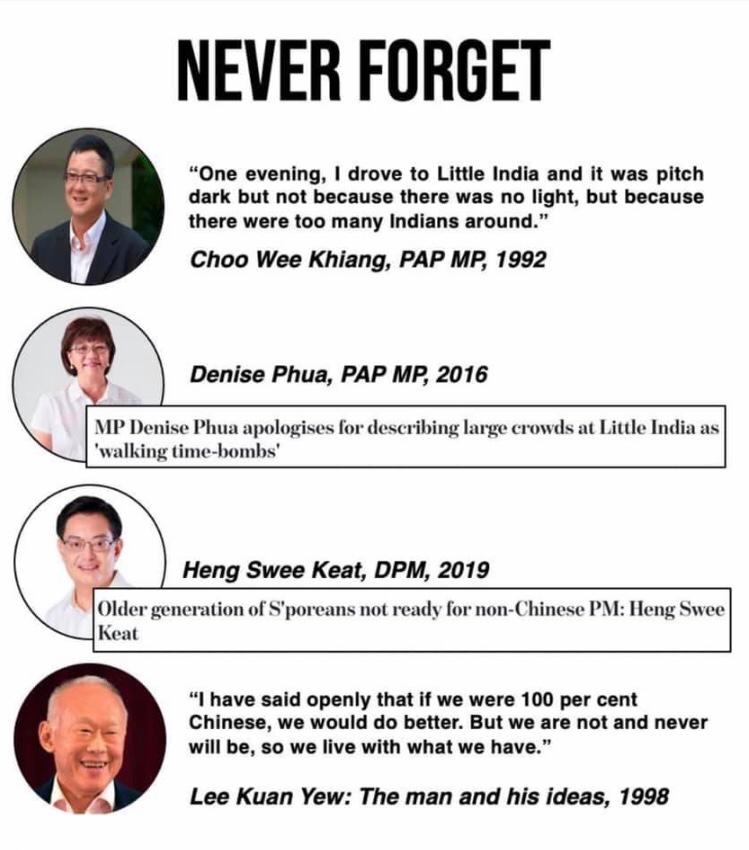
This argument is faulty. It enforces the idea that dark skinned people are less worthy of human treatment and places the profits of companies above that of basic human decency. What’s more shocking is that official attitudes seem to support this. There have been too many cases of senior politicians making blatantly racist statements in the public arena and keeping their jobs as the following illustration shows.


Furthermore, with the explosion of Covid-19 cases in worker dormitories, you’d imagine that people would finally understand that its in the national self interest to ensure the workers get better living conditions. Unfortunately, you have too many like the Fawning Follower aka Critical Spectator, who still insist that the downtrodden need to remain that way for everyone’s benefit.


The foreign worker population like the black population inthe USA have born a disproportionate amount of Covid-19 cases. They are generally law abiding and as stated on many occasions, what they want is to get what is due to them for their labour and some fairness.

To be fair to the Singapore government, its acted quickly to contain the spread of Covid-19 in the dormitories and been generous in giving welfare to the affected workers. However, this is only cosmetic and doesn’t solve the real problem.

Let’s remember that the cause of the 2013 riots came as a result of the police appearing to show more interest in protecting a bus driver who had killed a worker than in the welfare of the worker itself. While mild compared to what is happening in the USA, our system needs to be revamped to such a way where our “anti-racist” rhetoric actually means something and we don’t justify the exploitation of an underclass in economic terms.

Let’s start with this. Politicians who make “racist” remarks in public should pay with their jobs. It would show that we’re actually serious about combating racial discrimination. If our leaders can get away with making “racially insensitive” remarks in public, what type of example does it set for the rest of the population?

We’ve been lucky in our race-relationship management. However, we have underlying problems and let’s not waste a good crisis and use the time to take stock and reform the system for the better. The sooner we do it the better for the rest of us.

© BeautifullyIncoherent
Maira Gall