covid-19
Showing posts with label covid-19. Show all posts

Saturday, June 06, 2020

It Could Happen Here


As an Asian, particularly a Singaporean, the temptation to feel smug has never been greater, particularly when you look at events in the world’s most prominent nation, the USA. While Singapore has problems and has lost some of its shine from the explosion of Covid-19 cases, our problems remain relatively mild, when compared to say the hundred thousand odd Covid-19 cases in the US and the riots across America that were sparked by the murder of George Floyd, a black man who was murdered by white police officers on video. Our problems, as they say, are rather “first-world” when compared to the USA.

However, as tempting as it is to get smug, it’s probably best not to get smug at all. While Singapore’s apparent tranquility might give one the impression that all is well, many of the underlying problems that have exploded in the USA are present in Singapore. We’ve merely been better at applying the cosmetic dressing.

Like the USA, Singapore is an unequal society. The latest figures on inequality based on the Gini-coefficient (which measures inequality on a scale of 0 to 1, with 0 being perfect equality), Singapore hit a two-decade low of 0.452 last year. The report can be found at:


By comparison, the USA has a Gini-coefficient of 0.485. Singapore compares well to its main Asian rival, Hong Kong, which has a Gini-coefficient at 0.539 (joke being the tycoons control Hong Kong the way the government controls Singapore) and unlike top placed Lethoso (0.632), its not a case of a handful of people owning everything else. However, Singapore compares badly to the European nations, like Germany, which has a score of 0.27 and even some of our fellow ASEAN neighbours like Indonesia which has 0.368 (this being a country which has some of ASEAN’s richest people while having visible signs of poverty).

Whenever the issue of the Gini-coefficient is brought up, Singapore’s powers-that-be, inevitably argue that the Gini-coefficient isn’t the most accurate measure of anything in particular, rather like the way my old headmaster used to argue against school league tables (that being until the tables showed him something he liked to see).

What’s particularly interesting about the “inequality” in Singapore is that it is often colour related. You have the professional and executive classes, who are more often than not Westerners or well-educated local Chinese, and much to the dismay of many locals, a growing number of Indians from Mumbai and Delhi. At the lower end of the spectrum are the guys doing menial jobs like cleaning our streets, manning our ship yards and construction sites and looking after our kids. These guys are predominantly from what Donald Trump calls “Shithole” countries of the Philippines, Bangladesh and India (specifically the Southern Parts).

The wage differentials are staggering. While our CEO’s have yet to experience American style 100 million annual stock options, the pay at the higher end of the scale is not to be sniffed at. DBS’s CEO, Piyush Gupta famously had a salary of SG$9,000,000 a year. Our Prime Minister is the world’s highest paid head of government (US$1.61 million per year versus the USD400,000 for the US President) and the CEOs of our top companies are not doing too badly either.

At the other end of the scale are the labourers and maids who would be lucky to have a thousand Singapore dollars in their pockets. I still remember a labourer of a company we put into liquidation telling me that he earned a princely sum S$18 a day for a 12-hour workday.

What’s particularly interesting is the attitudes towards the pay differentials. When it comes to paying working professionals, it called “talent retention,” and we’re told that we’ll lose our competitive edge if we don’t pay better than first world salaries to people from the first world. It was always interesting to see the extent of our efforts to “retain” and “attract” talent, especially when it came to the vices. The police parked themselves across the streets so that working professionals could have their pick of prostitutes and overpriced booze without any interference (men, will be men).

By comparison, when it comes to anyone from “developing” Asia, the line of defense is – “they’re earning far more than they’d ever get back home.” This on its own wouldn’t be a major topic, but when you add the way law enforcement looks upon migrant workers, which is as a source of potential problems. Bored policemen on petrol inevitably cannot help questioning workers who are damaging the neighbourhood by sitting in a corner and having a cup of tea.

Just as there’s an economic defense for paying “talents” from New York or London well, there’s an economic defense for paying people from Dhaka and Manila badly. The argument runs like this, if we didn’t pay them badly, we would not be able to give you the Singaporean quality housing and infrastructure at affordable prices.

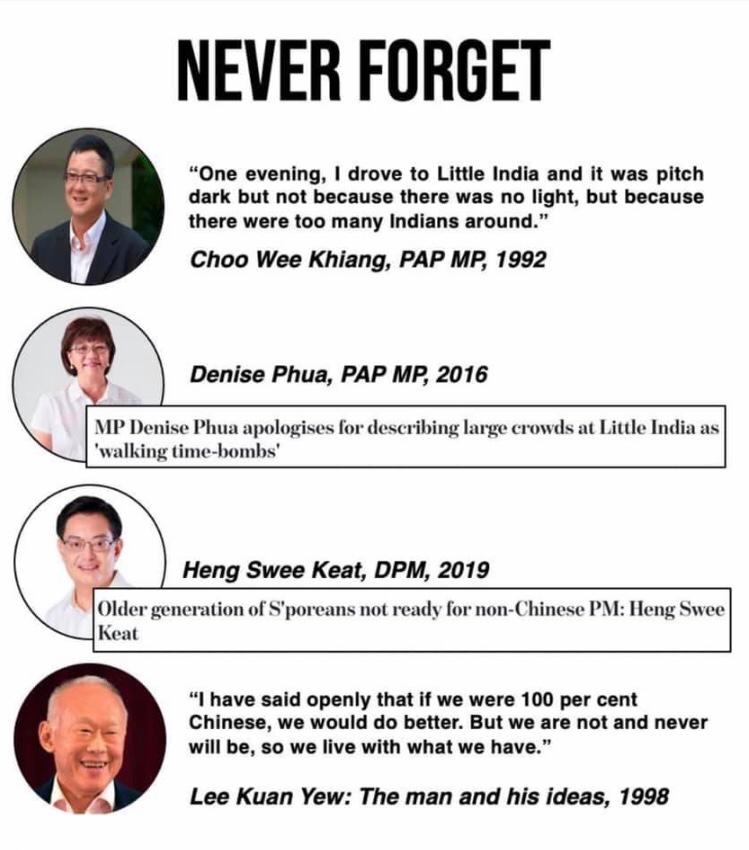
This argument is faulty. It enforces the idea that dark skinned people are less worthy of human treatment and places the profits of companies above that of basic human decency. What’s more shocking is that official attitudes seem to support this. There have been too many cases of senior politicians making blatantly racist statements in the public arena and keeping their jobs as the following illustration shows.


Furthermore, with the explosion of Covid-19 cases in worker dormitories, you’d imagine that people would finally understand that its in the national self interest to ensure the workers get better living conditions. Unfortunately, you have too many like the Fawning Follower aka Critical Spectator, who still insist that the downtrodden need to remain that way for everyone’s benefit.


The foreign worker population like the black population inthe USA have born a disproportionate amount of Covid-19 cases. They are generally law abiding and as stated on many occasions, what they want is to get what is due to them for their labour and some fairness.

To be fair to the Singapore government, its acted quickly to contain the spread of Covid-19 in the dormitories and been generous in giving welfare to the affected workers. However, this is only cosmetic and doesn’t solve the real problem.

Let’s remember that the cause of the 2013 riots came as a result of the police appearing to show more interest in protecting a bus driver who had killed a worker than in the welfare of the worker itself. While mild compared to what is happening in the USA, our system needs to be revamped to such a way where our “anti-racist” rhetoric actually means something and we don’t justify the exploitation of an underclass in economic terms.

Let’s start with this. Politicians who make “racist” remarks in public should pay with their jobs. It would show that we’re actually serious about combating racial discrimination. If our leaders can get away with making “racially insensitive” remarks in public, what type of example does it set for the rest of the population?

We’ve been lucky in our race-relationship management. However, we have underlying problems and let’s not waste a good crisis and use the time to take stock and reform the system for the better. The sooner we do it the better for the rest of us.

Monday, May 04, 2020

Awfulness and Stupidity - the Second Mover Advantage


One of the things that used to irk American policy makers was the fact that their Asian bugbear at the time, was Japan, which had a talent of copying everything that the Americans invented and making them cheaper and, in many cases, better. The most noticeable was in the automobile industry, where the likes of Toyota, Honda and Mitsubishi ended up bruising the Detroit Big Three (GM, Ford and Chrysler) in their domestic market.

What the Japanese demonstrated was called “Second Mover” advantage and rather than inventing brand-new things, they found a way of improving on what existed. As is often said in the area of work place efficiency, there’s no need to reinvent the wheel when you can use what you already have.
There are lots of examples of how the second mover has gone onto surpass the original. 

Unfortunately, for many people at risk of getting coronavirus or being suffocated by burning forest, the most prominent second mover is Mr. Jair Bolsonaro, a proud Trump imitator who revels in the name of “Trump of the Tropics,” and has a secondary job of being President of Brazil.

While Mr. Bolsonaro has not made the headlines that the original Trump sitting in the North of the Rio Grande has, he’s had a way of surpassing the original in the things he says and does. It should also be said that while Brazil isn’t the world power that the US is, it is a country that counts. Brazil is the “B” in the “BRICS,” and with an area of 8,515,767 square kilometres, it is the fifth largest country in the world and its population of 210,147,125 it is the sixth most populous nation on the planet. Brazil’s nominal economy is estimated at 1.86 trillion US dollars, making it the ninth largest economy. It is by far and away the country that counts in South America. In the pre-Bolsonaro days, Brazil was regarded as the most benign of the BRICS. Here was a large market with lots of resources. However, unlike China, Brazil is democracy that values human life, unlike South Africa had something other than natural resources and unlike India, it was comparatively free of communal strife.

Mr. Bolsonaro has decided that these things were a crock of shit and that ordinary Brazilians were being screwed for being nice to the rest of the world. It helped that his predecessors had legal issues (euphemism for being corrupt) and Mr. Bolsonaro, like his idol in the North of the Rio Grande was swept into power on the promise to make things right for Brazil’s poor.

His first decision of helping Brazil’s poor was to allow the Amazon Forrest. Mr. Bolsonaro used to line that we’ve grown very used to in Southeast Asia – economic development takes priority over preserving the environment. In other words, we’re going to get rich whether the lefties in the West like it or not. The result has devastated much of South America, covering neighbours in a smog like haze, which many of us in Southeast Asia are familiar with and potential natural resources provided by the forest have been squandered.

When French President, Emanuel Macron called him out on this, Mr. Bolsonaro publicly announced that the French President was merely jealous because his wife was better looking, which had nothing to do with the issue at hand but seemed to satisfy a certain sense of lost masculinity in Bolsonaro voters.

Mr. Bolsonaro, like Mr. Trump had the good fortune to preside over an improving economy and so the masses forgave him. The covid-19 struck and the truth of Mr. Bolsonaro’s tough guy with a heart for the people was revealed.

While the Original in the North tried to downplay the seriousness of the virus and then started looking for scapegoats and then prescribed unproven cures, Mr. Bolsonaro has been remarkably constant in his handling of covid 19. That is, he’s been remarkably consistent about disregarding the reality of the devastation brought about by the virus. Despite losing his health minister and justice minister, Mr. Bolsonaro has decided that it is perfectly acceptable to trash the advice of his own healthcare officials. Mr. Bolsonaro refuses to stay in orders, attends rallies and likes his big crowds. As with his hero in the North, Mr. Bolsonaro’s supporters blame the “left win” media for trying to tarnish their hero.

Where Mr. Bolsonaro outdoes the original Mr. Trump is in his belief that the virus is no big deal. The Trump and his supporters when down playing deaths caused by the virus at least make the effort in giving their nonchalance a little bit of context, such as “more people are killed by the flue” etc.
Mr. Bolsonaro is quite open about the fact that he really doesn’t care about the deaths caused by covid-19 and the potential risk to national health. As Brazil’s death toll reached past 5,000 – his only thoughts were “So What?” More can be found at:


Another area in which Mr. Bolsonaro trumps the Trump is in the way in which he encourages the public to undermine stay at home orders. While Mr. Trump tweets his encouragement for protestors against stay home orders, Mr. Bolsonaro, a former army officer, has lead from the front and gone as far as to call for the military to intervene (though, as President, one wonders why he’s calling from the military to intervene, when as President, he could order the military to do so). More can be seen at:


Unlike the US, which was born as a democracy and had 200-years to build its institutions, Brazil has on the scale of things only just achieved things that make society prosperous like a government for the people and rule of law. Mr. Bolsonaro is working to undermine these things, which cannot be good for Brazil, South America or even the wider world.

At the time of writing, Brazil has 102 thousand cases and over seven thousand people have died.  It looks like Mr. Bolsonaro is trying to catch up and perhaps surpass his hero in the North of the Rio Grande. This cannot be good news for Brazil’s poor in the overcrowded favellas.  


Friday, April 24, 2020

The Richest Man in the Cemetery


Steve Jobs, Apple’s legendary founder, is reported to have said on his death bed that he felt that his life had been an absolute waste even though he was judged to be an absolute success by every metric society used. His reasoning was simple, he had spent his time pursuing wealth and “success” which was at the cost of the time he could have spent with his loved ones. He said, “There’s no point being the richest man in the cemetery.”

I think of this at a time when earning a living has become exceedingly tough. If you’re like me, working on contract or part-time basis, its especially tough. The guys who used to give you lots of work can no longer do so in as much as they don’t have the business to give you the work.

My blue-collar existence vanished because restaurants are no longer allowed to have dine-in customers, hence there’s no need for service staff. My income from the white-collar existence is curtailed because nobody wants to meet, so I can’t “sell” the services. The media is also not interested in anything beyond the outbreak of infections in worker’s dormitories, hence there’s also not much prospect of drumming up publicity work. If I was to take a job as an “essential” worker in say, a hospital, the wife and kid would shoot me for putting them at risk.

In the meantime, bills need to be paid. While the banks are supposed to be more sympathetic, they still demand loan installment payments and so on. So, what can one do? In my case, it is a case of living very simply, staying in touch with the people who may be in the position to give you work so that they’ll remember to give you work once they can and also looking for other things that might earn you a few bucks. I’m blogging more than I used to. While what I earn of advertising revenue barely buys me a cup of cheap coffee, I keep the brain active and stop myself from rotting.

So, I am actually sympathetic to people who have been protesting against lockdowns and stay at home orders. I think of people who are demanding to go back to work. The desire to earn money isn’t just limited to “ruthless” billionaires who want more money. Worrying about money is a very common thing and I am living the frustrations of people who see their financial resources being depleted and the bills continuing to pile up.

However, I’m reminded of what Steve Jobs said. There’s a reason why businesses are not opening and why stay at home orders have been issued. With the exception of perhaps North Korea, countries around the world loosened up the restriction of movement of people because this brought prosperity and by extension more revenue for governments. So, when revenue hungry governments shutdown the movement of people and start dolling out cash, there has to be a good reason.

As Steven Jobs said, “There is no point being the richest man in the cemetery” and if you apply that to a state or national level, there’s no point having a roaring economy if you have a virus that cripples people.

Uganda’s President, Yoweri Museveni has described the current situation as being akin to being in a war, where you should be glad you focus only on the basics of survival. He’s right, the coronavirus has maimed and killed people and the only proven way that the virus has been kept in check has been through social isolation methods.

The statistics are very telling. In the USA, there are now 49,845 deaths as a result of the covid-19, that was in a matter three months. By comparison, the US lost 54,246 lives in the Korean War over a period of three years. Who is to say that the figures won’t rise further?

The best part of the coronavirus is that it’s a silent killer and you never know who might have it and who can give it to you. I remember discussing this topic with a Belgium fellow who felt that people were overreacting. My line to him was “How do you know I’m not infected and can’t pass it to you?” In such situations, a dose a paranoia is healthy survival.

Furthermore, its not just a case of “my body – my choice.” You might be healthy and fit but the fellow next to you may not be. If you get the virus, you may be able to survive but if you pass it onto other people, they may not be able to. Unwittingly, you became a case of death.

Then there are those who complain that Covid-19 kills less than the flue. Well, that may be true but then again death isn’t always the worst outcome. Studies have shown that those who have recovered end up getting infected again and being weakened – not exactly the best thing to keep the economy thriving.

Yes, stay at home orders are bad, especially when you have bills to pay. The alternative is worse. So, what do you do, except wait out the period and figure out how to tide things over? Losing patience could lead to losing more.


Wednesday, April 22, 2020

It’s Not What You Have but How You Use It


I’ve always been fascinated by Vietnam and the Vietnamese. I’ve always had this fascination long before I got married to a Vietnamese lady who brought a little girl who would change my perspective on life. I guess, it was the fact that the Vietnamese were the first guys who took on the world’s biggest military power and won. While my school friends at the International School of Hamburg saw Rambo as being cool, I identified with the little men in black pajamas.

Now that I am now married to a Vietnamese girl, I can see that I was not far off in those childhood images. The Vietnamese are a tough people, who have endured a lot. Vietnamese women in particular are tough cookies.

Age has allowed me to better understand my sympathies for the Vietnamese. These were small, poor guys who took on the world’s biggest powers and won. History has made it such that we can never forget the Americans flying off from their embassy in Saigon despite dropped numerous bombs on them. History is also littered with records of how the Chinese have invaded countless of times and always returned home with a bloody nose. The thrill in life is not being part of a big unit but being a small and puny thing that beats the world's big guys.

In the age of the Coronavirus, that image of Vietnam has become even more pronounced. In the early days of the virus, Singapore rushed to grab international headlines of what a great job it was doing. Yet, at the time of writing, Singapore is Southeast Asia’s hub for coronavirus infections with some 9,125 infections (which it is quick point out is mainly foreign workers) and 11 deaths. America, the world’s greatest nation has 824,698 cases and 40,297 deaths. Vietnam by contrast has 268 cases with no fatalities. The real model for pandemic measurement is Vietnam.

This achievement is even more impressive when you look at Vietnam’s relative handicaps. Unlike the USA and Singapore, Vietnam shares a border with China and regular border crossings are a part of Vietnam’s history. Unlike Singapore, Vietnam is a large country with developing communications infrastructure., which means that enforcement of the rules, particularly in remote areas is a challenge. More importantly, Vietnam has a weak healthcare system and unlike Singapore, Hong Kong, South Korea and Taiwan, Vietnam does not have the financial resources. So, how did Vietnam succeed where more advanced nations failed?

A detailed article on Vietnam’s success can be found in the following article from the Diplomat:


I believe that the further point that’s not mentioned is the fact that Vietnam understands its own strengths and weaknesses. While Vietnam has achieved impressive economic growth and been a beneficiary of the US-China trade dispute with manufacturers moving from China to Vietnam, the Vietnamese understood that they didn’t have the resources to cope with a full-scale pandemic. As such, Vietnam took the view that prevention was better than the cure and acted quickly and early on.

By way of an example, when I landed in Hanoi airport in early January of this year, Vietnam had installed thermo-cameras at the airport at the airport and all airport staff had to wear a mask. By comparison, Singapore, a global model of efficiency, was still debating on whether you should wear a mask if you were unwell. A week later, when I returned to Singapore, the Vietnam Airlines staff all wore mask on the flight. By contrast, the staff at Singapore Changi Airport did not have mask.

Something similar was visible during the Vietnam War. The Americans with their superior fire power and military tactics won all the pitched battles. The Vietnamese realized they couldn’t take the Americans on in a full scale pitched battle, so they merely made life difficult for American troops (including ensuring the GIs ended up with the diseased hookers) and ensured that when American fire power was used, it was always done for the world’s cameras, and the nation that was used to being the “good guys” did not look good. While Americans troops looked at the battle, their opponents looked at the war and its long-term objectives.

If Vietnam has anything to teach the world, its probably to understand what you have and don’t have. It’s a case of being clear about what you want and utilizing your strengths quickly so that your weaknesses don’t become a part of the equation. While other nations have grabbed headlines, Vietnam has focused on its objectives and been the real-world beater in dealing with this virus. Vietnam’s understanding of itself will make it the country to be in Southeast Asia.


© BeautifullyIncoherent
Maira Gall