Sunday, March 05, 2023

Politics of the P***


If there’s any topic that’s going to get the men around the table uncomfortable, it is undoubtedly the topic of the size of their p***. I have friends from a variety of places and one of the things that we all have in common is the fact that we are attached to our trouser snake. A man has a very different relationship with his penis than a woman has with her vagina. To a woman, the vagina is something of an inconvenience – a place where pee comes from and its got to be washed because infections down there are no fun. Studies show that women don’t even think much of the vagina during sex (you got to deal with the rest of a woman’s body to get her happy).

Men on the other hand think of their penises as part of themselves. We have strange pet names for the fellow in between our legs and looking after the penis is very simple when compared to looking after the vagina. When it comes to sex for men, if its good for the penis, its good for its owner.

I live in a part of the world where the man’s relationship with his penis is a religious experience. In Hinduism and certain Buddhist cultures, penises are revered. It is said that touching a penis relic can help fertility. In Bhutan, penises are everywhere – literally everywhere:


 However, while the male relationship with his organ can take religious tones, it can also take particularly nasty ones when it comes to the insecurity that men have about their pricks. If you want a guy to lose his cool, insult his penis. The insult to his penis is an insult to his very being as a man. Helen of Troy sparked a major war when she ran off with a Trojan Prince. She was effectively telling her husband, the King of Sparta that she found his P*** less satisfying than the young Trojan prince and that was a reason to go to war. The King of Sparta, who could have had plenty of other women, simply would not take it lying down.

Wars have been fought over the little head on a man’s body and when my favourite sexologist posted an article on Linkedin, I thought I’d try and see if there were a very observations to be made, especially since there was the question of where Singapore was on the map. We are, unfortunately for many of my readers (who are mostly likely to be Singaporean guys), we rank near the bottom of the scale. However, if you want a regional comparison, we, the Singapore men rank as the second largest in Southeast Asia. More importantly, we Singapore men are better hung than our Malaysian Cousins. Only Indonesian men are better hung:

https://www.asiaone.com/singapore/world-penis-size-league-table-ranks-singapore-10th-lowest-guess-where-malaysia


Our position on the prick scale has a strange parallel with our attitudes towards the rest of the region. Unfortunately, Indonesian men are on average bigger than us, making us only the second best hung men in the region. If you look at things from a socio-political point, Indonesia is by far and away the largest place in the region and no matter what Singapore does, we’re always going to be smaller than them. Let’s remember, Lee Kuan Yew was very aware than he was “A Dek” (Malay for Younger Brother) in his relationship with Suharto.

However, when it comes to the rest of the region, particularly Malaysia, we’re constantly trying to prove that we’re better. Malaysia had an F1 Race, so we want the world to know that we have bigger and better one. When Malaysia had the audacity to build a port across the water from ours, we started suing shipping companies that decided to dock in Malaysia.

In short (no pun intended), we have what you could call the “small man” syndrome, trying to show that we’re bigger than everyone else. So, I guess our position on the prick league should give us some satisfaction when we compare ourselves to our regional counterparts.

Prick size can become a major election issue. In the 2016 elections in the US, we had the issue of Donald’s Trump’s size. It became a topic that he felt needed to be addressed in public. Then, he decided to call Mexicans rapist even though there has been no proof that Mexicans are more inclined to rape than anyone else. Why would he do that? Well, given his sensitivity to the topic of his manhood……well one might point out that the average Mexican is better hung than the average US citizen. Were the people who supported the view that Mexicans are rapist suffering from a bout of penis envy?

Looking at the prick league can be fun. However, size isn’t the only thing we should be looking at. Should we not be looking at the parallel study of how often we get laid? Unfortunately for Singaporean men, whilst we may be better hung than our ASEAN counterparts, we’ve also hit low fertility rates. Clearly, we’re not getting laid enough and the only thing that our government can point out is that you can have it in small spaces.

In a way, that survey is probably the more important one. There’s no point in having a large one if you don’t use it, which again seems to sum up a lot about our society. We spend ungodly amount of time trying to show they world how large we are, but we the citizens never seem to get to use it.

Friday, March 03, 2023

“It is not blue or red, it is green” – Rupert Murdoch, Chairman and CEO of NewsCorp

 As a student, I was brought up with the idea that one of the most dangerous figures in modern history was Rupert Murdoch. This was in the 1990s and Mr. Murdoch owned a good portion of the British Press, in particular the Sun, which was the most widely read paper and at the higher end of the market, he owned the Times. When the Times started selling copies at GBP 1 per copy, my deputy headmaster gave an assembly talk about how Mr. Murdoch was cutting the price of his high end paper to gain control of young minds.

My deputy head had a point. Mr. Murdoch owns a good chunk of the media in the Western World. This position makes him valued by politicians in the UK and the US for a good reason. I’m old enough to remember the 1992 election in the UK, when the conservatives under John Major pulled off an upset. The Sun declared “It’s the Sun Wot Won It.” So, much for political neutrality of the media. The headline was not lost on a young Labour MP called Tony Blair, who made it a point of courting Rupert Murdoch when he became leader of the Labour Party. Mr. Blair subsequently won a landslide in 1997 and stayed in the top job for a good decade.

While Mr. Murdoch has plenty of influence in the politics of the Western World, there are times when the system does bite back. In 2011, his paper, The News of the World got shut down by order of Parliament after they were illegally hacking into phones and bribing police. More recently, Mr. Murdoch has had to take a stand in a law suite brought by Dominion Voting System against Fox News, which owned by Rupert Murdoch.

The key point from this trial is that Mr. Murdoch admitted that his hosts knew that theories about voter fraud in the 2020 election were false and yet they promoted the theory that the election was stolen because they needed the ratings. Mr. Murdoch has now famously said:

https://www.youtube.com/watch?v=kdhvZ1yQ_nE


 Mr. Murdoch has effectively stressed that even at the age of 91, his main focus is on money. Politics or ideology is a secondary concern to him and he also touched on one of the arguments that would appear in my university communication classes – namely who shapes whose opinion – the audience or the media? While politicians court Mr. Murdoch because they believe he can shape opinions, he seemed to imply that he was merely behaving as a normal businessman and giving his target market what it wants to hear. Who is he to tell Trump voters anything different from what Trump tells them provided they make his channel more attractive to advertisers. Mr. Murdoch was the lone voice from the media in 1997 who refused to be apologise to hiring paparazzi, who had been blamed for the death of the very popular Princess Diana. His point was simple, he was willing to pay the paparazzi because they took pictures of the popular princess because the public that were in anguish over how the press had ruined the princess’s life couldn’t get enough of newspapers with pictures of the princess.

Mr. Murdoch is probably what you’d call an old school newspaper tycoon, who happily gives the paper buying and tv viewing public what they want. Politicians see him as a friend and threat while the public don’t care as long as he provides them with content they want.

However, as the case with Fox News is showing, one has to ask if the media needs to be held to certain standards and who should enforce them? There’s something clearly wrong in the opinion section of Fox News, where the anchors know that certain people are lying but they still get to promote the lies because its good for business. However, do we need the other extreme, as happens in the Singapore mainstream, where editors effectively edit government press releases (The no fail PR strategy in Singapore – get the government to send the press release – it effectively becomes an order to attend events).

A model of balance could be found in the UK, where there editors and producers are allowed to make judgements on the news value of a story without fear of how it might make certain members of the government feel. However, at the same time, there are regulatory bodies like Ofcom, that have the power to take the media to task should they cross certain lines.

Societies do need to find that balance and the problem that old school tycoons like Mr. Murdoch are giving way to a myriad of niche players like the infamous Alex Jones of infoWars. However, whilst the task is challenging, it must be done.

Thursday, March 02, 2023

The Worms Can Teach the Way the Stars Cannot.


One of the great joys about living in Singapore is the fact that despite being so small, we are incredibly diverse. Some would call in unequal and I guess if you looked at the fact that we are attracting the world’s wealthy to our shores while at the same time our elderly need to collect cardboard boxes just to get by, this is probably true.

However, our diversity or inequality isn’t limited to wealth. We are an incredibly diverse place when it comes to talent and character and this is probably no where more clear than in the army. Anyone who has gone through national service will get a glimpse of the best and the worst that the nation has to offer. In my basic military training (BMT) batch, you had a guy who already gotten his degree and a fellow who only studied up to primary six and went to a different school for each year of formal education.

Then, when I got posted to 23 SA, I had the privilege of serving under a battery commander who was the text book ideal of what a commander should be. My former boss was reasonable but firm. Took the time out to listen to the men and specialist. More importantly, a rarity among people in positions of power – he actually lead by example. One of the most annoying was during a fast march (5km in full battle gear to be completed in less than an hour) when the national service battery commander ordered the men to carry their riffles over their heads. The actual battery commander did so and then barked at the rest of us with “I’m doing it – you better follow.” Years latter he would get caught in a similar situation – call it a publicity coup, except it was a weird one for a scholar-general. Instead of being photographed shaking hands with ministers or other generals – he was caught packing goody bags for National Day alongside the troops and they caught the sweet too.

However, whilst my former boss remains a shinning example of leadership skills, two of the best lessons came from two Sergeant Bilko characters. This was at a time when I was happily posted out of my unit to be a recruit instructor under the Artillery Formation’s Training Cadre team.


 You can definitely learn a trick or two here

First character was a Warrant Officer who was nicknamed the Fox. He was called the Fox for a good reason. He knew how to stay away from most things. He was one of those characters who would support you in everything that you did – that is, you could always count on him to give you “moral support.” One of the few times I got ready to punch someone was on the island of Tekong where the Commanding Officer (CO) decided to hold a 16km route march at noon (Tekong being two degrees hotter than mainland Singapore). Struggled during the first four kilometres but somehow had to stay strong because recruits were dropping like flies. Then, the Fox decided he needed to give us encouragement, yelling “come on it’s only four clicks.” Ya, except whilst we were marching – he was on the Land Rover.

People who worked for the Fox didn’t much like him. The guys in office noticed that he insisted on processing lots of sick leave reimbursements for his entire family. He did, however, have one unique talent. Whenever you heard his voice, you could be assured that CO was lurking around. He was in Singapore Armed Forces (SAF) speak “A crab detector.”

That was the character that one cursed during National Service. However, when I joined the corporate sector, I realised that he wasn’t particularly unique. He was doing what a lot of people do in the corporate sector. They focus on pleasing the boss without doing very much.

You can curse these characters for wilfully screwing you up by simply not being where they are required. However, somehow these guys thrive. Think of the main lesson as – why do you need to show up, unless you have to. Someone would latter explain to me the obvious logic of telling the boss what he wanted to hear – It doesn’t cost me anything and once he’s in a good mood, the atmosphere becomes better.”

The second Bilko like character to teach me important lessons was my platoon sergeant. He had a golden rule, which was “The Battery (in an artillery unit, the equivalent of a company is a battery. However, during BMT, the artillery unit becomes the equivalent of an infantry platoon. Hence terms become interchangeable during the Training Cadre phase) must run without me.”

He too was never around. Once found his zonked out in his bunk when I needed him to conduct drill lessons. His instruction to me was “get them to area cleaning.” You could say he was a “lazy SOB,” but years later, I would discover the extreme – leaders who were so paranoid about their abilities, they wouldn’t let you tie your shoe laces without their approval.

If you look at the largest companies, you’ll notice that the biggest ones are inevitably the ones where no individual is irreplaceable. Take General Electric (GE) for example. When its CEO, John Flannery was fired after a year on the job, the company merely replaced him and life went on. Apple did not collapse when Steve Jobs died. Instead, it remains at number one or two on the world’s largest corporations by market capitalisation at any given time. How did it happen? Simple, they became bigger than their iconic founders.

A good leader can make a big difference to an organisation. A great leader will ensure that the organisation thrives when he or she leaves the scene. I think of being a parent. Often tell the Evil Young Woman that I could drop dead tomorrow. If she can’t handle things without me, I’ve failed. Great leadership is like great parenting and its ironic that one of the Sergeant Bilko’s of my life would be the first to make that point to me.  

Tuesday, February 28, 2023

Fighting is Fun – When You are Not Doing It

 I recently took a personality test, which effectively said that I like peace in my life and often try to be a peace maker. I accept that this is probably accurate. I don’t like getting into fights and generally think that most things are simply not worth getting into a scrap for.

It’s not that I haven’t been in fights before. Had my share of school yard scraps and there have been so many times that I’ve actually played out how I could inflict maximum damage in my daily dealings should I ever be driven to it. Still, I resist the urge to escalate things because, well it’s not worth it.

Anyone who has ever been into a fight, understands that both sides get hurt and when you enter a fight, you need to have an end goal in mind as well as a clear understanding of your strengths and weaknesses. Ironically, my last “real” physical confrontation was with my ex-wife. Although I’m physically stronger, I was reminded on more than one occasion that I would lose if I returned violence with violence. So, I took legal advice, allowed her to hit me and got the protection order. My end goal in that confrontation was simple, I wanted the violence to stop and when it was clear that the protection order would mean the end of the marriage, I allowed her to initiate the divorce proceedings, not so much for her but for my in-laws who had lost face because I took her to court.

Entering a confrontation requires a certain mindset and you need to know what you want out of that confrontation. Once you know what you want, you then work out how you beat the other guy. Say what you like about Iron Mike Tyson who ended most of his fights in seconds. Actual fights should be counted in seconds. Fights that go on for hours with the protagonist beating the life out of each other is best left for movies. Its this simple, the result of a fight should be to ensure the other fellow can do you no harm while you minimise damage to yourself.


 The object of the fight should be the elimination of the other guy’s ability to do you harm

However, sizing up the opposition is not an easy game and its usually best to avoid confrontations, particularly of the physical variety, and to work round things. Why do you need to hurt or risk getting hurt if you can get the same thing in a different manner. As much as I am trying to exercise, I get that I’m pushing 50 and the body isn’t designed to do what it used to do, so I got to think of ways to get things done with minimal damage to myself.

Realising that getting into fights is a painful and damaging experience also gives me an allergy to people who talk about fighting and getting into fights as if it were a sport. One of the reasons why I try to avoid such people is that they forget that fights are easy to start but finishing them is a different story.

Why should one have an allergy to such people? The answer is simple, the fight was started as an ego boost with no end goal in sight and the only thing standing between these people and the fist of the person they’ve provoked is a bystander – notably you if you happen to be around.

As I’ve said earlier, there are very few things worth getting into a scrap over. Someone else’s need to prove themselves is definitely not one of them. School yard bullies trying to prove they have the stones have a hidden talent, they have wings, which didn’t grow with Red Bull but with the realisation that the other guy can hit back. Suddenly the guys who never went into the field during national service will discover the ability to camouflage themselves better than a chameleon.

Its always best to live humbly. You never know who you may face. Be prepared to fight for the things that you need to fight for but don’t get into fights for the sake of it. Life’s too short to waste energy on dealing with unnecessary pain and should be saved for the things that actually bring joy to you.

Monday, February 27, 2023

The Problem with Rule by Fear


I’ve just finished a six-part Nollywood series called “Shanty Town” on Netflix. It’s been a wonderful experience. The series is a portrayal of human nature at its worst and it is wonderfully instructive on the topic of ruling by fear.

Talking about the rule of fear is an especially interesting topic in Singapore because our first Prime Minister, Mr. Lee Kuan Yew, once made the point that he would prefer to be feared that to be loved. The late Mr. Lee did a spectacular job in ensuring that the rest of us feared him and we did as we were told. Thanks to Mr. Lee, Singapore is everything a country should be – green, clean and rich.

Mr. Lee made no apologies for his use of the heavy hand and when you look at the state of Singapore, its hard to argue against what Mr. Lee did. As a Singaporean, you’re bound to get “what are you complaining about,” looks whenever you say something that’s less than perfect and these days, the people who will tell you off are not from third world countries.

Mr. Lee was so effective at being feared, his successors decided to copy his play book. Hence, Singapore, despite all the glitz, remains a place where one treads of the side of caution, particularly if you’re in the business of promoting opinions. Let’s remember that POFOMA and FICCA are very real things that can be used against people who step out of line.

In a way, I get the government’s point of view. The argument is that the heavy hand of the law has kept us green, clean, rich and safe. However, there are issues when the “rule of fear” is the only thing that you have to keep people under control and these issues are all on display in Shanty Town.

The series focuses on a group of prostitutes who are controlled by a Pimp called “Scar,” who is pretty much the central character. He is, to put it mildly, a disgusting specimen of humanity. He rules the girls through fear and deceit. He has no qualms slapping them around and groping them at his whims and fancies. He is wonderfully unpredictable. He can turn on people as and when he feels like it and everyone around him is understandably terrified of him. In one scene, we actually see him chopping of the head of a girl he has “set free.”

However, the truth is that despite his fearsome appearance, the guy is a snivelling coward. While he terrorises people around him, he himself gets terrified whenever his boss, who happens to be a politician shows up. The politician or “Chief” doesn’t need to say or do much. He never raises his voice at Scar. However, whenever he enters the room, Scar gets up and prostrates before him, kissing the proverbial ring:

https://www.youtube.com/watch?v=XvObfRmx5cg


 In another scene, he gets kidnapped and starts making all sorts of threats when he hears that it’s a woman who has kidnapped him (Scar being the guy who terrifies women). However, when he sees that it’s a woman of great power (another politician), he grovels and begs forgiveness.

So, the point here is that people who try to use fear into intimidating “subordinates” are themselves terrified of their superiors. Scar may have no qualms about terrifying the girls under him but when it comes to the politicians, he’s a snivelling little thing.

Then, there’s the fact that when the girls finally get the courage to deal with him, they end up taking turns to stab him to death. You can feel each stab he receives is personal and he’s left to bleed to death.

Scar is not only prone to using violence against the girls. He’s happy screw them in more ways than one. His usual take is 60 percent and then charges them for protection and rent, which means that they end up with nothing. On top of that, he expects to be serviced. So, not only does he beat them for fun, he robs them.

So, once they find the courage to break free, they do so in a violent manner. Freedom from him is freedom from fear, poverty and exploitation and once they cross the line, its legal niceties be damned.

It’s ok to have people scared enough to do as they’re told. However, there’s got to be a trade-off, in as much as the people need to see that you deliver the goods and make life better for them. If you only use fear and intimidation to screw people over, you got to be prepared that one day, people will lose their fear and their vengeance will be terrible.

Whilst I can understand using fear and heavy handed techniques initially, I believe that you got to move on to other things to sustain what you are trying to create. Heavy fines stop people from littering in Singapore. However, whilst the fines may make Singapore a clean place, it doesn’t make us a clean people. Just take a trip to Johor and trust you me, you will find Singaporeans littering like there’s no tomorrow because – well, suddenly they can. I’ve known educated people telling me that they like littering in other people’s country because they can’t in their own.

Having people fear you can be useful in the initial stages. However, if you don’t use that to make things better, you have to be prepared for the day you will fear them.

Sunday, February 26, 2023

Are They Being Brought Up in a Better World?


Singapore’s government has been in something of a jam in the last few decades. Singapore is getting older and people are not having babies. On Friday 24 February 2023, it was announced that our fertility rate had hit an all time low, a low so low that it even became the topic of international news:

https://www.bloomberg.com/news/articles/2023-02-24/singapore-fertility-rate-falls-to-lowest-on-record-at-1-05#xj4y7vzkg

The decline in the fertility rate has been something the government has been desperately trying to address for the longest of times. We had budget day before the announcement of the record low fertility rate. In that budget, our Prime Minister-In- Waiting, Mr. Lawrence Wong announced that he was throwing even more money at couples if they had more children. The logic behind Mr. Wong’s announcement was simple – since the we, the people, say that having kids is expensive, the government will make it less expensive and so we should jolly well start reproducing.

Unfortunately, Mr. Wong’s solution to the problem isn’t new. If anything, it’s the definition of insanity being trying the same thing over and over again but expecting different results. The government has been throwing subsidies at couples to have babies and yet our fertility rates keep declining.

The good news is the decline in fertility rates isn’t unique to Singapore. It’s something that is happening in just about every advanced economy on the planet. Fertility rates in the US, Western Europe and Japan have been on the decline for the longest of times and now places like South Korea, Singapore and most worryingly China are following suite.

It’s this simple. As economies grow, they need more workers. Hence, women who were once expected to stay at home are given opportunities to join the workforce and in cases like Singapore, they’re expected to be fully participating in the work force (my grandfather would not tolerate the idea of my grandmother working – I will stay away from a girl who won’t work). The reality is that as women discover greater opportunities in the work force, the less likely they’ll want to stay home and become baby making machines. Look at the fact that a woman is most fertile (twenties to mid-thirties) at best time that one has when it comes to building a career and having a life.

So, if one is serious about wanting to make babies, particularly the right type of babies (in Singapore it specifically refers to babies from graduate Chinese mothers), one has to start by asking the people equipped to have babies why they’re not making babies in the first place.

Women have been fairly clear. Things like flexible hours at work and more child care facilities have been examples of what has been asked for. However, Singapore’s government remains obsessed with the work culture that lead to the problem in the first place. Instead of using Covid to restructure the economy, we rushed back to an industrial age form on work, doing our best to get people back to the office or factory for eight hours a day. The interest of the landlords has thus far proven greater than the need of the productive population.

Then, there’s the reality of children. I’m speaking as a guy who loves babies. I’ve always been fascinated by small people and after a point, I ended up getting involved with single mothers. Also ended up liking their kids more than I liked the mothers. Looking at chubby-baby like things gives me a shoot of joy – its like have an overdose of Prozac:


 My Prozac Dose – Copyright The Daily Mirror

Given that I have a soft spot for chubby cute things, one has to question why someone like me has not started a family filled with babies.

The answer lies in a question my mother asked, which is “Are you brining them up in a world that will be better than the one you were brought up in?” I adopted the Evil Teen back in 2014, so I am a parent and her existence in my life look at my mother’s question. Is she growing up in a world that is better than the one I grew up in?

Unfortunately, I don’t think the answer is yes. Sure, new generations have opportunities that older ones didn’t have. I, for example, have more access to information at a click of a button than my parents and grandparents had from access to physical libraries. If the Evil Teen has kids, my grandkids will probably have tools that make Google old fashioned.

However, it seems that opportunities are becoming harder to get by. Dad’s older brother once said that all you needed to know is how to read an write and paper qualifications didn’t matter. However, he was speaking in a day when having O-Levels was a big deal. These days, you a bachelor degree is the basic entry level requirement to get a job and who is to say that one may need a masters degree to clean toilets in future?

In Singapore, we take a perverse pride in having a demanding education system, where kids need to spend further hours in tuition on top of basic school, just so that they can pass exams. I used to hate parent-teachers’ meetings because the only solution the teachers ever seemed to propose was “more tuition.” Surely, there must be something wrong with the system if a child needs more teaching on top of the teaching that’s already being provided.

You could argue that the regime we put our kids though is worth it, if it prepared them for life. Unfortunately, despite all the rigorous training we put them through at school, that doesn’t seem to be the case. We are told that “foreign talent” is essential to do the jobs of the future that are being created by the economy. Here’s the question that nobody seems to ask – if our education system is so good, why can’t the locals do the jobs that the economy is creating.

Then, there’s the fact that wages don’t seem to be rising along with cost and we’re told that we need to be “more productive” if we want more money.

When look at all these factors, its easy to see why nobody wants to have babies. The lack of babies is far greater than a question of the cost of the maternity ward. Subsidising the maternity ward is like subsidizing the cost of a car. There’s the cost of bringing the child into adulthood and just as there’s cost in running a car. Then, there’s the question of the end goal. Is that child going to have a better life than the one you had or is he or she going to have a life filled with stresses that go beyond reasonable?

Saturday, February 25, 2023

Let’s Celebrate the Rise of the Turban

 The White House has announced that Mr. Ajay Banga, former CEO of Mastercard is to appointed as the next President of the World Bank. The news can be found at:

https://www.whitehouse.gov/briefing-room/statements-releases/2023/02/23/president-biden-announces-u-s-nomination-of-ajay-banga-to-lead-world-bank/

Assuming he gets the job, Mr. Banga is going to be making history on several fronts. The most obvious point is that Mr. Banga will be the first Sikh and first person born and raised outside Europe or America to head an international development organisation. Mr. Banga is an American citizen, thus he fits the traditional understanding that President of the International Monetary Fund (IMF) is always a European while the President of the World Bank is always an American. However, Mr. Banga was born in India and educated in India (he is an alumni of IIM Ahmedabad and St Stephen’s College in Delhi), thus he brings the experiences of the “recipient” experiences of development aid to the table.

These are the superficial reasons to celebrate the nomination of Mr. Banga to the World Bank Presidency. The first reason to celebrate his rise have to do with the objections to Mr. Banga’s nomination. The main complaint against Mr. Banga’s appointment is the fact that he’s a Wall Street Insider. Any complaints about his skin tone have been absent.

https://www.ndtv.com/world-news/activists-slam-bidens-pick-ajay-banga-wall-street-insider-for-world-bank-3811259

The second point about Mr. Banga’s appointment is the fact that his story is the story international talent. Mr. Banga was born and educated in India. However, he chose to make his remarkable career in the USA. Mr. Banga, like Ms. Indra Nooyi, former CEO of Pepsico, is part of a trend of Indian educated people who have found greater opportunities elsewhere and moved and settled in the places where the opportunities are.


Copyright – Brunswick

If you look at the story of the likes and Mr. Banga and Ms. Nooyi, you’ll understand that the debate about “stayers” and “quitters” is, to put it mildly, a silly one. As noble as patriotic sentiments of building your nation may sound, nobody is going to hang around if they believe that they are not getting anywhere nor can you expect them to stay if someone or somewhere else offers them greater prospects in life. We may complain about our expat population being filled with people who couldn’t make it in their native lands. However, we forget that whilst they may not have made it in their home lands, they found places where they could make it.

The lesson here is that you need to create opportunities for people to grow if you want them to stay. There’s no point is telling them that you gave them education and therefore they need to stay if they believe that they’re not going to advance where you are.

It’s not that Mr. Banga and Ms. Nooyi have abandoned India. At the 2013 IIMPact symposium (As a matter of disclosure, I worked on the publicity for the event – my last great working achievement) that was hosted in Singapore, Mr. Banga, made a point to tell his fellow IIM Alumni that they needed to do something for India. Mr. Banga is an active member of the America India Foundation (AIF), which works to better the lives of India’s multitude of underprivileged.

Countries that want to grow need to produce people like Mr. Banga. They need to allow people like him to have opportunities to grow if they want them to stay and they also need to provide emotional connections so that if they leave but succeed elsewhere, they will be willing to contribute to you.

In the modern world, you need to accept that people will move around. Gone are the days when people were expected to stay forever out of gratitude. The skill that countries and corporations need to master is relationship building with their people – give them reasons and opportunities to grow and when they leave, give them a reason to find ways to continue contributing to your wellbeing.  

Thursday, February 23, 2023

Keeping it Within the Circle


The official news today is that Read-Admiral (two-star) Aaron Beng, age 41 will be taking over as Chief of Defense Force from Lieutenant-General Melvyn Ong, age 47. Admiral Beng will be making history as the first-ever navel officer to become Singapore’s top military officer. More of the story can be found at:

https://www.channelnewsasia.com/singapore/navy-chief-aaron-beng-takes-over-chief-defence-melvyn-ong-mindef-3296136


 There will undoubtedly be the usual mutterings from the online crowd about another “untested” scholar taking over a top government job and one might argue that running the head of an armed force that has never seen a day in combat shouldn’t bother anyone in particular.

However, Singapore is a nation with conscription (Yes, I did my two and a half years in a combat vocation in a combat role) and the armed forces are a reflection of the society at large and if you look at the people who have become Chief of Defense Force (CDF), you’ll notice that its become something of an old boys club. Of the ten of Admiral Beng’s predecessors, eight were from the army (3 Guardsmen, two from the artillery and infantry, armor and signals getting a single representative in the group). Of the two air force men who got the job, only Bey Soo Khiang (as a matter of full disclosure, I did present to him twice during my national service days) stayed in the job for more than two-years. The other, Lt-General Ng Chee Meng was catapulted into a ministerial position.

https://en.wikipedia.org/wiki/Chief_of_Defence_Force_(Singapore)


 The job of the Chief of Defense in any country is a challenging one. The job is primarily a diplomatic one, where Chiefs of Defense meet with each other as part of international war games and he (they inevitably are) is the bridge between the armed forces and the political leadership of the nation. To do this, he needs to be trusted by the political leadership but at the same time needs to command the respect of the men on the ground. Take the example of General Mark Miley, who was careful never to criticize President Donald Trump but at the same time made great pains to tell the troops that their oath is the constitution rather than to the individual in the office.

In way, Singapore’s top brass has it easy. Our generals are all young (all of them took the job before 50) and all of them have lucrative post-military careers. In a region famous for military coups, our generals have stayed in the barracks. In cynic might argue that there’s no need to have a coup when you just need to wait your turn.

However, just because our armed forces have thus far remained subservient to the political leadership, there’s no guarantee that this will be forever so. What if, for example, there’s enough of a public outcry about generals taking lucrative jobs in the public sector and the Prime Minister of the day decides to put an end to the current system. If that were to happen, who is to say that his or her generals would remain loyal?

Whilst this scenario looks unlikely in Singapore, you will notice that the defense chiefs in countries that often under military rule are inevitably from the same force – the army. Take Pakistan for example. Of the 18 men who have served as Chief of Defense Staff (CDS), only three have been from other forces. The last non army man to be CDS in Pakistan was Air-Chief Marshal Feroz Khan, who was appointed by the late Benazir Bhutto

https://en.wikipedia.org/wiki/Chairman_Joint_Chiefs_of_Staff_Committee


 In Thailand, which, to all intents and purposes is controlled by the military, you also have the same thing. The last CDF in Thailand from outside the navy was Admiral Narong Yuthavong, who served back in 2001.

https://en.wikipedia.org/wiki/Chief_of_Defence_Forces_(Thailand)


 The key issue here is that when one armed force becomes much powerful that the others, it creates a situation where cliques are formed around the levers of power and loyalty goes to the person who put you in that position rather than to the system itself.

Hence, there is a rotation of who becomes Chief of Defense in mature democracies. It isn’t always an exact balance, some services to get more time at the top but its not to the extent where everything becomes controlled by people from a particular force. The USA even goes the extra mile of ensuring that special exemption needs to be granted by Congress in order for a former general who has retired from service less than seven-years to be even considered for Secretary of Defense (as was the case with both Jim Mathis and Lloyd Austin).

https://en.wikipedia.org/wiki/Chairman_of_the_Joint_Chiefs_of_Staff


Both Australia and the United Kingdom also make it a point of rotating the top job between the services:

https://en.wikipedia.org/wiki/Chief_of_the_Defence_Force_(Australia)


 https://en.wikipedia.org/wiki/Chief_of_the_Defence_Staff_(United_Kingdom)


 Rotating the top job amongst the three services, isn’t unique to the Western world. In order to asset greater civilian control over the armed forces, countries that used to suffer from military coups start promoting officers from other branches.

Take Indonesia as an example. In the  days of Suharto, the commander of the armed forces was inevitably from the army (which was Suharto’s power base.).

https://en.wikipedia.org/wiki/Commander_of_the_Indonesian_National_Armed_Forces


However, when Indonesia had its first democratic election and saw the ascent of Gus Dur into the presidency, navy and air force officers started getting to the top.


 This is also the case in Nigeria, which was until the 1990s, infamous for being run by various military dictators. However, once General Abdulsalami Abubakar started returning the country back to civilian control in 1998, you started seeing officers from other forces taking the top job:

https://en.wikipedia.org/wiki/Chief_of_the_Defence_Staff_(Nigeria)#:~:text=The%20current%20chief%20of%20the,Abayomi%20Olonisakin%20in%20January%202021.


 One of the ironies of military coups is that the institution that gets damaged worst by the military coup is the military itself. Generals at the top start to be more interested in power than being good at fighting. Everything becomes about looking after your clique instead of building an effective fighting force (much as I may not like to admit it – the army is not the be all and end all of a war). Look at the record of Pakistan’s military, which has a history of taking over the country. Sure, its powerful within Pakistan but its been squashed in every conflict with India, where the armed forces are under the “jackboots of civilian control.” Burma’s military doesn’t exactly have a great record of keep insurgents in check, even if its been pretty good at butchering civilians.

Stable societies don’t have coups. There’s a clear parallel between stable societies and diversity at the top of the military and its not just limited to the military. Diversity at the top with change every so often keeps things moving.

Singapore’s military planners should take note of this and hopefully Admiral Beng will not be the last officer to take the CDF job.

Monday, February 20, 2023

Grandpa Gets IT


The Future of Being Old – copyright – feros care.

One of my colleagues was very excited today because over the weekend, he found an app that allowed him to borrow books from the library without actually having to go into the library building and to get the physical copy of the book. He gave a small demonstration of how the “libby app” worked.

What makes this conversation particularly noteworthy is the fact that my colleague is over 60. Although he is the oldest person in the office, he is by far and away the most “tech-curious.” This man is more than a skilled number cruncher. He knows the developments in the field and proudly does his best to use the latest tools available to him.

As I hang around this particular colleague, I’m left wondering where today’s employers get the idea that people over 45 don’t get it? Sure, I see plenty of stories about how certain things have to be done a certain way because the old folks will suffer. However, is this necessarily true?

Like it or not, old people are going to be a major demographic. Singapore, like the rest of the developed world is aging. If you look at the age pyramid, you’ll notice that there’s been a significant rise in the number of people over 60 between 2012 and 2022:

https://www.singstat.gov.sg/-/media/files/publications/population/population2022.ashx#:~:text=Population%20Size%20and%20Growth,-Singapore's%20total%20population&text=The%20resident%20population%20grew%20by,per%20cent%20to%200.52%20million.


 The rise in the number of old people and the lack of babies scares the government. It’s seen as a problem and somehow its bad for economic growth. The common belief is that you need bright young things who get technology if you are to get ahead in this “innovation-driven” world.

However, I know enough “old folk” who do it and I’m left wondering if it’s really a case of the old not getting technology or the rest of us not getting the old. If you look at demographic terms, you could say that people in the silent and greatest generation (or in Singaporean terms – the Pioneer Generation), may not have been able to grasp certain technologies. However, this generation is dying out and if you talk about technology in relation to them, its probably in the context of how to provide care for them.

The bulk of today’s old are the “Baby Boomers” or the “Merdeka Generation” if you want to use the Singapore label. This group was born between 1946 and 1964. At the earliest, they turning 60. Many of them are comfortably moving into their 70s. A lot of them are not highly educated (in Singapore, this would be the age where having O-levels was considered relatively good). However, many of them are and they do use technology. One of the funniest moments in life came from a conversation with my seventy-something year old father who started telling me to use “Apps” because that’s the future.

Whilst my dad is an unusual character in many ways, I’ve known people of his generation who do WhatsApp and use social media, for example. My stepdad is turning 91 and he has a very active Instagram account.

So, the stereotype that people of a certain age being “tech-phobic” is not necessarily accurate. They may be slow to adapt to technology because a lot of tech is not designed for old people in mind. Touch screens are not fun when you have leathery fingers and reading of a small screen is tough when you have eye problems. However, as the following article suggests, just because seniors don’t adapt to technology the way the kids do, it doesn’t mean they don’t use technology:

https://www.mobihealthnews.com/news/contributed-seniors-arent-tech-averse-were-just-not-designing-their-needs

My Gen Z kid is growing up in a world where there is an app for everything. Why do you need to go out for food when there are apps to bring food to you? She sees the world differently from the way I see it let alone the way my parents see it. Tech companies have Gen Z in mind when they design products.

However, what if tech companies started thinking of products that old people would relish. The old folks are becoming increasingly tech-savvy and there has been growth in the use of technology by the over 60s:

https://www.pewresearch.org/fact-tank/2022/01/13/share-of-those-65-and-older-who-are-tech-users-has-grown-in-the-past-decade/

From a business stand point, it’s a logical place to head. The number of old people is increasing. Unlike the millennials and Gen Z, most of us in the Boomer and Gen X generations have worked for a while and a few bucks to spare. As we age and discover limitations to our physical and even intellectual output, our need for technology increases. So, instead of hiding behind the mantra that “Grandpa doesn’t get IT,” technology providers should look and understand that Grandpa needs IT more than you.

Sunday, February 19, 2023

Busily Unproductive

 I make no secret that I detest working in the office and regard white collar work as a form of masturbation where people get a high on being in a cubicle because they happened to have had the good fortune of spending three years in a cocoon so that someone who has done nothing useful would be able to issue them a certificate as a validation of their cleverness.

Sure, I’ve worked in a professional organization for the last nine-years of my life. I do so because it provided me with the steady income, which allowed me to contribute to the family that I was building and now, I have a chance to feather a small nest for the day I am too crippled to be of any use to anyone. It pays relatively better than blue-collar work too. However,  I make it a point of doing all the physical work in the office because it gets me away from the office and needing to look at files and spreadsheets, thus making things tolerable. 

I do appreciate the fact that work professionals do. A good lawyer saves you a lot of trouble. A good accountant is must have when it comes to managing money. As a former US president pointed out – you would want the surgeon operating on you to know everything that there was to know everything to know about surgery. So, I am not against professionals or academic study per se and I whilst I detest entering offices, I appreciate that it works for some.

What I am against is office culture and the need for paper qualifications being imposed on me. I admittedly took a “serious” job late in life and now that I achieved what everyone expected, I'm left wondering if my life was better for it. Sure, I have an nice, respectable title and the income helped pay down the house for a while. However, when I had a lot less anger towards the world and respected the clients I worked with when I was a freelancer. 

Being an employee has its benefits but there are things about it that grate on me. One of them is an obsession with visibility rather than with actual production. I remember when I first started at the Bistrot and my colleagues would urge me to look for things to do because the boss wanted to see his staff being busy.

Now, I get why you need to do things on a job but I don’t see why I should look for things to do for the sake of doing it. My time in the Bistrot was best spent focusing on important things like making sure premium wines moved rather than inventing things to do so that the boss would feel that he was getting hour’s-worth out of me (I made the point to him that as long as I managed to sell a certain number of glasses of wine, I was actually paying myself).

What is true in the blue collar world, is even more so in the office where people have come to take great pride in the fact that they burn their spare time in the office and how they are so consumed by work that they don’t eat, sleep or drink.

Now, I get that working long hours from time-to-time is necessary and as an uncle who once pointed out to me, the days when you knocked off exactly at six-o’clock have long gone. Here in East Asia, we take particular pride in being among the most hard-working people on the planet. The Japanese and Koreans in particular, make no bones about the fact that they devote their lives to the company they work for.

However, whilst there are times when putting in the hours are necessary, one has to ask whether the hours worked are necessarily beneficial. Why do we equate long hours spent in a cubicle as being the same as hard work? I could, if pushed to, sit in the office and send emails out at obscene hours but would that mean that I was hard working or productive?

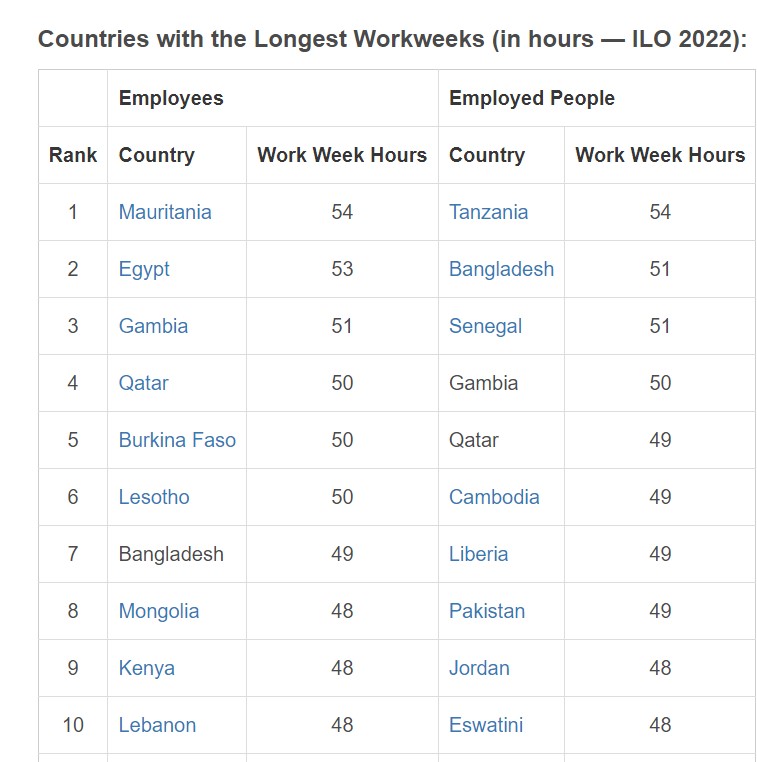
Let’s take a look at the countries that work the longest hours:

https://worldpopulationreview.com/country-rankings/average-work-week-by-country


 Now, let’s look at the countries that are deemed as the most productive:

https://worldpopulationreview.com/country-rankings/most-productive-countries


 The most obvious point here is that there is no correlation between the places that work long hours and the countries that produce the most per worker. If you argue that the average Irish worker is lazy for working 39.7 hours per week when compared the average Mauritanian who works 54 hours a week, the automatic counter is that the Irish workers gives significantly more back in terms of what is produced.

Go to any given office in a developing country and you are bound to find people running around like there was a lot to do. Posting letters is a full time job for some people in the office and they become very busy at it. In the developed world, offices are different. One has to avoid sitting near the exit because at the end of the day, there will be a stamped.

Are we saying that people in developing countries are more hard working and dedicated to their jobs than those in developed ones? Well, maybe they are but why aren’t companies leaving developed countries to hire more devoted and hardworking employees? Well, it could be because the guys in the developed countries are more productive?

In a way, the problem in developing countries is the fact that bosses like the appearance of busy and hence you get workers who become busy but nobody knows what they are busy doing. I’d call this being busily unproductive.

The solution is simple. Instead of paying people to look like they are doing work, why don’t we actually pay people to produce work. Hence, instead of spending time in an office until the wee hours of the day, people will focus on getting things done and busily unproductive might finally be an oxymoron.

Saturday, February 18, 2023

It’s Not a Crime as Long as We Make Money


Around five years ago, I had the honour of being taken out to lunch by a very prominent Emirati Businesswoman who proudly described herself as a “super saleswoman for Singapore” She described Singapore as “washing the face of the Oriental,” because we were the only Asian nation that stood in the top five nations of the world’s least corrupt nations.

I think this incident because its actually one of things the main things that people from elsewhere like about us. You could say that our reputation for non-corruption is our greatest strength. It’s like the one thing that we have that our neighbours don’t have. The multinationals will rush to enter the large emerging markets of Indonesia, Thailand and Vietnam but they will make sure contracts are signed under Singapore law. As my favourite Malaysian Datuk says, “As long as I stay away from politically sensitive topics in Singapore, the courts will treat me fairly.”

Unfortunately, it seems that our economic managers can’t grasp this concept and have sought to redefine corruption as something that only the people at the lower rung of the ladder get involved in. This was made clear by the announcement that our extremely vigilant and active “Corrupt Practices Investigation Bureau” (CPIB) decided to let off six executives at Keppel Offshore & Marine (Keppel) with a stern warning (“You’re naught – don’t do it) for their role in a corruption scandal in Brazil. The outcry from the public was harsh and our second minister for national development, Ms. Indranee Rajah had to get up and defend the once stalwart CPIB. Her main point was that there was not enough evidence to prosecute the six:

https://www.channelnewsasia.com/singapore/keppel-corruption-case-bribery-insufficient-evidence-former-employees-indranee-rajah-3256456


Prior to joining politics, Ms. Rajah was a senior lawyer, holding the title SC (Senior Counsel – the Singapore version of King’s Counsel). You could say that this makes Ms. Rajah a very credible person to make such a statement. However, this comes after Keppel had to make a resolution of S$88 million to Brazilian authorities back in 2017 for “corrupt” practices and the Brazilian litigation wasn’t the only one.

https://www.channelnewsasia.com/singapore/keppel-offshore-marine-pay-s88-million-resolution-brazilian-authorities-corruption-case-3156681


 The American justice department also got involved.

https://www.reuters.com/article/us-keppel-corp-settlement-lawyer-idUSKBN1EL1C1

Keppel’s legal strategy has been to blame its agents in Brazil. However, given the sums involved, its hard to believe that somebody or some parties involved had to have authorised the release of the sums to the agents. Then, there’s also the standard point that Singapore’s authorities like to use – “If the Company has nothing to hide, why settle with Brazilian and US authorities?”

To be fair to Keppel, it was doing business in Brazil, which ranks as the 96th most corrupt country in the world according to Transparency International. As a Brazilian friend of my family once stated, “If you work in the civil service and haven’t made your fortune after four years, you must stupid.”

The fact remains that growth markets are now in places like Brazil and Brazil is a very big, must-be-in market for just about any company with international aspirations. There is also the fact that the squeaky cogs in the machinery of business need to be oiled. Singapore’s karaoke bars do a very brisk trade because wheels of commerce do need to greasing.

Singapore’s unofficial minister of promoting the inexcusable, or the Critical Spectator has even gone as far as to promote the six for their role in the whole affair:


His argument is simple, the six did what they needed to do and made money for the Company, which in turn is good for Singapore.

As he so often does, our unofficial minister of promoting the inexcusable misses the point. Sure, the line between the legitimate and illegal can be thin and at times blurry when it comes to “greasing the wheels of commerce,” but the line exists – even in countries that rank lowly on Transparency International’s rankings. These countries struggle with corruption because the culture is often ingrained and the enforcers are often compromised. As such, the countries that rank higher on the index also have laws meant to ensure that companies domiciled on their soil don’t engage in corrupt practices elsewhere.

Nobody accepts that corruption is a good thing. What is accepted is that there are countries which are more corrupt than others and these countries need to be helped combat corruption.

In the case of Keppel, that line, as the litigation in the US has shown, has clearly been crossed. Its not like there was an exoneration in the US and Brazil and Singapore only following suite.

Things get even more complicated when you consider the fact that Keppel’s largest shareholder in Temasek and its chairman is a former minister. It does without saying that the dirt on Keppel is ultimately going to be slashed at the government’s door.

Lee Kuan Yew, Singapore’s first Prime Minister, had a very simple policy. He clamped down on the people at the top. Mr. Lee was very sensitive to any taint of corruption and ensured that even the smallest whisper of it was dealt with swiftly and publicly:

https://www.youtube.com/watch?v=ncYO9YYqbv4

Unfortunately, this isn’t the case here and the public has been allowed to wonder if the “stern warning” issued to the six men is an effort to protect people rather than a genuine case of proven innocent.

Singapore’s greatest strength is that of non-corruption. It’s something we cannot afford to squander by redefining the meaning of corruption when senior people at the top of the food chain are involved in scandals.   

© BeautifullyIncoherent
Maira Gall