Wednesday, June 17, 2020

Happily, Non-Essential


The Straits Times, Singapore’s flagship newspaper has got itself into the crosshairs of Singapore’s professional classes, thanks to a survey it conducted and published in its Sunday edition (14 June 2020), which revealed what Singaporeans thought about certain professions and their necessity to the rest of society. The now infamous infographic can be seen below:


Essentially, the graph showed that what the 1,000 odd Singaporeans surveyed thought of as essential, included people like doctors, cleaners, garbage collectors and deliverymen. The people who topped the list were the artist, social media managers, PR specialist, Business Consultants and Human Resource Managers. It was clear that the with the exception of doctors, the “essential” professionals were primarily blue-collar workers while the “non-essential” guys were what you’d call “working-professionals.”

The survey has royally pissed off our professional classes. There have been snide remarks about how the Straits Times conducted a crappy survey, thus showing why it’s becoming less relevant. There have been a few remarks from professionals that can be summed up as “if you think I’m non-essential, wait till you need this,” and I even read someone complain that society was being selfish because people were sitting at home watching Netflix but not respecting the work of the artiste who produced the movies they were consuming. There was an accusation that the Straits Times was dividing society into the essential and non-essential.

As someone who has made his living by selling “non-essential” professional services (advertising, public relations, legal and liquidation and accountancy), I was actually delighted to see the results of this survey. For far too long, Singapore has been a society that has literally spat on people in “blue-collar” jobs (I never tire of talking about the horny aunties who thought I was a reforming convict based on the fact that I speak the way I do but worked in a restaurant) and we’ve worshipped the “professions” to an over the top extent. I remember my oldest friend who had given up a lucrative legal career to be a primary school teacher. She told me that she had to sweep floors as part of her job and then said, “Remember how we were told that we didn’t study hard, we’d end up sweeping floors for a living.”

She was right. People of my generation (I’ll be 46 soon, so it’s Gen X) were told that the punishment for not studying was a bright career in sweeping streets. Parents, who had worked humble jobs like sweeping streets, would sweat blood and tears to ensure that their kids would never follow in their footsteps.

I think of my ex-wife’s family. The one person in her family that I admired was my former father-in-law who drove a Mercedes and put two kids to university by selling eggs (he literally picked up from his wholesaler and drove around his clients, the industrial cafes of Singapore). However, all his hard work was meant to ensure that his kids would never deliver eggs. The hero of her family was my former brother-in-law, who ended up working for Defense Science Organisation (part of the government) after getting all sorts of fancy degrees. For me, the tragedy of her family was that it abandoned something valuable (years of building up a network of relationships and physically demanding work) for something that produces very little value (with all due respect to my former brother-in-law, do we really need to think of more ways to exterminate people, especially for a country that is unlikely to face war?)

Our worship of the professions, which worked alongside with our disdain for blue collar jobs has helped us create one of the widest pay differentials. A working professional with at least five-years-experience in Singapore should be able to draw around S$4,000 plus (based on an averageaccountant pay). By contrast, blue collar worker with a similar number of years of experience would be lucky to make around $2,500 a month. This hit home when I got once paid $800 for drafting and disseminating a press release, which took me all of two or three hours. That was exactly what I took home from a month of working in the Bistrot (based on four hours a night for 26 nights a month).

Well, whatever one might say about Covid-19, I’m glad that its finally made us realise the importance of the guys doing the menial work and the lack of importance of the “high-flyer” jobs.

As a matter of clarity, I’m not suggesting that there’s no value in anyone’s work. Lawyers, for example, are important when it comes to contracts. You need an accountant to help you keep track of where your money is going. I’d always stress to clients in my incarnation in PR that you need someone to ensure you look good to the public, even when things are bad. Advertising professionals help drive sales.

It’s good that the working professionals are getting upset in as much as it shows that they take their profession seriously and have enough passion to do a good job. However, the question at stake here is – whether your job is “essential,” which is a word often associated with the break down of things.
I take myself as an example of a remarkably unremarkable person in these circumstances. I’ve never had much money to begin with, so why do I need an accountant. Since I don’t have much money to begin with, it’s highly unlikely that I’ll need a lawyer and let’s not talk about my need for a PR or advertising consultant to promote my non-existent image.

However, when we have a situation where I could easily come down with a nasty bug, I definitely need a doctor. I happen to take clean streets as a given and I expect the trash to be collected. Being clean has become especially important as it reduces the likelihood that I’ll get a nasty bug. Are we surprised that the average Joe (or Ah Beng, Mutu and Ahmad) think that these jobs are the “essential” jobs to their lives?

What’s heartening is the view that Singaporeans are willing to pay more for these services if it means the workers get more and it’s also heartening to see that the majority of people understand the difficulties of these jobs in as much as while they’re jobs that are regarded as essential, they’re also jobs that people don’t want to do, even if more money was offered.

Let’s hope that the understanding of the importance of blue-collar work leads to people backing up their new found understanding with their wallets. Let’s not accept excuses that improving the lot of blue-collar workers is harmful consumers. Singapore needs to move beyond being a place for “cheap” this and that, when cheap means keeping people poor so that a group of middle men can get rich.

At the other end of the scale, I would suggest that it’s time to relook at how professions look at themselves. If I look at the industry that I grew up in (advertising) and the industry that I work with on a regular basis (legal and accounting), it’s reached a stage where groups which were initially advisors have to industry have become industries themselves.

While this is for the most part, a positive thing, its also had an unintended consequence of getting the respective industries to treat themselves too seriously. In the case of advertising it came from the complaint that advertising people became too focused on making ads for themselves at award ceremonies rather than on selling products, while in the legal industry, it became about keeping problems alive. People in professional services became guilty of falling in love with being professionals. The profession becomes a mystic art and practitioners indulge in titles like “guru.”

Look at the way these industries bill – through the time sheet, where they charge by the hour. This system encourages professional services to think of themselves as a mystic art, where the customer has to pay for wise counsel. It goes without saying that this system does not encourage efficiency.

I never saw an issue in “results” payment. I’ve billed clients based on coverage obtained and been ticked off by fellow professionals for taking a risk. Lawyers in America charge on their ability to win cases. This is the way things should be. The client comes to you for advice because you are an expert at this or that. Your payment should be based on how well you achieve the objective rather than on your ability to delay the problem.

Unfortunately, in places like Singapore, you end up having “champerty” laws, which make payment by results illegal and encourage the professions to view themselves as “cults.”

Covid-19 should be a social changer as much as an economic one. Respect and increased value for blue collar work should accompany a desire by working professionals to remember their original purpose of using knowledge to serve rather than to turn their knowledge into a cult.

There are hopeful signs. The example that comes to mind is a friend who named his law firm after an ice cream flavor His argument was thatlaw should be a simple process and used to serve businesses and not the otherway round. To put his money where his mouth is, he developed a document assembly system that reduces the time a client needs a lawyer to draft documents. It goes without saying that this has upset his fellow professionals (drafting documents is a major money spinner for lawyers). However, his argument is simple – he’s there to serve the businesses rather than his fellow professionals and he’ll do what he can to demystify his profession, which in the end is good for the profession.

Saturday, June 13, 2020

Lucrative Problems


I got to admit that I love Bollywood and being forced to stay at home and having access to Netflix has allowed me to catch up on a few Bollywood movies. The smattering of Hindi I’ve been able to pick have come from watching Bollywood movies.

Anyway, I watched Aiyaary, where there was a scene about an incident in Kashmir (the long-disputed sore in Indian-Pakistan relations). In this scene, the younger character asks his mentor, “There are intelligent and capable people on both sides. Why is it that we can’t solve the problem?” The reply of the older character replies, “Kashmir is an industry,” and he goes onto explain that too many people on both sides are making money from the problem. He then let’s his protégé understand that, “When you’re making money from a problem, you safeguard the problem instead of solving it.” The dialogue can be found at:


This section of the movie caught my attention because the world is going through a lot of problems. We have a global pandemic, the depletion of natural resources, climate change and now there’s racism in much of the Western world. Old conflicts like Kashmir and the Israel-Palestine issue seem set to get worse.

None of these problems are new. These problems were highlighted in the global media some thirty years ago and if you followed the news in that time, you’d get the impression that these were insolvable problems.

However, if you look at the technological advances that have been made in that period, a sane mind would have to ask, “Why can’t we solve these problems?” Why, for example does South East Asia and the South America get covered in a haze every so often? The annual bout of regional choking haze comes from the burning of forest, which is meant to clear land for cash crops.

When environmentalist complained about the ecological devastation, the standard reply in Southeast Asia (and is now being loudly used by Brazil’s Jair Bolsonaro) was that “the poor world needed to feed people,” and the subtext was “even if it pissed off Western environmentalist,” who were merely imperialist trying to keep us poor.” While this might have been the case in the 1960s, why does this have to be the case in 2020? You’d imagine that we’d have found a way to substitute palm oil in certain products or found a way for farmers to clear land that didn’t kill off the rest of us.

Unfortunately, it’s not been in anyone’s (or at least the people who count) interest to find a solution. The plantation owners keep poor people busy and politicians have been convinced that its in their interest to keep the plantation owners happy.

Here in Singapore, there’s the issue of foreign labour, which has become an issue now that Covid-19 has exploded in foreign worker dormitories. Suddenly, Singapore’s media has shifted its focus on the condition of foreign workers and there have been letters galore about the need to rely less on foreign workers.

True to form, the industry has hit back and there have been a number of letters from “industry” groups, which called for any cut to the supply of foreign labour to be “short-sighted” and detrimental to the economy. One of the most prominent forum letters can be found at:


The argument against having more foreign workers is unfortunately the same as it is the same argument against any basic improvement to the welfare of foreign workers – namely less foreign workers like better foreign worker welfare will increase the costs for employers who will then have to charge more and make everything more expensive for us, the consumers.

This argument has been used very effectively to dodge solving the actual problem, which is the fact that employing a foreign worker is not actually cheap for employers nor does it give foreign workers the money they thought they’d have but the system benefits a host of other parties like labour suppliers, dormitory operators, labour agents and repatriation companies. Any disruption to the system will inevitably upset a host of other people. Nobody explains the problem better than Alex Au, who works at TWC2, an NGO for migrant workers:


Crudely put, every foreign worker is a money spinner for a host of parties. The government, despite its generous support for the migrant workers in this pandemic, is in fact one of the guilty culprits. The revenue from the foreign worker levy is a major money spinner (average of $750 per worker per month – the stress of this being an average) for the government. However, in addition to that, there is a quota system, which limits the number of foreign labourers that a company can hire.

The official reason for the levy and quota is that it reduces the price differential between foreign labour and local Singaporean labour. The reality is that it has created a very lucrative niche called Labour Supply. The basics are simple – hire a labourer on the cheap and then “rent” them out to other companies that need labour but don’t have the quota. As one former accountant for a labour supplier says, “The worker works the overtime while the labour supplier pockets the overtime pay.”

Other laws get exploited too. There is a lucrative niche for lawyers working on workman 
compensation. All you need is to find a worker involved in a workman compensation claim. You pay for the housing, flight ticket and perhaps give him a bit of pocket money and once he’s gone back, collect the workman compensation, which is inevitably higher than what you paid.

The answer to our foreign labour problems is simple. You just need to reduce the people in between the labourer and the employer. If you reduce the army of middlemen, the employers can get cheaper labour and the workers can get more money. The key parties would benefit. However, the middlemen form an industry in themselves.

I look at the situation with maids as an example. At one time, a maid in Hong Kong earnt up to $700 a month because there wasn’t a powerful middleman. In Singapore a maid would costs an employer around $700 a month but the maid would only get $400 if she was lucky. The difference between the Hong Kong and Singapore scenario is the fact that there is a levy to be paid in Singapore.

I’ve never argued against the need for middlemen. Agents and even labour suppliers have a role to facilitate the relationship between employer and employee. Dormitory owners also serve a purpose in housing workers. Nobody is saying that these businesses should not be allowed to make a profit.

What is being argued here is that the system needs to be changed so that the most important players (namely the employer and employee) get a fairer deal. The system as it is, remains a problem. It’s a choice between increased costs for employers and basic welfare for workers (which is defined as livable wages and accommodation that does not make people sick.)

Entrepreneurial thinking is needed to restructure the system and the sooner the government bites the bullet and goes through the pain (including losing the addiction to easy levy money), the better it will be for all of us.

Thursday, June 11, 2020

Why Are You So Dark?


I’ve often argued that the human race has an incredible talent of finding areas of differences, there is one unfortunate factor that seems to unite the world. That unfortunate factor is the inability to view anyone of a darker skin tone as a normal human being.

Racism, particularly in the West, is currently a “Black-versus-White” issue. The murder of George Floyd, an African-American at the hands a “white” police officer on video ignited many years of pent-up anger that the Western world’s “black” population has had from years of laws that were designed to keep them down and when those laws were abolished, the fact that prejudices that lingered were for many parts accepted.

Unfortunately, the issue of racism is neither limited to a case of “blacks-versus-whites” nor is it limited to the Western world. In America, there is the undiscussed issue of “Asian-Black” relations. This was first seen in the 1992 LA Riots (caused by the beating of a black man by White Police officers and the subsequent acquittal of the police officers despite the evidence), when the city’s black population tried to loot stores owned by America’s Korean population. In the most recent incident, it was a cop of Asian decent who looked away while his “white” colleague murdered Mr. Floyd. More can be found at:


Like it or not, Asians who have settled in the Western world have not been helpful to the issues faced by the black communities. The reason for this is simple, the Asian inability to see the suffering of other minorities in the West is the very thing that makes Asians valued immigrants – material success.

In America, they’re known as the “model-minority,” or the poor migrants who arrive with nothing and within a generation are part of the educated professional class (so much so that the Old Rogue, used to say “If American universities really admitted by merit, there wouldn’t be a single round eye). In Britain, Asians, particularly the Chinese were well regarded as the group that stuck to its corner, prospered (no state handouts) and avoided contentious politics. My stepfather, who works in a hospital in Germany says that unlike many of the other minorities, the “Yellow People,” never went onto German welfare. This same sentiment was echoed by Finnish friends who stated that Japanese and Vietnamese were welcome because they worked hard and kept to themselves.

As an Asian, who grew up in the West, I felt proud that “my people” came to the West with nothing and built something. While this achievement of Asian communities in the west is a good thing, it blinds “us” to the realities to the harsh realities of other communities. When the Black talk about social justice after screwed by the history of slavery, the Asians shrugged with the “so what, we were once poor and made it out – what’s wrong with you,” mentality. Yes, we were fresh off the boat but we didn’t have the conditioning that many American blacks suffered. Contrary to what Ben Carson would argue – slaves were not immigrants.

Being a “model minority,” has given the Asian communities a false sense of security in the status quo and many Asians forget that they too once benefited from the struggles of the African American Community as this clip from the comedian Hassan Minhaj explains:


The situation that “dark-skinned” people face is not exactly prejudice free in Asia too. One of the biggest examples of how Asian people are proving to b as awful was from an infamous ad from China, which showed a black man approaching a Chinese girl, who then shoves him into a washing machine, where he emerges Chinese and therefore desirable;


With attitudes like these, it’s not surprising that the Chinese in Africa are often regarded as arrogant arseholes (sure, unlike the Western Colonial powers before, there’s no lecture on human rights, but the Chinese are far from liberating heroes).

Over here in Chinese majority, Singapore, we claim to be “multi-racial.” Unfortunately, beneath the lovely exterior, it is politically acceptable to endorse racism. The official line is that, “Singapore’s majority Chinese population is not yet ready for a non-Chinese Prime Minister,” even if the one politician with global credentials and accepted by all races is a non-Chinese.

While it was heartening to see many Singaporeans (including the Chinese ones) open up their hearts and wallets to foreign workers as cases of Covid-19 erupted in the dormitories, an unhealthy number thought nothing of denigrating dark skinned labourers who were doing the work they wouldn’t do.

The only salivation for the Chinese race in this respect is that it’s not the only race in Asia with an issue with the dark skinned. The Indians (many of whom are dark skinned, particularly in the South) also have a strange fixation with trying to get fairer. Take a look at this commercial, staring Bollywood icon Shah Rukh Khan, which while not as obvious as the Chinese detergent ad, isn’t exactly subtle in its messaging:


The message is clear. Fair equals handsome, hence if you’re a guy who wants to pick up girls, you invest in skin whitener. I think of one of my best friends, who is a good looking Nepali, who takes great pride in the beauty of his kids because ….they’ve got his colour.

I’d go as far as to argue that it’s almost worse than in the West. While the Western worlds are erupting into violence on the streets, the problems are clear cut. Blacks are clearly being screwed over by the system, particularly the police force. While America is the focus, I’m old enough to remember when the Algerians rioted in Paris and when the Stephen Lawrence Inquiry Found Police forces in the UK to have major issues with race. Sure, current leadership hasn’t helped. However, these are problems that can be solved with the obvious – i.e. legislation, money and so on.

In Asia, its almost as if the prejudice against the dark skinned is part of accepted culture. Let’s go back to “fair and handsome.” Think of it, it’s probably not meant to be racist against dark skinned people. It’s just an accepted fact that fair automatically gets equated with handsome. I remember my late grandmother telling me, “These Indian girls are actually pretty – it’s just that they’re dark.”

Changing culture will take time. I think the obvious is to encourage mixed race marriages (or as one Jewish guy said “My dick is not racist”). This will be particularly tough, especially when you consider that most Asian marriages are about families as much as the individuals. Yet, as the Western situation has shown, the prejudice against dark skinned people has to be eradicated to a level where dark skinned people don’t feel that it’s the natural order of things for them to be screwed.

Both the West and Asia need to re look at the way they treat the dark skinned. It’s not just a black and white issue but a human issue that needs to be addressed. Racism and ancient prejudices don’t have a place in the modern world.   

Tuesday, June 09, 2020

He Stung Like A Bee


Thanks to Covid-19, I’ve been consuming lots of Netflix moments. One of my most recent was to watch Ali, the 2001 film that depicts the life of boxing legend Muhammad Ali. This is perked my interest in boxing and the story of the man himself.

I could not have found a better time to get interested in the life of Muhammad Ali. Like most people, I’ve been glued to the TV, watching images of protest and riots caused by the murder of George Floyd, the black man, murdered by a white policeman. The Western world is going through a lot of angst about racism and police brutality. I’ve argued in a previous blog posting that Singapore, which, while geographically in Southeast Asia, has the same underlying problems that the Western World in terms of race relations, particularly with a dark-skinned underclass.

However, if you look at the life of Muhammad Ali, you’d find that there is a glimmer of hope. While his boxing achievements are well known, there are small, lesser well-known anecdotes from his life, which should inspire hope. What I found most interesting, came from the eulogy given by his fourth wife, Mrs. Lonnie Ali, where she told the story of how he got started in boxing:


Muhammad Ali or Cassius Clay as he was known before then, grew up in Louisville, Kentucky in the 1960s. This was during “segregation,” a period of American history that was pretty similar to apartheid in South Africa. Government policy was designed to keep black people poor and while slavery had been officially been abolished a century or so ago, the laws were designed to keep the black population down. Kentucky was one of the places where segregation was not just law but culture.

So, when you look at this era of American history, in which he grew up, the first great sign of hope was the fact that the man who got him into boxing was a white policeman called Joe Marten. Mr. Martin, who had a sideline as a boxing coach. As Mrs. Ali said the funeral, “Something is going on when a cop from the South gets along with an inner-city black kid.”

The main point here is that goodness is possible in culture that is racist and small acts of kindness can make a bigger difference than brute force. The comparison that comes to mind is the American military campaign in Vietnam, which involved lots of bombing and the British campaign against the Malayan Communist, which involved a hearts and minds campaign. Superior force only united the local population against the Americans. The hearts and minds campaign brought the locals onto the side of the British. In the current situation, the cities that have managed the riots best are places where the cops put down their batons and hugged the protesters. The places where the situation that got inflamed were places where the cops treated the protesters like they were part of the battlefield.

The next point from the life of Muhammad Ali was the fact that he was associated with the Nation of Islam, an organization that is effectively promoted black supremacy (the other extreme). His first political mentor was Malcolm X and in between Cassius Clay and Muhammad Ali, he was Cassius X.

As he grew in his boxing career, the man known as Muhammad Ali was particularly sensitive about his name. As far as he was concerned, his name was “Muhammad Ali,” and “Cassius Clay” was his “slave name,” which was thrust upon him by white slave owners (the original Cassius Marcellus Clay was a 19th Century Republican Abolitionist). One of the most vicious beatings he gave anyone in the ring was to an opponent who called him “Cassius Clay.” Legend has it that with each beating he gave, he’d yell “say my name.”

Eventually, like his political mentor, Malcolm X, Muhammad Ali moved away from the Nation of Islam’s more extremist ideology, towards mainstream Islam. He embraced people of all colours and faiths and was loved for it. There is a scene in the movie Ali, when his second wife tells him “Those brothers Xs and Ys are only there when you’re the champ and no longer there now you have no use to them.”

What does that say? I believe that this point of Muhammad Ali’s life shows us that going to the opposite extreme is not the answer. Extremist groups are only interested in themselves and you gain so much more when you cross lines of race and religion. At Muhammad Ali’s funeral, there was a point that religious leaders from all faiths would be present and acknowledged.

Muhammad Ali was not a saint. He was a philanderer (four wives and nine kids) and his “trash talking” which promoted fights did hurt. His rival, Joe Frazier, who had helped him out financially in the period where he was not allowed to box because of his opposition to the Vietnam War, grew very bitter towards him because Ali did insult him (called him a gorilla – didn’t help that Ali by contrast was very good looking in his youth).

However, he was a man of great courage, who overcame the circumstances of his birth and rose above the racism of his era. He gave back to the world. In an age where brutality towards the underclass and racist undertones are encouraged at an official level, his life story should inspire us to make a world of what it should be instead of what it is.       

Saturday, June 06, 2020

It Could Happen Here


As an Asian, particularly a Singaporean, the temptation to feel smug has never been greater, particularly when you look at events in the world’s most prominent nation, the USA. While Singapore has problems and has lost some of its shine from the explosion of Covid-19 cases, our problems remain relatively mild, when compared to say the hundred thousand odd Covid-19 cases in the US and the riots across America that were sparked by the murder of George Floyd, a black man who was murdered by white police officers on video. Our problems, as they say, are rather “first-world” when compared to the USA.

However, as tempting as it is to get smug, it’s probably best not to get smug at all. While Singapore’s apparent tranquility might give one the impression that all is well, many of the underlying problems that have exploded in the USA are present in Singapore. We’ve merely been better at applying the cosmetic dressing.

Like the USA, Singapore is an unequal society. The latest figures on inequality based on the Gini-coefficient (which measures inequality on a scale of 0 to 1, with 0 being perfect equality), Singapore hit a two-decade low of 0.452 last year. The report can be found at:


By comparison, the USA has a Gini-coefficient of 0.485. Singapore compares well to its main Asian rival, Hong Kong, which has a Gini-coefficient at 0.539 (joke being the tycoons control Hong Kong the way the government controls Singapore) and unlike top placed Lethoso (0.632), its not a case of a handful of people owning everything else. However, Singapore compares badly to the European nations, like Germany, which has a score of 0.27 and even some of our fellow ASEAN neighbours like Indonesia which has 0.368 (this being a country which has some of ASEAN’s richest people while having visible signs of poverty).

Whenever the issue of the Gini-coefficient is brought up, Singapore’s powers-that-be, inevitably argue that the Gini-coefficient isn’t the most accurate measure of anything in particular, rather like the way my old headmaster used to argue against school league tables (that being until the tables showed him something he liked to see).

What’s particularly interesting about the “inequality” in Singapore is that it is often colour related. You have the professional and executive classes, who are more often than not Westerners or well-educated local Chinese, and much to the dismay of many locals, a growing number of Indians from Mumbai and Delhi. At the lower end of the spectrum are the guys doing menial jobs like cleaning our streets, manning our ship yards and construction sites and looking after our kids. These guys are predominantly from what Donald Trump calls “Shithole” countries of the Philippines, Bangladesh and India (specifically the Southern Parts).

The wage differentials are staggering. While our CEO’s have yet to experience American style 100 million annual stock options, the pay at the higher end of the scale is not to be sniffed at. DBS’s CEO, Piyush Gupta famously had a salary of SG$9,000,000 a year. Our Prime Minister is the world’s highest paid head of government (US$1.61 million per year versus the USD400,000 for the US President) and the CEOs of our top companies are not doing too badly either.

At the other end of the scale are the labourers and maids who would be lucky to have a thousand Singapore dollars in their pockets. I still remember a labourer of a company we put into liquidation telling me that he earned a princely sum S$18 a day for a 12-hour workday.

What’s particularly interesting is the attitudes towards the pay differentials. When it comes to paying working professionals, it called “talent retention,” and we’re told that we’ll lose our competitive edge if we don’t pay better than first world salaries to people from the first world. It was always interesting to see the extent of our efforts to “retain” and “attract” talent, especially when it came to the vices. The police parked themselves across the streets so that working professionals could have their pick of prostitutes and overpriced booze without any interference (men, will be men).

By comparison, when it comes to anyone from “developing” Asia, the line of defense is – “they’re earning far more than they’d ever get back home.” This on its own wouldn’t be a major topic, but when you add the way law enforcement looks upon migrant workers, which is as a source of potential problems. Bored policemen on petrol inevitably cannot help questioning workers who are damaging the neighbourhood by sitting in a corner and having a cup of tea.

Just as there’s an economic defense for paying “talents” from New York or London well, there’s an economic defense for paying people from Dhaka and Manila badly. The argument runs like this, if we didn’t pay them badly, we would not be able to give you the Singaporean quality housing and infrastructure at affordable prices.

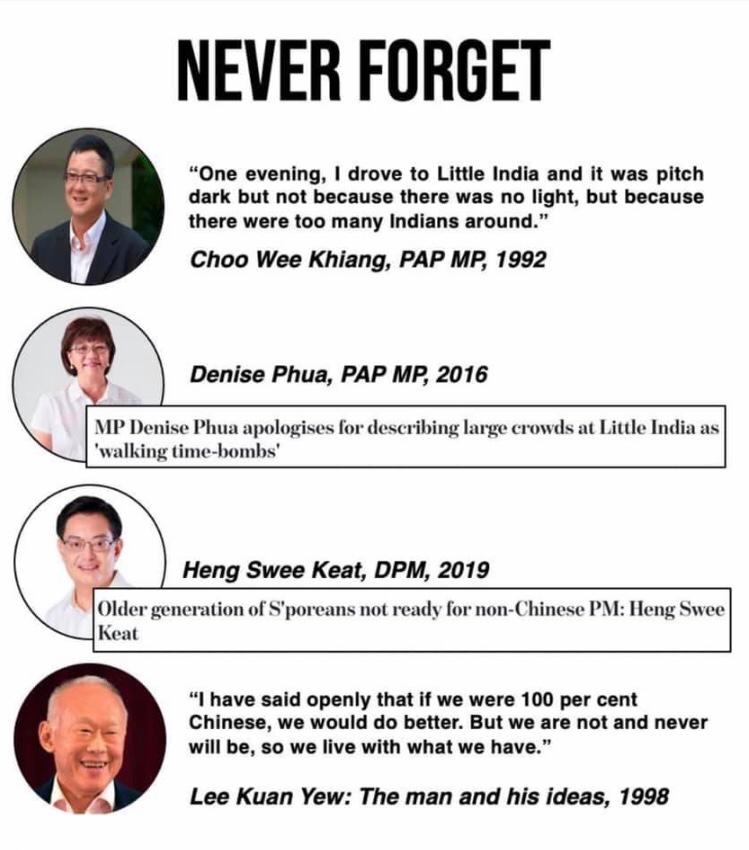
This argument is faulty. It enforces the idea that dark skinned people are less worthy of human treatment and places the profits of companies above that of basic human decency. What’s more shocking is that official attitudes seem to support this. There have been too many cases of senior politicians making blatantly racist statements in the public arena and keeping their jobs as the following illustration shows.


Furthermore, with the explosion of Covid-19 cases in worker dormitories, you’d imagine that people would finally understand that its in the national self interest to ensure the workers get better living conditions. Unfortunately, you have too many like the Fawning Follower aka Critical Spectator, who still insist that the downtrodden need to remain that way for everyone’s benefit.


The foreign worker population like the black population inthe USA have born a disproportionate amount of Covid-19 cases. They are generally law abiding and as stated on many occasions, what they want is to get what is due to them for their labour and some fairness.

To be fair to the Singapore government, its acted quickly to contain the spread of Covid-19 in the dormitories and been generous in giving welfare to the affected workers. However, this is only cosmetic and doesn’t solve the real problem.

Let’s remember that the cause of the 2013 riots came as a result of the police appearing to show more interest in protecting a bus driver who had killed a worker than in the welfare of the worker itself. While mild compared to what is happening in the USA, our system needs to be revamped to such a way where our “anti-racist” rhetoric actually means something and we don’t justify the exploitation of an underclass in economic terms.

Let’s start with this. Politicians who make “racist” remarks in public should pay with their jobs. It would show that we’re actually serious about combating racial discrimination. If our leaders can get away with making “racially insensitive” remarks in public, what type of example does it set for the rest of the population?

We’ve been lucky in our race-relationship management. However, we have underlying problems and let’s not waste a good crisis and use the time to take stock and reform the system for the better. The sooner we do it the better for the rest of us.

Friday, June 05, 2020

Growing Too Old


I’ve been unemployed for a good portion of my working life and when I got a “corporate” job in my late thirties, everybody told me that I had to hang onto it because it was probably the only job that I would have. The reason for it was very simple, I started “working properly” in my late thirties and by the time I reached a certain level, I’d be “too old” to be employable.

Like it or not, one of the worst of the “isms” in Singapore is ageism. While “racism” (particularly with the riots in the USA) and “sexism” make media headlines, ageism affects far more of us and in an age of shorter working life cycles, is perhaps a larger and more serious issue. Singapore is filled with too many stories of people in their mid-forties who have been retrenched and unable to find work but still stuck with mortgages and children whom they need to send to school.

In a way, the down and out situation in Singapore is the mirror opposite of London. When I lived in London, the tramps camping at my door were inevitably young and white, who had fallen into a drug habit. In Singapore, by contrast, the old are inevitably old. In the pre-Covid-19 world, all you needed to do was to sit in any outdoor eating area and you’d find that the people doing the “heavy stuff” like carrying dishes were inevitably old as were the people desperate enough to go round tables trying to sell you tissue paper for a dollar or so.

What makes this scene particularly sad is the fact that Singapore claims loudly and proudly to be an “Asian” society that “respects” elders. Ironically, the biggest proponent of “Asian Values” was the late Lee Kuan Yew, who grew up with a disdain for anything Chinese until he entered politics and realized that it was the Chinese Educated who demonstrated in the streets. The late Mr. Lee was a poster boy for “active aging,” working well past his ninetieth birthday. However, while he was busy ensuring himself jobs in the cabinets of his successors, it was a singular act. All his cabinet colleagues, including Goh Keng Swee, his loyal deputy who did the work, retired in what was called “leadership renewal,” or the process of getting the old to give way to the young.

Mr. Lee was in theory right to focus on “leadership renewal.” There is such a thing known as hanging on too long and letting the things that made you great become a total liability to the people you once cared about. “Arab Spring” old folks on top who didn’t know when to let go.

However, a good idea has been taken to an extreme, where old folks who never had salaries of our well-paid ministers are pushed out of work once they hit a certain age. In many cases its usually at an age where people still have mortgages and other hefty bills to pay. How did this happen?

I believe that the heart of the problem is ideological. Singapore is famous for being the world’s “nanny state,” with the government behaving like a stern parent. For the most part, the parent has been wise in many of its decisions. However, the parent has been unable to listen to the realities on the ground. There’s been an ideological conflict at the heart of our governing philosophy. On one hand we’ve told the people that the only viable source of employment is foreign investors and the government. On the other, hand there’s also a message of “non-welfarism” where the government claims that it does not give out cash because it wants people to be self-reliant.

This was perfectly fine when we had multinationals coming in and hired people for life. However, this isn’t the case anymore. The multinationals may still use Singapore as a regional base but the real markets are in other parts of Asia, with more to offer.

Hence the situation became such that the “big” growth drivers were not hiring the way they used to and people were stuck with rising expenses and less stashed away.

Like it or not, our CPF system, while useful, is inadequate. My ex-boss at Citibank, Mr. Eddie Khoo, told me, “Ask Singaporeans about a retirement plan and they’ll tell you there’s CPF. What they fail to realise is that most of your CPF is used for housing, it doesn’t give you enough cash.”

Mr. Khoo was correct in that most of our forced savings was tied up in housing. What he didn’t add was that the government’s solutions to the “aging” problem has been to tie up CPF monies in CPF. First, they’ve been raising the minimum sum requirements along with the retirement age.  Then they’ve capped the limit of what you can use it for.

If I take myself as an example, the only thing that CPF has helped to do has been to defray my mortgage payments. However, beyond that, it’s become like a mirage, where I see more money being added to the account but with further restrictions on withdrawal, it is money I will realistically not be able to utilize as I age no matter how much I have.

In addition to increasing the retirement sum, the other method has been to raise the retirement age. Like everything else coming from the Singapore Government, this sounds good in theory. Yes, people are aging but they’re healthier than they used to be and can remain useful.  As Senior Minister, Tharman Shanmugaratnam has said, “No one is too old to hire, too qualified to adapt.”

Unfortunately, the practice is rather different and getting Mr. Tharman’s words into practice will take time. You cannot change a culture of age discrimination overnight, even if the problem needs to be solved urgently.

Again, I take myself as an example. I am turning 46 in November. I left my corporate job last year between my age and a Covid-19 ravaged economy, I’m challenged to think of what I’ll do next to feed myself. I’ve psychologically accepted that I am unlikely to ever go back to full time corporate again.

So, what does someone like me do? Effectively, my only assets are the fact that I’m relatively healthy and I’ve met a few interesting people and done one or two things.

So, to ensure I have enough money to pay for my bus card, I take up a bit of blue-collar work here and there. It’s not going to make me rich anytime soon but a few dollars in the pocket here and there. In addition to this, blue collar gigs allow me enough time to look at other things.

I write more and I look for a bit of PR work here and there, which I can put aside to pay down debts and to set aside for the day when I’m a bit too old to do very much. Hopefully, I’ll be able to do things.

However, the question remains, while I ever be able to earn enough remains on my mind and the answer for many people my age, is ironically, to look at other places to live. A lawyer I know is looking at Manchester as a retirement venue. An old editor believes that home may be in India. My kid, is telling me that we should look at Vietnam as a possibility. My Dad moved to Thailand and has a decent enough life. His point being, at 70 plus he gets the odd job here and there and he can afford a comfortable life style, which he cannot in Singapore.

Perhaps the government in Singapore should consider this. If the aging are not allowed to contribute to Singapore, why should they stay there and spend retirement funds there?

Monday, June 01, 2020

The Colour of Marrying Up and Down


I’ve just read an interesting criticism of myself on TRemeritus. This was a response to my article “Don’t Forget the Hippos,” and the writer of this complaint decided that it was worth taking a shot at my analysis on global politics. After having a go at me for my article, she then made the point that Singaporean women were marrying up by marrying Ang Moh’s (Local Hokkien Slang for Caucasian), while Singaporean men were marrying down by marrying women from China and Vietnam. I’m not sure how that was related to anything that I had written about but I “educated” to the fact that Singaporean men are rejected shits and as a parting shot, I was told that Singaporean women would not want me.

I found this funny that I person of colour (Judging by the name Tracey Ching) would express so much comfort in indulging in racial stereotypes at a time when normal (KKK Members and Neo-Nazis don’t count as normal or people) White People in America and much of the Western World are taking to the streets to condemn racism. I’ve found it quite ironic that the “White Race,” which has been condemned for creating the “racist” structure of the colonial world are in many ways, the enlightened ones trying to undo racism while the people of colour are the ones trying to enforce it.

As a matter of full disclosure, my own mother was married to two men of European decent, after she left my father. I consider myself exceedingly blessed for having my stepfathers and I was lucky when my dad married an American girl of Irish decent who came along with a lovely family. So, I grew up in a situation where at any given time, I had at least one parent who was of European decent. There was never a situation where my “non-white” parent was made to feel “privileged” for having the “white” spouse.

So, I guess this background set up to find it curious as to why one’s skin tone or birth place would come with any connotation of superiority or inferiority. My stepfathers were successful professionals, who earned good salaries as were the parents of my school mates. However, on the other hand, I noticed that when I lived in London, the tramps on the street were inevitably white.  Contrary to what many Asians and Africans might think, the White race encompasses people who cover the entire social spectrum.

I guess you could say that to an Asian girl, a “white” spouse would more often than not mean a working professional and if you’re from what the US President calls a “Shithole” country, living in a place where you can get away with slagging off the leader would be an improvement of sorts.

However, I’ve never understood the mentality that many people of colour have that the White race is somehow superior and somehow its an obligation to keep them that way. This is particularly true when you have girls of colour marrying a white man and getting it into their heads that it’s something they can hold over everyone else. I used to get very offended when a Pinoy girl who had married one of the partners in the Bistrot used to take a “superior” tone with the Filipino staff. The husband happened to be a sweet man and insisted on being treated like the rest of the customers whenever he came to dine.

It’s almost as if the people of colour find certain comfort in that old stereotype of a colonial overlord. I go back to my work experience at the Bistrot. I refused to take a role as a full-time manager because the salary on offer was considerably less than my European predecessors. I remember the staff telling me, “You can’t compare – he’s an Ang Moh,” as if it was a natural state of affairs for someone to be paid more merely for the colour of their skin. At the same time, I had European customers telling me that if the previous manager could get so much, I should have the same if not more. In fact, the European manager told me the same thing.

Just as I’ve never been able to see “white” as a sign of superiority, I’ve never understood why colour should be seen as a sign of inferiority, particularly in a marriage partner.

As a matter of disclosure, I am married to a Vietnamese girl. My wife is not the best educated girl that I’ve been out with and I won’t pretend that it wasn’t an issue with my family. I am also aware that plenty of Singaporean and Western men have been screwed for serious money by girls from the third world.

Having said that, I’m not sure how that is “marrying down.” Whatever the Chinese and Vietnamese girls may lack in English language skills and formal education, they more than make up for it in street smarts and determination to make a better life for themselves and their families. While the lack of education may prevent them from working in “formal” professions, they’re perfectly capable to helping a man propel himself to higher paths with their character judgement.

Still remember my other half meeting a colleague of mine. My colleague went onto to tell me “Vietnamese girls just want money, and I’ve done my research.” My wife’s conclusion was “that girl thinks you’re making it big and is hopping to cash in.” Somehow the colleague couldn’t help but resort to a stereotype of what she claimed to research while my wife could read the person from one conversation.

People from the “developed world,” often underestimate people from “shitholes.” We assume a sense of superiority based on material advantages and formal education. What we forget is that the people from the “shithole” countries have street smarts and a hunger to make life better. You can look at an association with them as being “down” but never forget that they’re looking for a way to leap past you and that is something that should be celebrated rather than looked down on.

Sunday, May 31, 2020

Good Riddance to an Anachronism


There’s only a day left to the end of Singapore’s circuit breaker and like much of the nation, I’m about to head back to the “normal” life of being in an office. The prospect of going back to an office like existence brings me back to a letter I submitted to the Today Newspaper, which they subsequently rejected.

The letter in question was a response to a commentary by the FT correspondent Lucy Kellaway, who had praised the concept of office and said that we would miss the office when it died. Ms. Kellaway’s commentary can be found at:


I think Ms. Kellaway has hit the nail on the head in her description of offices as social places. Think about it, we spend at least a third of the day in an office and most of the people we probably spend more time with people in the office than we do with our families. Offices are great melting pots and I’m surprised that our social planners seem focused on creating the imaginary “kampong” (Malay for village) experience in housing estates when they should be focusing their efforts on offices. Offices are effectively social places masquerading as work places. My only joy at returning to the office is that I’ll have a reason to leave the house for a few hours each week.

However, with the exception of its social value, I don’t miss the office and I believe that far more can be achieved outside the office. Offices are generally bad for productivity both for the business and the individual.

I have had two stints working in an office and I’ve found that my happiest moments in both stints came from doing task that required me to be outside of an office, even if it was just for 15-minutes. Leaving the office was when I actually did productive and meaningful things. If one looks at the eight hours a day that one is obliged to spend in an office, one has to question how many of those hours are actually spent on doing productive things. Contrary to what you may be told about an office being a place to do work, the truth is that an office is often a place where people indulge in petty power plays and ego building.

The main case against offices is that they are often vanity projects and focus a corporation on paying for the vanity rather than actual work. I think of the common complaint that clients had against advertising agencies, which was they expected 50 cents on the dollar of advertising spend was wasted, they were just not sure which 50-cents was wasted. Big agencies are known for having big offices in the swanky parts of town. Advertising isn’t the only industry where the big players need big offices.

The need for offices, particularly the big ones has made landlords very rich. This is especially true in places like Hong Kong and Singapore, where land is scarce and the service economy is larger than in other parts of Asia. With the exception of Li-Ka-Shing who ventured into ports, telecoms, retail and technology, the great fortunes of Hong Kong and Singapore have predominantly been made from owning office space. Think of Lee Shau Kee of Hendersen Land in Hong Kong and the Ng and Kwek Families on Singapore.

Having worked in liquidations in Singapore in the last five-years, I did notice that the landlord was inevitably one of the largest creditors in most cases and the business that went down was inevitably paying rents that were forming a high percentage of the actual revenue.

Hopefully, the “home-based” work that was forced on us by Covid-19 will get businesses to question the high rents. Why do you need to pay millions a month for office space when the revenue is generated by people working from home? Hopefully land used for office space will be used for more productive things like residential property, hospitals and schools. One should also hope that the tycoons like Lee Shau Kee and the Ng’s of Far East would then focus their money in more productive technology industries.

The other issue that I have with offices is that they encourage tribalism. As was often discussed in anthropology, humans have a tendency to define their identity by finding opposites. In the old days, race and religion were the usual tools of forming identity. These days, its increasingly about profession and being in the right office.

While there is nothing wrong with being a working professional in itself, the problem with offices is that they give you a false sense of the wider world. They encourage you to sort yourself out according to profession (accountants, lawyers, architect, PR professional etc) or by department (finance, marketing, HR etc). You are obliged to spend the day with “your people,” which gives you a sense that your people are the only people around and that only function in a business is yours.

Lucy Kellaway talked of the great office romance, where people fell in love with the people they met at the office. I guess this is to be expected, that one meets a future mate from one’s immediate social circle. However, isn’t that the crux of the problem, that we only meet and mingle with the people from our industry and organization. This is a form of intellectual inbreeding, which like other forms of inbreeding is distinctly unhealthy.

Let’s not mourn the office and celebrate freedom from the right to inbreed with our own kind.  

Saturday, May 30, 2020

The Pleasure of Not being Liked


My favourite Malaysian Datuk once said to me that, “Look at the people who are your friends. They were probably your friends 10-years ago. Look at the people who don’t like you. They probably didn’t like you 10-years ago too.” The good Datuk argued that people either liked you or didn’t and there was nothing you could do to change that.

I’m also reminded of the fact that people often judge you by the company you keep and you’re often bound to view yourself by the same company. This has become especially true in the context of social media, where we do much of our socializing. For example, whenever I get a friend request on either Facebook or Linkedin, I usually check to see if we have friends in common. This helps me to gages the context of my relationship (did the mutual friends come from school, army, family, workplace etc). Chances are, if you have a mutual friend with someone, you’ll have a mutual interest and more importantly, mutual values.

It goes without saying that I enjoy the company of the people I like, and I like to think that the people who like me back also enjoy my company.

However, while friends often enrichen your life, the people whom you don’t like and don’t like you can often do more from you than your friends.

One of the biggest pleasures I get is reading the comments from the readers of TRemeritus, which picks up various blog pieces. My critics enjoy calling me names, especially eunuch – one who criticizes the President of the USA but doesn’t have the guts to criticize my own government. I’ve also been accused of name dropping and claiming to do all sorts of things which they claim are impossible.

I always simile because these guys are doing me a service. For all the angst they have towards me, they’re reading whatever I write and TRemeritus republishes from my blog. The second point one should notice is that while I’m being pilloried for not having the courage to blast the Singapore government, I’m posting under my actual name rather than behind a self-created identity, specially used for the internet.

While reading the criticisms leveled against you by the online crowd is fun, the real pleasure in life comes from being in the cross hairs of people who have the power to make life downright miserable.

I’m reminded of a friend who asked me whether I would like to be “F*** blue,” by the late Lee Kuan Yew. If one thinks with a sane mind, the answer is no. While Old Man Lee has been credited with making Singapore what it is, he was by many accounts a nasty bastard who took pride in ruining anyone who crossed him. He was particularly hard on journalist and being summoned to the Istana for a dressing down was usually the fastest way to end one’s career. The logical answer to my friends’ question would be a resounding “No are you crazy.”

However, my friend did point out that I was someone insignificant and if Lee Kuan Yew, the man who shaped Singapore was ever to summon me for a dressing down, it would mean that I had finally done something worthy of his notice.

For the record, I’m still too insignificant to enter the cross hairs of the Singapore government. However, I can claim to have needled a few interesting people.

The first one was Mr. Kishore Mahbubani, Dean of the Lee Kuan Yew School of Public Policy and the persuasive voice of top-down-government. It was at talk by Carlos Gutierrez, former Treasury Secretary under Bush II. The Secretary had given a speech on following the business principle of “doing what works.” I asked him about whether government would “stop doing what doesn’t work” – the Cuban Embargo as a case in point. Secretary Gutierrez did give a nice PR answer (which only enforced the point that the US Embargo had kept both Castro Brothers in power) and the moment he finished; Mr. Mahbubani rushed to shut down the discussion.

The second instance was a French Ambassador who was giving a talk at Institute of South Asian Studies. His Excellency was talking about nuclear proliferation and somehow decided to brush of a question on Israel’s refusal to join the IAEA. I pressed the challenge that Western Powers have consistently rushed to fight Muslim leaders who may have the bomb but have ignored Israel’s refusal to play by the rules and when North Korea proved that it had the nukes, everybody rushed to negotiate.

My most recent achievement came from the CEO of Centurion Corporation, the largest dormitory owner in Singapore. I had written a letter to question why the government had chosen to underwrite the bill in increased costs that the dormitory owners were facing. My published letter can be found at:


When this letter was published, a friend of mine had dismissed the fact that Centurion Corporation would not bother to respond to me. Well, the CEO himself has put a name to “clarify” what I wrote.


I’ve submitted a rejoinder and submitted it to the press for their publication. Not sure if they will be it was nice to be noticed.

Whatever I’ve achieved in pissing off certain people, I’m nothing compared to Tenzin Tsundue, a Tibetan activist who has become a pain in the side of the People’s Republic of China. Mr. Tsundue, was born in India as a Tibetan refuge and has made it his life’s mission to regain Tibet’s independence. 

Mr. Tsundue is a good writer and his writings have caught the attention of people in Beijing. His actions are such that whenever there was a visiting Chinese delegation, the Indian Authorities would lock him for good measure and only released him once the visit was over. This is an achievement. A major world government locks you up to stay in the good books of the leaders of the second largest economy on the planet. As Tsundue himself says, “I don’t even know where my next meal is coming from and they’re scared of me.”

While its generally best to be friendly with everyone you deal with, pissing people off can be a rewarding experience in terms of your personal branding and standing in the world.

Wednesday, May 27, 2020

Don’t Forget the Hippos


The current geopolitical scene today is dominated by two elephants, namely the USA and China. The USA remains the world’s largest economy and the American military remains the only military force on the planet that can fight two wars in the world at any given time. The other elephant is China, which in the last four decades has grown its economy to being able to challenge that of the USA (even American policy makers admit that it’s a question of when China becomes the larger economy) and with growing prosperity, its invested in its military, so much so that American military planners don’t take assume that they’ll automatically win any potential war with China.

Unfortunately for the rest of the world, both elephants have character flaw. China, under President Xi has become especially mean, nasty and secretive. Whatever growing rights that China’s citizens enjoyed under his predecessors have since vanished. In the handling of the Covid-19 outbreak, scientist in China who tried to warn the world ended up vanishing, which was something that didn’t happen during the SARS outbreak of 2003. Mr. Xi has used anti-corruption drives to consolidate power to such a point that he has decided that he’ll do away with the tradition of leaders handing over power after a decade.

While the USA under Trump isn’t nasty, it become something of an incompetent buffoon, which has become particularly noticeable in its handling of Covid-19. America, which used to be a donor nation in any disaster has needed to get mask from elsewhere and the world has been transfixed by images of American doctors begging for basic protective equipment. As this happens, you get daily scenes of the President bragging about the great job he’s doing. Even before the outbreak of Covid-19, the Trump Administration was unashamedly transactional in its foreign policy and its high staff turnover suggested that it could barely get its act together.

So, what can the rest of the world do? How do you choose between a nasty elephant and an unpredictable and stupid one? I’ve previously argued that small nations need to work more closely together, as in the case of the European Union. There’s another solution, which my favourite litigator reminded me of in a recent article that he shared on Linkedin:


The answer is to remember that while the elephants are by far and away the most dominant animals in the jungle of geopolitics, there are other large animals who can help small insects. For my favourite litigator, the two animals are the United Kingdom (the dominant global power before the USA) and Japan (the dominant power in Asia, before China). You could say that if the USA and China are elephants, the UK and Japan are hippos.

Hippos may not be as domineering as elephants but they have the potential to offer the world. Britain may not have the firepower of the USA; the British armed forces have been an invaluable ally in America’s conflicts. The British Armed forces are considered to be amongst the world’s most professional and experienced, so much so that I remember one of my favourite Englishmen reminding a group of Singaporeans that American Navy Seals go to the UK for training by the SAS and SBS. British Armed forces have defended British citizens in troubled spots and have shown themselves more than capable of defending their interest.

The economy of the UK isn’t something to be sniffed at either. London remains New York’s only competitor as the world’s main financial centre, even with the loss of unfettered access to Europe through Brexit. The UK remains the sixth largest economy in the world with a nominal Gross Domestic Product (“GDP”) of US$2.83 trillion and a Purchasing Power Parity (“PPP”) of US$10.4 trillion. It’s not the largest economy or largest market but it is still in the top ten places of markets to be.

The United Kingdom has serval key strengths which cannot be rivalled. It is the home of the English language; the language used in global commerce and has strengths in soft power exports like music and sport (90 percent of Manchester United Fans have never been to Old Trafford). The UK has the Oxbridge Universities, which are consistently in the top ten of the world’s best and British Universities have trained many global leaders. The Commonwealth of Nations, which was formed from the empire provides the UK with relationships to a quarter of the known world. Furthermore the “Common Law” Jurisdiction allows British Entrepreneurs to operate in a wide variety of familiar legal jurisdictions, a fact that my favourite liquidator is banking on. Britain is in many ways incredibly flexible and friendly for entrepreneurs.

In Asia, the forgotten player is Japan, which is the world’s third largest economy with a nominal GDP of US$5.1 trillion. While this is dwarfed by the US$14.1 trillion of China, the average Japanese remains wealthier and Japan has advantages in high technology manufacturing. Japan is in many ways a very futuristic society that has embraced technology in ways that no one else has done, as this video from Drew Binsky explains:


Japan may lack the sheer mass that China has, it has one crucial advantage, stronger soft power. While Japan has yet to atone for many of its crimes in the Second World War (which is a source of tension with its neighbours), it is perceived as a more benign force that China. Everyone in the ASEAN region worries about China swallowing their territory in the South China seas. There are no corresponding fears about Japan.

Furthermore, the most obvious friendship in Japan’s favour is India, the only country that competes with China for sheer mass. India is what you’d call the proverbial third elephant that never quite lives up to its potential because of its schizoid politics. Like Japan, India has a rivalry with China and as Bloomberg Columnist Andy Mukherjee said many years ago, Japan’s most obvious bet is to build India up. Japan has the money and technology but does not have the size to compete, whereas India has size but remains poorer and more backwards than China. Hence, Japanese-Indian cooperation seems like the most obvious course to follow and the warm relationship between Prime Minister Narendra Modi and Shinzo Abe can only speed up this process.

Both Japan and the UK are in many ways, “sunset” powers that once occupied top spot and are now forced to find their global relevance by playing second fiddle to the American elephant.

However, the fact remains that both the UK and Japan are countries that play a role on the global stage. The British in particular had to build their global empire by learning how to operate as small units cooperating, have certain skill sets that the rest of us can learn from.

Working with elephants is important, even if one of them is stupid and the other one is nasty. However, they aren’t the only animals in the proverbial jungle and working with other large animals can also be a way of securing ones future.

Sunday, May 24, 2020

God’s Virus


Although I’m officially a Buddhist, my intellectual framework is based on Christian Theology. This was a subject that opened my eyes and challenged many of our long-held assumptions about faith. It was a subject that I excelled at and the two teachers I had, had high hopes for me. My last teacher, David Pook, in particular, had high hopes that I’d get an “A” at A-level and go onto read theology at university. Unfortunately, I got put off by the idea of having to learn ancient Greek (can’t even speak to Greeks), Hebrew and Sanskrit, which were all part of the theology courses in British universities. David did take it personally that I didn’t go onto read theology.

It’s been nearly two and a half decades since I’ve looked at a Bible with an analytical mind. However, I still find the way man relates to the higher powers, fascinating. I think that its probably no coincidence that I ended up back in Singapore, which has a shockingly high number of “religious” people and the societies that would provide most of my benefactors would be India and Saudi Arabia.

I would also add that my personal religious beliefs have been shaped by encountering people of many faiths and life is such that I’ve found beauty and horror in all religions. I am a Buddhist who loves the teaching of the Abrahamic God. My guiding principles on faith come from a Malay taxi driver who told me that “Salaam,” the shaking of hands and building of friendship is the first real religion and a Malay bus driver who told me that “Too much emphasis is placed on the word of the book and not enough on the spirit.” Whenever I post anything on religion, it’s always based around these two principles.

Covid-19 has been a particularly interesting time for anyone who observes man’s relationship with God and one of the fault lines in theology has become very clear – namely that its “human” centric. Our beliefs have always been shaped around the principle that God has given us the human race “mastery of all other beast” and we behave as if God only deals with us when it comes to planet earth.

Think of all the things that we pray for. It’s all about us and us alone. We ask God for wealth, good exam results and so on. Praying for the rest of our planet doesn’t even cross our minds. Human nature is such that we’re now fighting over our right to worship in places where we want to worship rather than what we’re worshiping. In the US, the debate is about “Church” being an “essential” service. In places like Indonesia people hold up placards saying “Don’t Fear the Virus, Fear Allah.” People still insist on their right to gather to worship God despite the fact that such gatherings have already struck down enough people with the virus.

From a theological perspective, I’m starting to think that the virus was sent by God to set us straight. The human race is now being forced to look at the world beyond itself and God, for want of a better word, is now getting us to think of the rest of the planet.

I don’t think it’s a coincidence that the virus started in Wuhan, China, the world’s worst polluter. While China has achieved something amazing from an economic perspective (Third world shit hole to second largest economy in a generation), it has done so at huge environmental costs. While the average Chinese has more money than his or her parents could have dreamed of, they live in a world where breathing is dangerous.

I also don’t think it’s a coincidence that the world leader in number of cases and deaths is the USA, which under the Trump administration, has become the world’s most arrogant nation that tries to use its clout to get its way. Trump Administration had plenty of warning and time to act and continues to live in a state of denial. To add to this point, its no coincidence that Brazil under Bolsonaro, which has allowed vast destruction of the Amazon, is now in second place in terms of number of people infected and killed.

I think of the virus as God’s way of reminding us that there is something greater than our own materialistic pursuits and that we have to look out for the rest of the planet. The human race is being forced to understand that the divine gift of “mastery” over the other beast, also means looking after the eco-system as well as taking from it.

As the human race is forced to halt “usual” activities, nature has had the chance to heal. In Singapore otters have been seen wondering our streets. The air, which was unbreathable in places like Delhi, Shanghai, Mumbai and Beijing is suddenly clear.

I actually had the privilege helping a client get the point across in a public forum that the human race cannot continue as before and that economic development has to work hand in hand with looking after the environment. The client in question is organizing a business accelerator program with a focus on businesses that help preserve the environment. The article can be found at:


For the better part of a millennium, the human race assumed that God gave it an exclusive to do as it pleased. I hope that people look at Covid-19 as God’s way of reminding us that we got to look after the state of the world. Rather than asking for God’s protection, perhaps its time to see this as God’s way of getting us to be more reflective and less selfish as a species.
  

Friday, May 22, 2020

Your Rich – We Have to Give You More


I’ve been spending a little less time on the blog and focusing more of my time on writing for the mainstream media in recent days. A part of shifting focus has been work-related. The other has been the fact that there are issues that need to be raised in a place where there’s going to be wide discussion.

The most prominent issue that has caught my attention and the attention of many in Singapore is the issue of foreign worker dormitories. The reason for this is simple, these are the places where the explosion in Covid-19 cases have been found and the government has decided to throw a lifeline to the dormitory operators by offering to foot the bill for the increased operational costs that the dormitory operators will have to face. More details on that story can be found at:


While the stay-at-home orders and lockdowns on the dormitories has undoubtedly raised operational costs for the dormitory owners, one has to ask why the government has decided to step in as their proverbial sugar daddy. This is especially in a situation where the dormitory owners are in no danger of going bankrupt.

As matter of principle, I’m against subsidies from the government, whether its to individuals or corporations. Having grown up in the West, I saw how noble intentions ruined. Welfare, which was meant to help the poor ended up destroying the incentive to work. “Free” healthcare was often abused (think of the 18 months it takes to get an appointment with an orthodontist in the NHS) and then, there’s the well subsidized business of farming, which became very lucrative for farmers who realized that farming was not about crops or livestock but filling out forms.

I get why some subsidies exists. On a personal level, there are people who are basket cases that you can’t leave to rot (think of the problems they’ll cause as they rot). I think of Flesh Ball and her various men as an example. When it comes to businesses, there are times when a subsidy is necessary, especially when it involves bringing something to market that will have eventual social benefits. Renewable energies for example, were highly subsidized because they were expensive. However, those subsidies have paid off in that the cost of producing renewables are now competitive and it has provided the world with energy sources that don’t damage the environment.

Then there are exceptional circumstances where subsidies to businesses help provide social collapse. Subsidies to businesses in the current shut down of the global economy have helped keep people who might otherwise be unemployed in a job. The alternative is mass long-term unemployment, which in turn would mean social unrest.

So, the question is, does the dormitory operations industry justify giving a subsidy? I believe that the obvious answer is no.

Firstly, there is no benefit to the tax payer in doing so. Unlike renewable energy companies, they are producing anything that would add value to either people or the planet in the long run. They are merely putting people into a certain space and charging a fee for it.
Secondly, the dormitory operators are not in any danger of going bankrupt and throwing people out of work. While a breakdown of their number of employees is not available, a look at Centurion Corporation’s website would indicate that they are still hiring.


As mentioned in two letters to the Straits Times (including one by me), the dormitory owners are exceptionally profitable. Details can be found at:


Numbers quoted in both letters were taken from Centurion Corporation’s financial website at (Being a listed company, Centurion Corporation has to publish its financial results):


The letter by Mr. Cheng Shoong Tat got the board of the Centurion Corporation to scramble and they had to issue a “clarification” as to what their $103.78 million profit on revenue of $133.353 million meant. They’ve made a point that of that $103,78 million profit that they made includes a “one-time” net fair valuation gain of $66.3 million on investment properties and assets held for sale. The clarification also makes the point the worker dormitory business is just 65percent of their total. More details can be found at:


What does this mean in layman terms? Is the company saying that the $66 million in “fair-valuation” gains merely an accounting treatment rather than actual cash?

Even if you take the “clarification” at face value, Centurion’s profits are exceedingly healthy by any standards. If you take out the “one-time” net fair-valuation gain, the profits before tax would be $44.735 million (Gross Profit less expenses), which would mean profit margins of 33 percent (still very healthy by any standard) and if you less income tax, there’s still $37.522 million, which means a margin of 28 percent. Furthermore, the “one-time” net valuation gain is also in the financial results for 2018, which would suggest that the one-time gains are fairly consistent.
All these factors should not distract from the fact that Centurion Corporation is sitting on a cash pile of some $48 million (cash at bank).

Nobody is saying that Centurion Corporation and its brethren are not allowed to make profits. What is questioned is why the tax payer has to subsidise them when there is a situation where they are likely to make less. The point about going into business is that you take the risk and rewards accordingly. When times are good, you are entitled to your profits but when times are harsh, you take the losses. Other businesses have also taken hits. SIA, for example has had to lay off staff because the global airline industry has been badly hit. However, SIA provides jobs for many Singaporeans and actively promotes Singapore, something which the dormitory owners do not.

The most crucial point to the case against footing the bill is that many of the costs that are now being imposed on the dormitory owners are now being forced to take on, were costs that should have been factored in when the Foreign Employers Dormitories Act (“FEDA”) came into force in January 2016. This act essentially sets certain standards in the industry of providing accommodation for foreign workers and the fact that the government introduced this act would indicate that the government realized that it needed to have some oversight on the industry. More can be found at:


This leads to the fact that half of all dormitory owner’s flout licensing requirements on a yearly basis as the Minister of Manpower admitted to parliament:


So, the question remains, why should the tax payer bail out a highly profitable and cash rich industry from failing to fulfill its legal obligations? What hold does this industry have over the tax payer that it can demand a right to be subsidized to correct its own failings. When was it my obligation as a tax payer to fund an industry’s right to make healthy profits.

© BeautifullyIncoherent
Maira Gall