Sunday, August 23, 2020

Do You Need to Spend So Much?

 Whenever I think of Singapore elections, I’m reminded of a talk that I attended that was given by Kamal Nath, who was India’s transport minister at the time. The host had said something about India’s elections being very messy and Mr. Nath proceeded to go on about how he found it strange that his Singapore counterparts faced an election that involved going up and down a lift.

Mr. Nath is not be the only outsider to be baffled by all the interest in our elections. As I’ve said in my last few postings that we must be the only democracy (yes, we are a democracy) on the planet where the governing party fights to try and whitewash parliament and the opposition parties fight to be…opposition. In other democracies, an election is inevitably about fighting to be government. I don’t think its wrong to suggest that we must be the only place around where the opposition celebrates when it wins four seats in an election and the ruling party mourns when it has 84 out of a possible 94 seats. I can imagine every other world leader look at our prime minister with a sense of sarcastic commiseration of “Boo-Hoo, you lost another four seats,” in the same way my school matron looked at me and told me, “Boo-Hoo, you found ONE zit on your face.”

Having said all of that, its probably a good thing from a survival point of view that our ruling party goes into an over drive correction type of mode whenever its losses a few seats. It’s a sign that it is at least listening to the electorate and does not take the electorate for granted (though most of us would argue that we would rather the government not wait till the election to listen) and if one were to analyse the election results, one can argue that the ruling party has a reason to worry.

The first argument, which I’ve used previously, was summed up by the Young Muslim Politician from Pasir Ris GRC who munches on Pork on a Ramadan Day, when he said, “Once you go blue, there’s no going back.” Our main opposition party, the Workers’ Party have proven to be exceedingly good at holding onto the seats that they’ve won and that’s despite the ruling party doing everything in the book to make their life miserable. Once a constituency is lost, it’s pretty much lost.

The second point that should give the ruling party some concern comes from a table published in the Straits Times, our national daily, which compared how much the ruling party spent in each constituency and how much the opposition spent. The table can be seen below:


It goes without saying that the ruling party outspent the opposition by an average margin of two to one and had by most standards a pretty thumping win. Like it or not, elections around the world are increasingly about money. The candidate with the most money has the ability to spend on ads, events and so on. The most prominent example of this are the American elections, where aspiring presidential candidates need to raise funds on a consistent basis in order to stay in the race. While its less pronounced in other parts of the world, money talks at election time.

Having said that, Singapore isn’t any part of the world. The ruling party is for the foreseeable future in no danger of being unseated. As such, the power of patronage remains solely in the hands of the ruling party. It is the only party in a position to offer things.

So, the first key question that one should ask is why does the ruling party need to spend twice what its underfunded opponents in order to convince people to vote for them? In any other democracy, the candidate needs to work hard to persuade you to give out your vote because, well they may lose and by extension not be able to give out what they promised. In Singapore it’s different. The guy promising you a lift upgrading has the ability to grant it. In case you think your MP won’t have the clout to get you things, the ruling party will send you someone with the clout – look at how the Prime Minister-In-Waiting was sent to East Coast Group Representative Constituency (GRC) just before the election and this was a place where they scrapped through.

The second point can be found in Senkang GRC, which fell to the Workers Party. The ruling party fielded a minister, who also happened to be the head of the labour movement. In this constituency, the ruling party outspent the opposition by nearly three to one instead of the average two to one. Yet, they lost.

The ruling party has every advantage conceivable. They are the only party with actual resources to make things happen. They have a track record of some competence (even if the pandemic did expose some major lapses).

Let’s put it crudely, we all like people who can do things for us. We all like people to throw money at us. Logic has it that when the only guy in the room comes in throwing money at people and still gets rejected, it’s probably because people don’t trust that guy or they suspect something is off behind that generosity.

Is the ruling party suffering from the laws of diminishing returns? Whatever it is, the ruling party needs to do some soul searching about its relationship with the voters, who could still reject them despite the fact that they could outspend and offer things the other side couldn’t.


Friday, August 21, 2020

Good Bye Mr. Ngiam - You Tried Your Best to Warn Them


Mr. Ngiam Tong Dow, one of Singapore’s most prominent civil servants died yesterday (20 August 2020) at the age of 83. Mr. Ngiam, who had been ill for around four years, was what we called a “pioneer” in the civil service and he spent 40-years at the heart of our governmental decision-making process as a senior civil servant. He worked closely with our founding Prime Minister, Lee Kuan Yew and his successor Goh Chok Tong.

While Mr. Ngiam had an undoubtedly distinguished career in the civil service, what Mr. Ngiam will be remembered for is the fact that he spoke his mind in the public sphere and with the exception of one key issue, remained untouched by the government. He produced powerful soundbites against certain policies and was published in the main stream media. You could say that he was Singapore’s most prominent “loving critic,” though the phrase “most credible critic” might be more appropriate. A collection of Mr. Ngiam’s most prominent criticisms can be found in the following link:

 https://mothership.sg/2013/10/10-sayings-ex-top-civil-servant-ngiam-tong-dow-lays-smack/

What makes Mr. Ngiam’s criticisms of government policy so prominent was the fact that they were all made years ago and while his views were aired in public, nobody in position to do anything actually took his criticisms seriously. The only time it appeared as if someone had taken Mr. Ngiam’s works to heart was when he said, “When you raise ministers’ salaries to the point that they are earning millions of dollar ; every minister – no matter how much he wants to turn up and tell Hsien Loong off or whatever – will hesitate when he thinks of his million-dollar salary. Even if he wants to do it, his wife will stop him.” This sound bite was regarded as controversial and a month later, Mr. Ngiam had to state that his recent comments on ministers were “Unfair and illogical.” A copy of Mr. Ngiam’s retraction can be found at:

 https://www.straitstimes.com/singapore/ngiam-tong-dow-says-his-recent-comments-on-ministers-unfair-and-illogical

Nobody denies that the government of the day has the right to take advice from whoever it chooses to. In a democratic system (something which Singapore claims to be), governments merely need to ensure that they do two things – firstly to ensure that whatever they do, they do it in manner which pleases their voters enough for them to come out and renew their mandate when they have to call an election and secondly, they need to ensure that they don’t get involved in anything criminal. Other than that, a government can do pretty much what it wants to do within its mandated term in office. In most countries that follow the Westminster system, there are two further external checks, namely another party waiting to take over the government and a press that has the right and moral obligation to report on the government’s actions.

However, in the case of Singapore, these checks do not exist. Opposition parties are so insignificant that they fight elections for the right to be opposition rather than to form a government. The press effectively takes instructions from the government. As such Singapore’s governments can do pretty much what they want as long as they hold an election every five years (which involves dolling out lots of goodies) and don’t get caught doing anything criminal (even if laws can be made to make legal what was once illegal).

Singapore has been lucky in the sense that its governments have remained fairly stable, competent and honest. Unlike Malaysia, our Prime Minister has not been found with an unbelievable amount of cash in his personal bank account and as the government consistently reminds us, our GDP per capita is high and even in a crisis, the government has “reserves” to help us out.

While things may be relatively good, especially when compared to our neighbours, Singapore is facing problems that an “All Wise” and “All Knowing” government has failed to solve and it has remained oblivious to the fact that it is neither “All Wise” and “All Knowing.” What should be more worrying is that the government seems more intolerant of dissent than it was in the 1960s.

Mr. Ngiam was not a rebel. By the time he started giving his famous soundbites, he was comfortably retired and no threat to anyone. Nobody could question his loyalty to the PAP led governments that have served Singapore. 

So, while the government had every right to ignore Mr. Ngiam, one would have imagined that a government that has a reputation for being “wise” and having “foresight,” would have taken Mr. Ngiam’s public criticisms seriously enough to at least make an attempt to pretend to reconsider or discuss Mr. Ngiam’s views.

Furthermore, the only time that Mr. Ngiam has had to make a public retraction was when he made a comment about ministerial salaries and said that he was being unfair and illogical. While the government can deny that it never talked to Mr. Ngiam behind closed doors about his comments on ministerial pay (let’s not forget that Mr. Ngiam was a beneficiary of high government pay), it is too much of a coincidence for many that the one-time Mr. Ngiam had to backtrack was on the topic of ministerial pay. 

As far as the more liberal parts of society are concerned, Mr. Ngiam died a hero. For the ruling elite, they should use his death to celebrate a life of service and also to contemplate the intolerance for disagreement. Mr. Ngiam played a key role in our success story and he had ideas that resonated with many. If you look at the issues that hurt the government in the last election, you’ll realise that these were issues that Mr. Ngiam had brought to their attention.

If the PAP sees itself as an “All Wise” and “All Knowing” ruling entity, it needs to be wise and knowing enough to listen when one of their most celebrated, competent and loyal servants starts disagreeing with them in public.

Ah Peh’s in Bermuda’s.

 It’s been one of the best weeks that I’ve had in the insolvency business. The reason for this is simple, I am currently supervising the clearance of stock from various outlets of a retailer that we’re in the process of liquidating. This has kept me out of the office (I see offices as places where the impotent reside in order to get rid of what passes as sexual tension) and more importantly the experience of this job has introduced me to the world of the Chinese Karang Guni man.


Like the rest of Southeast Asia, Singapore’s economy is dominated by ethnic Chinese businessmen. Like the Jews in Europe, the Chinese in Southeast Asia learnt to operate across borders and the great fortunes in this part of the world are from ethnic Chinese. The only difference that Singapore’s ethnic Chinese business community and their regional counterparts is that Singapore is only Chinese-Majority nation in the region and the only place in this region where the Chinese are not persecuted.

These businessmen are primarily in what I’d call basic businesses like supplying food, cloths and machinery bits. My former father-in-law, Yong Koon is the prime example of this. Yong Koon built a small business distributing eggs. He’d wake up in the morning, have breakfast, visit his wholesaler and then go round the island distributing eggs. While his was not one of the big fortunes, he managed to put two kids through to university and the family car was a Mercedes. I remember telling Gina that the real hero of her family was not her brother who worked as a government researcher but her dad.

While the economy in this part of the world (including Singapore) is run by small time Chinese businessmen, they are in fact despised by the famously “pro-business” government. Our “patron founder,” Lee Kuan Yew, who was an English-educated Peranakan (Straits Born Chinese) regarded the small time Chinese businessman as a crude, backward lout who disrupted his view of how the world should be. His contempt was clearly stated in his book where he says, “We do not have entrepreneurs – we have traders.”

Mr. Lee spent the rest of his life trying to scrub out the small Chinese businessman. The most obvious place to start was his war against Chinese dialects, which was the language of the small Chinese businessman. I’m old enough to remember campaigns telling kids to “Speak More Mandarin and Less Dialect.” His personal vendetta against dialects reared its silly head in an interview in 2006 when we were trying to break into the Arab market. Suddenly someone said something about learning dialects and he went into a rant about how the human brain was not able to absorb too many things. I’m old enough to remember my army instructors telling us that we could be punished for speaking dialect and that was perfectly acceptable.

Leaving aside issues of personal culture and identity, this move cut Singapore’s business community from the rest of the region, where the people did business with the people who spoke their dialects.

The official war against small time traders is also clear in our official version of history. We are constantly reminded that we were a backwater swamp before Lee Kuan Yew and his team came along. We were far from a destitute place. We were a thriving “hub” (long before it became a fashionable adjective) of regional commerce. Lee Kuan Yew did ensure that we could continue to be one and improved on what was there but build it from zero – isn’t accurate. There actually was an economy worth talking about, thanks to small time Chinese “traders” (I think of the term as complimentary rather than derogatory.)

When you look at Singapore today, it’s hard to argue against Lee Kuan Yew and his policies. Our prosperity and standard of living is the envy of many around the world, I include places like Europe and the US.

However, institutionalizing contempt for the small Chinese businessman is clearly a mistake that we are now paying for. This is seen most clearly in the current job market where retrenchments and pay cuts have become a fact of life. Our people who have been brough up in the culture of the “bureaucrat” have been trained to think that the only source of income and survival is the steady job (preferably the office variety). This was all very well when there were steady jobs. However, in an environment where steady jobs are a rare commodity, our people are stuck because they’ve never had to look for other sources of income beyond the steady job from an established organization.

Had someone like Lee Kuan Yew been supportive of the culture of the trader instead of the bureaucrat, we’d be in a better position. If we people who thought like traders instead of bureaucrats, our people would have been psychologically prepared for the bad times and found alternative sources of income beyond the job from established organisations.

The “Ah Pehs in Bermudas,” who have bought the liquidated company’s stock of sporting goods are traditional small traders who can survive despite a rocky economic climate. They have a miraculously simple business structure – a group of individuals who come together for a project and then go their own way when the project is done. They keep overheads low and each individual has their own market. So, not only are they selling the sporting goods, they’ve also volunteered to take away the “rubbish” like used furniture because someone from the network has a market for it?

These guys are good for society on a few levels. They make their money without looking to the government or multinationals; hence they don’t compete with others for precious jobs. They find ways of making their money from recycling what many of us deem rubbish, which saves space at landfills, thus being good for the environment. You’d imagine any government with an iota of common sense would try to encourage these guys. Yet, our famously “business friendly,” “smartest in the world,” government has decided that guys who try and solve their own problems at a ground level are a nuisance. For example if you get caught taking drinks cans from the trash bin to sell off, guess what, the government will happily bust you for theft for having the audacity to steal from the government and its big corporation partners.

Wednesday, August 19, 2020

Your Baby Didn’t Die

I’m going to do something that I don’t usually do – I’m going to try and make the most of the fact that I’ve spent the last half decade working for a firm that specializes in a unique field of accountancy called “insolvency.” The field that I’ve worked in is in a curious place between accountancy (liquidator’s and trustees in bankruptcy are mostly trained accountants), law (most of our work involves crossing a legal minefield) and management (the process of liquidation involves management skills of having to collect debts, pacify angry creditors, deal with frustrated landlords, firing of employees – many of who may not have been paid for some time, disposing of assets and so on.). In a funny way, my day job in the insolvency trade has given me many of the skills that my side hustle of promoting a start-up accelerator requires.

One of the main reasons why I don’t blog directly about what I do during the day is because much of what happens in the business involves legal. However, wherever possible, I do try to share my experiences of dealing with people in certain situations, particularly the sad and depressing ones and I guess one of the key topics that someone who has a toe-hole in this business should address is the emotional topic of corporate insolvency and bankruptcy.

Many of us were brought up with the notion that business is entirely about making money. The concept of business is simple enough – you buy low, sell high and pocket the difference. However, as the act of buying and selling involves human interaction, the concept of business is complicated by human emotion. If you hang around business people long enough, you’ll realise that business is not just about money – it’s about something more important – the human being.

In my five-years of being in the insolvency, I’ve seen how a business becomes part of a person. I remember liquidating a company set up by an Englishman who had found himself on the wrong end of a law suit. Throughout the process he kept repeating that we were taking away 27-years of his life and it took several reminders from us and his friend, who was an Australian lawyer that he had no company left.

The man had a point. The business he had started and built up from the ground was his life’s work. A few of the people who were collecting their goods from the Company actually remarked that the man was a pioneer in his field and was effectively an industry unto himself.

However, the fact remained, the court order against him had been issued and he was unable to come to an agreeable settlement with his petitioning creditor. While there was a semblance of a functioning business, we had the power to stop him from functioning and that was that.

While it was easy to sympathise with the man, the fact of the matter was he had not made payment on a judgement debt and the creditor had every right to wind him up. A good part of my job was to handle him and to keep reminding him that he and his business were contrary to what he was feeling separate entities.  The business had died but he was alive and well enough.

Too many business people forget that part of the reason they set up a “company” in the first place is because a company is a separate legal entity from the person. While a company may contain a person and more often than not in Asia (I’ve been involved in liquidating companies as old if not older than me) a family’s life’s work, the company is not in any biological sense a living being.

If a human being dies, that’s it. If a company dies, there is a possibility that the business it was running can be revived at some stage or another.

While this may seem self-serving (considering its my main stay to get liquidation and restructuring projects for my employer), business people need to remember that there is no shame in calling in professionals to help them restructure or in many cases to shut the company down. Companies, no matter how much time you might have spent building them up, are not living beings. One should not hold onto a company for emotional and personal reasons. When the company cannot survive, it is better to let go. There are laws relating to “insolvent trading” or situations where the directors are clearly aware that the company is in obvious financial difficulties and cannot be saved. I cannot stress enough that the company is not a living being where you have a moral obligation to look after.

The same point leads to the matter of personal bankruptcy. Like corporate insolvency, bankruptcy is an issue that many try to avoid. This is particularly true in Asia, where the concept of “Face” is all important (rough translation is reputation but the meanings of “face” are often deeper). Nobody, particularly someone who is known to be successful wants to confront.

However, the reality is that many of today’s lenders insist on personal guarantees (PGs) before they make loans of a certain quantum. There are situations where bosses have pledged personal properties to the banks and in some cases, even the landlords (one of the most powerful group in Singapore’s economy) insist on personal guarantees before leasing out a place.

When this happens and the company goes down, one can expect banks and landlords to call on their PGs. In this case, one has to be clear headed. If you owe in the millions and have no prospect of ever earning that type of money, bankruptcy is the sensible option.  I had to explain to someone recently that it was better to pay thousands on personal debts of millions. While bankruptcy does impose restrictions on things like overseas travel, it also allows one breathing space to reoganise one’s financial situation. A bankrupt is perfectly capable of earning a living. Bankrupts are also entitled to certain government assistance programs like legal aid.

Having said that, bankruptcy should not and does not protect one from criminal laws. While it’s pointless to sue a bankrupt (what can you collect), anyone thinking that bankruptcy protects them from fraud charges is wrong. You can do jail time for things like fraud.

Thanks to Covid-19, the world economy is in a bad shape. The prospect of business failure and a collapse in one’s personal financial situation is an increasing reality for many. Insolvency and bankruptcy are likely prospects. While neither are pleasant things to go through, they are not medical issues that involve your personal well being. If you have to go through them, use them as situations where you can figure out how to rebuild when things improve. Work with your liquidators or bankruptcy trustees. You can still make a living and you can always rebuild even when dealing with business failure or personal bankruptcy. 


Friday, August 14, 2020

You Take Care of the Results. I Will Take Care of the Politics

 One of the most accurate descriptions of Singapore that I’ve heard came from my former client, Datuk Vinod Sekhar, Founder of the GreenRubber Group. He described Singapore as “Disneyland under Martial Law,” and explained that Singapore was Disneyland, the place that everyone wants to be but it only got that way because we were under martial law.

Fortunately for us, the person overseeing martial law was on balance a fairly wise leader (as a matter of full disclosure, one my uncles was arrested without trial and on ridiculous charges by the said ruler) who on the balance of things produced a fairly benign society. We, the natives think of the said ruler with some fondness of a bygone era. He was like Don Corleone from the Godfather, ruthless when dealing with anyone who crossed his path but he did take care of “his” people. The Old Don and his gang can be seen below:

However, the said Godfather of Singapore got old and died and the leadership that succeeded him was what most of us would call “lacking.” The results of this new leadership, to use the Datuk’s analogy of Singapore being like Disneyland would be – Disneyland is like Singapore – everyone wants to be there except the guys who have to make the place tick.

Our complaints against the “new management” can be summed up as follows:

“Singapore is still under martial law, its just that the rules are increasingly unevenly applied.”

The new manager and his team can be seen below.


While the people from everywhere else would beg to differ, we the natives blame the “new management.” We think of the new management as being as the crazy control freak like the old Don and his gang but this time, we tend to notice that control freakery results in them benefiting at your expense. We, the poor sods, would argue that at least the control freakery of the old don was the competent variety, unlike the current crop which seems to be, well ….a little less than that. Talk to enough of us, especially those of us who are not on the established track and there will be a story of frustration when it comes to dealing with the new management running the old system.

I’m glad that I can write something from my personal experiences (which readers of this posts on the alternative media will undoubtedly crucify me for saying,) is that all is not lost when it comes to new management. There is room for real leaders.

I am currently working on a project where the client is an institution that is part of the establishment. I was in a meeting with the CEO of this client and he asked me what I needed to get the job done. I told him and he listened. Then he told me, don’t worry, send my team a list of what you need and I’ll get it for you. Then it came to another aspect of what we were doing for publicity and one his girls pointed out that there was a possibility of complaints from the public and I concurred and did mention to him that it might put him in a politically awkward situation (having done issues management for a statutory board, one is automatically attuned to how ones actions might put the client in).

At that point the CEO looked at me and said, “Don’t worry, you take care of the results and I will take care of the politics and complaints.” That moment in the meeting has stayed with me because this is precisely what I, as a contractor, needed to hear. Here was a client, respecting me for my skills and then telling me that he would allow me to do what was necessary to achieve the goals and more importantly, he would ensure I would not be troubled by politics.

If you think about it, one of the reasons why very talented people often fail is because they fail in their human relations and politics. I remember my stepfather, Lee, who was a very talented and capable creative director in a multinational. By his own admission, Lee didn’t go as far as he could have gone and by his ow admission it was because he was a lousy politician. I would understand my stepdad’s point when I started out in an agency and came to the understanding that organisations, no matter their size will inevitably have a level of politics. The success of the organization inevitably depends on its ability to keep the politics in control and the success of the individual within any organization depends on what my ex-boss, PN Balji described as “Not playing politics but knowing politics.”

When Dr. Goh Keng Swee, our former Deputy Prime Minister died in 2010, I suddenly realized the truth about the Old Don. Why was he immensely successful as a leader? It was because he respected competence and he kept the politics away from the people doing his work. Yes, Dr. Goh did do the “real” work of institution building but he could only do what he did because the boss the politics off his back.

This was the style of leadership that made Singapore and our leadership only started to show cracks when the man on top or more accurately the man pulling the strings (in his self-made consultant jobs of Senior Minister and Minister Mentor) decided that it was more fun to be a puppet master than a leader who made it possible for competent people to shine.

I had a good meeting and a better day thanks to this CEO. Yes, there was the joys of the business relationship but there was the greater hope that I had for the society at large that I had the experience of dealing with what decent leadership should be about. I pray that there are more of such men like the one I dealt with today because if there are, there is hope for the nation.


Thursday, August 13, 2020

The Convenient Racist


The big news on the international stage is the choice of Ms. Kamala Harris to be the Democratic Party’s choice for Vice-President. Ms. Harris, who is currently the junior senator from California will be the first “woman of colour” (her father is black Jamaican and her mother is Tamil) to be on any primary ticket. Of the four running for office this November, Ms. Harris stands out as something refreshing (the other three being crusty white men) and she’s helped electrify the campaign with Donald Trump calling her mean (she won’t sleep with him) and she’s made the elections interesting beyond America’s borders:

https://www.bbc.com/news/election-us-2020-53750619

While Ms. Harris has proved herself to be a capable politician in her own right, the truth is that she was chosen because of her gender and bi-racial roots. The Biden Campaign’s strategy in choosing a “woman of colour,” is obvious. If the Trump-Pence Campaign is all about getting old white men out to vote, the Biden-Harris campaign is going to be about getting women and “people of colour” to vote.


Ms. Harris isn’t the only politician in the world to be “helped” by her gender and race. Like it or not, the world is simply not colour blind and what you have between your legs counts when it comes to the polling booth. As much as we like to think of ourselves as “progressive” and being blind to colour and ethnicity, we’re not. It took America, the land that gave us a constitution based on individual happiness and liberty took more than two hundred years to elect a man who was slightly darker than pink (and let’s not forget his mother is white) and then promptly reversed that by electing his successor who decided that America needed to be more White than White and while it’s taken two hundred years to elect someone darker than pink, America has more famously never elected a woman to be president or vice-president (by contrast, the more “sexist” societies of the Muslim parts of South Asia have put four women into power).

People generally like people they are comfortable with. Unfortunately, comfort usually means people who are most like them and in a democratic society that happens to be ethnically and religiously homogeneous, leaders tend to look pretty much like the rest of the electorate. However, in diverse societies, the politics like business becomes a question of target markets. In American Presidential Campaigns, a presidential candidate looks for a running mate who can compliment him (most of them being men). The most striking example being the young and black Obama choosing an old white man called Joe Biden.    

If the divisions in a society are particularly deep, you might find a case of certain political offices being reserved for certain communities. In Lebanon it was understood that the President would always be a Maronite Christian, the Prime Minister a Sunni Muslim and the Speaker of Parliament being a Shia Muslim.

Singapore did have something similar in its presidency. Lee Kuan Yew states very clearly that he needed to show the government in KL that a Malay could rise up in Singapore and so he chose Yousof Ishak to be Yang De Pertuan Negara (Malay for Head of State, a title conferred on the Malaysian Sultans, though Ishak was to be a non-Royal head of state. The title was changed to President once we became an independent republic).

In our early days it was understood that the Presidency would be reserved for ethnic minorities as it was understood that as the Chinese were the majority, it was more than likely that the government and Prime Minister would be Chinese.

The rationale for reserving the presidency for ethnic minorities was clear. This was to preserve ethnic and religious harmony and it was a valuable symbol for ethnic minorities.

However, by 1985, it was obvious that the government felt that race was no longer a thorny issue and Mr. Wee Kim Wee (obviously ethnic Chinese) became our President. Then towards the end of Mr. Wee’s term, the Presidency moved from being about racial harmony to being about looking after our savings. The Presidency became an elected office in its own right (even if two Presidents have had their elections fixed).

The evolving nature of our presidency should be the story of our progress in race relations and this was a government that felt the need to reserve the head of state role for ethnic minorities. This is a government that is known to read the ground and plan carefully. So, when Mr. Wee Kim Wee was appointed to be President in 1985, they must have felt that it was no longer necessary to reserve the office for ethnic minorities because our race relations must have improved.

Singapore’s government also acts tough of “racist” or “acts that disrupt racial harmony.” I, like many Singaporeans grew up with the message drummed into our heads that racial harmony was something special.

Yet, while successive Singapore governments have done so many right things in the name of promoting racial harmony, they’ve also been playing the “race card” in a rather ingenious way.

The first step was to return the presidency to being about race and the rather clumsy attempt to arrange the winner (fix being an ugly word). The most embarrassing moment came from our Minister of Trade and Industry, Mr. Chan Chun Seng, who said “An Indian Muslim is a Malay,” which any half-educated Western Expatriate could tell you is not true. The nicest thing you could say about the Ministers comments is that our management of race relations must have been so successful that he couldn’t tell the difference between an Indian Muslim and a Malay.

One has to question why the government felt it was necessary to play the race card with the presidency when it had felt it was no longer necessary to do so back in 1985. Are we to say that race relations have worsened in this supposedly more “liberal” age and if the rights of ethnic minorities has become worse or at least so much so that you have to make the presidency about race again, what does that say about the government’s management of race relations since the 1980s?

Instead of having a candidate that could appeal to all (Malay, Muslim Lady), what we got was a presidency that lost its legitimacy before it even began.

The other point of convenient racism came when the party kept insisting that “Singapore is not ready for a Chinese Prime Minister.” This is despite the fact that the most popular member of government happens to be from an ethnic minority. While, Senior Minister Tharman Shanmugaratnam has said that he’s not interested in the job, one has to ask which part of Singapore is not ready for an ethnic minority to be Prime Minister when the Senior Minister is considered a “dream candidate” for so many.

To make matters worse, the newly appointed “Leader of the Opposition” or leader of the only other party to win seats happens to be an Indian. If the electorate is willing to support “non-Chinese” party leaders, where does the government get the idea that the nation is not ready to be led by a non-Chinese? Is the government still stuck in the politics of the 1960s while the electorate has moved on?

A government that has worked so hard to create a society that is “regardless of race” has to understand that it cannot no longer micromanage race relations or impose yesterday’s fears on today’s population. Talk to many local Chinese and you may find that they’re more comfortable with their Tamil and Malay buddies than they are mixing with Mainland Chinese. You need to address current issues rather than dig up old wounds. When the incident with Ramesh Erramalli broke out, Singapore’s Tamil population sided with an old Chinese security guard rather than with their “own kind.”

When the electorate gives a party led by an Indian more seats after you’ve said that they’re not ready for a “Non-Chinese” Prime Minister, the message is clear – Stay Out of Race Politics.”


Monday, August 10, 2020

Can You Think?


You have to hand it to Singapore’s Ruling party for having a sense of impeccable timing when it comes to releasing information. It waited a month after the General Election to release the news that Singapore had entered a double-digit recession and more crucially there was an announcement that 47 employers had been put on a watch list for unfair hiring practices. The report can be found at:

https://www.channelnewsasia.com/news/singapore/job-hiring-practices-discrimination-watchlist-pmet-foreigners-12993100

The report was focused on the PMET (Professional, Manager, Executive and Technicians) class and it focused on the financial sector, where it found that there were remarkably few local Singaporeans occupying top jobs. There was as the report states quite clearly that in many cases there was a concentration of a certain nationality (since I don’t need to be politically correct, the report meant Indian national).

As a matter of full disclosure, my main benefactors have been Indian Nationals and if I look at my three proudest moments in what I have as a career, two of them were as a result of dealing with Indian Nationals. I’ve also taken the view that being a “professional” is not what it’s cracked up to be. I am happy to talk about cricket, find it perfectly natural to eat with my hands, understand that Diwali and Deepavali are the same festival and appreciate the beauty of spoken Hindi and Bengali. For years we were happy with expats that were white and accepted being told what to do by that lot and only changed our tune when the said expats were a little darker.

Having said all of that, this report is rather striking. I cannot think of any other country where there is an issue of discrimination against the local people. In most places laws on discrimination are aimed at protecting minorities. The “native” born is usually the one with the advantage. In America, affirmative action is designed to ensure that women, blacks and Latinos can get jobs and that companies don’t turn into exclusive places for white men. In India, the discrimination is based on cast and Indian law makes it such that certain jobs are reserved for people for “Dalits” or “Untouchables.” Our laws by contrast are there to protect the “native” born Singaporean from being discriminated against. Isn’t there something wrong here?

The next question is why do we need laws to protect our locals in the job market? Is it because the job creators are inevitably from elsewhere or is it because our locals don’t have the skills for the jobs available? If the answer to either of these questions is yes, the government has some explaining to do. This is after all a government that prides itself in being much better at planning life than anyone else. As I was once told, “Why worry so much, the government will take care of you?”

When it comes to the first question, the answer is that Singapore has inevitably positioned itself as a haven for foreign companies. We are often told that our economy is dependent on foreign investment and with that, we were to understand that a god part of our economy would be run by foreigners from elsewhere. Things were relatively comfortable when the expats were primarily the white variety. Companies had to pay extra to move people from the West and there were simply not that many professionals from the West that were willing to move for love of money. As a result, the multinationals had to hire and promote locals.

This was comfortable (both materially and psychologically) for all as everyone knew their place. The expats got the life they’d never get back home and the locals were happy to rise up to the level that didn’t require them to be expats elsewhere. The government also made a point of drilling it into the minds of the locals that it was bad to be a “quitter” and good to be a “stayer” (even if they were happily getting other people to quit other places).

Things were a little different when it came to the Indians, who had more than enough people who were willing to relocate out of India and the natural balance of things got upset.

Leaving aside the multinationals from elsewhere, there are the GLCs or government linked companies, which are the local and increasingly regional behemoths. Many are looking at expansion in the region and this means increasingly looking at top management from elsewhere. DBS Bank started hiring former members of Citibank. Piyush Gupta, the current CEO is an Indian National and former CEO of Citibank’s Southeast Asia, Australia and New Zealand operations. He succeeded Richard Stanley, an American who ran Citibank in China. His predecessor was Jackson Tai another American who had previously worked for JP Morgan. The only Singaporeans who seem to get hired in the GLC sector are the former military men. Think of the SMRT Corporation which famously did a global search and conveniently found that the most talented replacement for the former Chief of Defense Force that was the CEO of SMRT to be – his successor as Chief of Defense Force (they were probably telling the truth; the global search may have involved spinning a globe).

So, if the multinationals and the GLC’s are closed for our local PMET’s, who will create jobs for them? The obvious answer is in the SME sector. While the government has been more generous in the name of promoting entrepreneurship (for disclosure sake, I am working with a government linked institution to promote a start-up accelerator), the truth is that SME enterprises are regarded as inconvenient insects and should the SME enterprise have the audacity to take market share from either a multinational or even worse, a GLC. As far as officialdom is concerned start-up enterprises are acceptable to meet quotas but unacceptable should they take a sliver of a market that a GLC takes for granted.  

As such, Singapore’s start-ups need to understand that government help will be of minimal use and they will need to work in consortiums with other SMEs from Singapore and beyond if they are to survive. Then, as my favourite data analytics entrepreneur (who is incidentally an Indian National) said, “You’d get better returns if you gave some of the money that you spent on foreign investors to local start-ups.” Unlike the multinational, the local enterprise has no choice but to operate in the country and hire and promote local.

The second question relates to the skill set of the locals. In the report, it was said that the employers found that the locals did not have the right skill set. Apparently, the government has told them that they need to “cast their net wider” (that’s coming from an organization that cast its net so wide it inevitably finds the same people).

The main question here is what exactly are the skills that our locals seem to be lacking? Our local universities are highly regarded and with the exception of particular technical skills, its hard to think of our locals lacking any real technical skills that most jobs would require. So, why aren’t they getting hired?

The answer might come from a reader of TRemeritus, who made the point that most workers in Asia are still factory-workers at heart. The entire Asian continent built its prosperity on the floor of the sweats shop and this particular reader pointed out that our workers are still thinking like sweat shop floor workers.

This mentality needs to change particularly in the more developed economies like Hong Kong and Singapore. Unfortunately, to move away from the sweat shop floor, you need a worker with a different type of mindset and that mindset doesn’t gel well in a social system that requires you to question the status quo. Unfortunately, Asian governments find it easier to pay Westerners more to move here and do the thinking that to train their own people to think.

There are some positive signs. China, which had positioned itself as the “workshop of the world” has produced technology innovators like Jack Ma. There is more worry about China Technology than China manufacturing these days.

If a communist dictatorship can produce people who think, why can’t Singapore? Unfortunately, the thinkers are usually brought in to work for the government and the need to think is removed. For example, Ministry of Education Scholars are sent to schools where the kids will succeed regardless of what you do. They didn’t get sent to schools where the kids barely show up. Our most notable ones, the military ones, are inevitably placed in war games centres to play chess rather than being in places that might see anything resembling combat. This needs to change. If you can spot intelligent people and spend money on sending them to the world’s best universities, surely you can utilize those brains by setting them to solve complex problems.

I don’t believe in shutting borders and as a small trading nation, Singapore needs to be open the world. However, expecting foreign investors and foreign “talents” to get our economy and society moving is not a long-term solution to anything. Building a competent local core is the real backbone of building a strong society that will endure. The answers are clear, its now up to the powers that be to decide if this is what they want.

Sunday, August 09, 2020

Who Are We?

 It’s my National Day today and I spent the better part of the morning watching the parade, which thanks to Covid-19 was substantially subdued but never the less well executed and then the afternoon was spent catching up with old friends that I hadn’t seen for a while. It didn’t occur to me that I would have a topic to write about for National Day.

It was only later in the evening when I was browsing through a friend’s Facebook page that I stumbled on a recording of Lee Kuan Yew reading out the proclamation of our independence that it occurred to me that there was something that needed to be said about National Day. The recording can be found at:

https://www.straitstimes.com/singapore/mr-lee-kuan-yews-reading-of-the-proclamation-of-independence-kicks-off-national-day?&utm_source=facebook&utm_medium=social-media&utm_campaign=addtoany&__FB_PRIVATE_TRACKING__=%7B%22loggedout_browser_id%22%3A%227b78fa7e0adc941009a232db0164e11461e0e48f%22%7D&fbclid=IwAR1cFSx0yujyS0hjjJIKWOdngXUzEIbKLZWi7s3ZRb6roI4yzIWf3MFR6PE

I don’t want to demean the efforts of those who marched in the parade and I am thankful for having a public holiday every August 9 but I do feel that National Day in Singapore tends to obscure one crucial fact – namely the fact that Singapore was not supposed to be a nation let alone a successful one.

If you watch enough of our National Day messages, you’re bound to get the impression that Singapore was a swamp that was dragged into being the successful ultra-modern metropolis that it is today by an all knowing and all seeing sage.

While Mr. Lee Kuan Yew was well known for his intellect and much of the success that is Singapore is due to his vision and execution, the official version isn’t quite accurate. OK, in fairness, every country does pump itself up on its national day but the problem with the official version of history is that it becomes something of an excuse for official high handedness. Whenever I’ve said something about the government being like that or that, I’ve had people from developed countries tell me off for being ungrateful to the all wise and all-knowing sage that set the tone for this country.

The first truth is that Singapore wasn’t quite the shit hole that the PAP government makes it out to be. While we had little in the way of natural resources or a hinterland, we had a port, which was the very reason why Raffles took interest what we call Singapore in the very first place.

The second truth is that Lee Kuan Yew was not exactly all knowing. He was in his early days the ideal leader for a democratic society. He recognized the genius in others (they in return recognized that the key to survival was not having eyes on his job) and letting them get on with it. One of my first shocks was his admission during the funeral of his old colleague, S. Rajaratnam in 2006, that there were, in his words “furious” debates. I grew up thinking that the old man never tolerated dissent. The key to success was this simple, he took care of the politics and allowed Rajaratnam, who was more ideological to get on with building symbols like our pledge and Goh Keng Swee, a pragmatist with a heart for the people, to get on with building the institutions such as our military and education system. Dr. Goh was in turn smart enough to listen to the likes of Dr. Winsemius, the Dutch Economist who led the United Nations Mission to Singapore.

The most important point is the fact that Lee Kuan Yew’s greatest success, namely the prosperous Singapore that we know today, came from his greatest failure, namely our ejection from the Malayan Federation. In his book, Lee Kuan Yew describes an “Independent Singapore” as a “Ridiculous Notion,” and what he fought for was a “Malaysian Malaysia.” The late Mr. Lee was an early champion of “Merdeka Malaysia.” The people of what we call Singapore, our British overlords who were planning to get out of the place and the Federal Government in KL didn’t want Singapore to be part of the Federation of Malaysia and yet, he somehow made it happen.

Again, this is not to take away anything from the man and how the nation that has given me so much was built up. What I am saying is let us look at the real success story and celebrate that instead.

Singapore was not a swamp that was brought into the modern age by a perfect sage. Our nation was built by a very clever man (and admittedly ruthless one) who knew how to read the situations not just on the ground but also in the larger nations around him. He was a man who respected talent in individuals and allowed them to challenge his views and when a consensus was reached, he gave them his backing. More importantly, he was a man who knew how to bounce back from failure.

My hope for a National Day celebrated in the midst of a global pandemic is that we don’t get blinded by our success and instead we look to the reasons why we were successful. Mr. Lee’s ability to build a consensus and to back talented individuals and build from failure are the very traits that our society will need in order to continue being successful.

What Do You Get for a Million Bucks?

 If you ever wanted to talk about something that never goes out of style, you could do no worse than to approach the topic of ministerial salaries. Tiny Singapore takes pride in the fact that it has the world’s highest paid ministers. The Prime Minister of Singapore, a nation of six million very obedient people and 721 square kilometres) earns more than twice his nearest competitor, Hong Kong’s Chief Executive (1,016 square km and 7 million who like to demonstrate in the streets) and four times more than the US President (world’s largest economy, third or fourth largest country by land area, filled with Covid-19 cases and rioters). A list of the world’s highest paid heads of government and state can be found at:

https://www.usatoday.com/story/money/2019/04/21/20-highest-paid-world-leaders-president-trump/39352195/

One of the key things to note about this is list is the fact that it is talking about “World-Leaders.” Hence, to get onto the list, one has to be either a head of state or head of government to be on this list. If one were to open up the list to normal cabinet ministers, the top ten would be from Singapore (the lowest paid minister in Singapore is paid S$935,000 a year or 681,936 US dollars, which would put them ahead of the next highest paid head of government, Ms. Carrie Lam, Hong Kong’s Chief Executive). The other thing to note is these figures are after a pay cut, which ministers took in the wake of the 2011 election, high ministerial salaries were a bone of contention.

There are two reasons for having the world’s most highly paid ministers. The first rationale for having the world’s most highly paid ministers was to prevent corruption. The late Mr. Lee Kuan Yew was a fierce proponent of clean government and while he was famous for using the stick (including giving one of his ministers the option of suicide or public humiliation), he also used carrots, which came in the form of very attractive salaries. The rationale is simple, pay people well enough so that they don’t have a need to steal from the public coffers.

The second rationale for paying public servants well is simple, you need to attract talent. While much has been made of how much our ministers are paid when compared to other world leaders, the government has argued that it needs to compete with the private sector for talent. Singapore sees itself as a corporation and when it is stated that the Prime Minister earns four times when the US President does, the counter is that when compared to General Electric’s CEO, he is still a pauper.

So, given that we are currently in an economic meltdown, one of the key questions that we, the tax paying public need to ask is what exactly are we getting for a million bucks per minister, per year? The late Lee Kuan Yew argued that $100 million a year was a good price to pay for people to run a $100 billion economy. Is he right and are we getting the best value for our tax dollars?

Believe it or not, I do believe that the government has a point. Why can’t public servants enjoy comparable pay to their private sector counterparts? One should also accept that while it is wrong to steal, one should remove all temptation to do so. Having said that, one should ask if the world’s most expensive government is also the most honest and most competent.

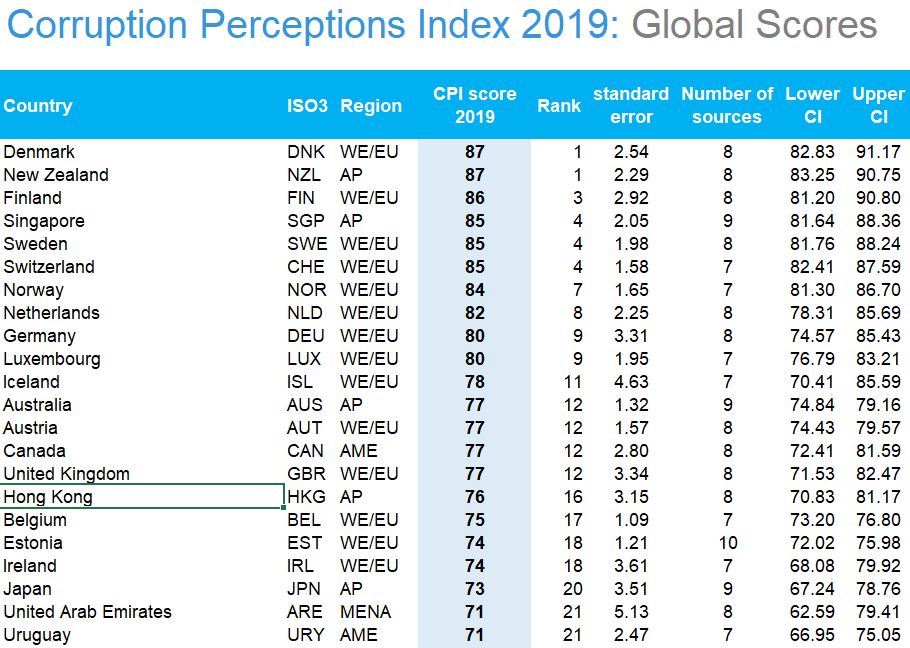
According to Transparency International, Singapore does relatively well in terms of corruption. Based on their 2019 Corruption Perception Index, Singapore is the fourth least corrupt nation, behind Denmark, Finland and New Zealand, countries which are known for having a culture of honest governance.


One has to look at this ranking with a critical eye. One of the most detailed analysis of how our ministerial salaries compare can be found at:

https://international.thenewslens.com/article/102993

Coming in fourth is not a bad position. We are the only Asian nation in the top ten of the lists of most honest governments and as a prominent Middle Eastern Businesswoman says, “Singapore washes the face of the Oriental.”

Having said that, we need to be a little more critical of our position in order for us to continue and improve. The main point that we need to hammer home is the fact that given that our ministers are paid exceedingly well in order to ensure honesty, we should be number one on the list. Let’s not forget that the Prime Ministers of the Nordic Countries and New Zealand are paid considerably less and Jacinda Arden has famously refused a pay raise stating that she’s already at the upper end of the salary scale.

The other point one should note is that there is that corruption is mainly defined as the “money” variety. Singapore has “no” money corruption in as much as you’re not going to get very far in bribing government officials and so on. However, one should note that Singapore has plenty of people willing to do you favours when it comes to working with government departments and if you look at the top jobs in Singapore, you’ll notice that they inevitably go to the same people. This has to lead you to the conclusion that Singapore’s talent pool is either incredibly small (one of Lee Kuan Yew’s mistakes. He encouraged the talent pool to bread within itself not realizing that inbreeding is bad for the gene pool) or Singapore has an abundance of itchy backs that need to be scratched.

The second point about the high salaries was the fact that government needs to attract talent. On the surface, this is not an unreasonable argument. Why should the nation’s best and brightest automatically head for finance houses to serve the proverbial one percent of the global elite, when they can just as easily be running a government department and serving a larger segment of the population. The saying of “You got to pay if you want talent,” applies to the public sector as much as it applies to the private one.

The Singapore government also seemingly obsessed with grooming talent, particularly that of the public sector. Our scholarship system enables the government to pick out the guys who get top notch results and bind them to the government. It’s a comfortable life with a well-defined career path. It gives the government bragging rights to say that the best and brightest are running the show. However, is that really the case.

While Singapore still does measure up pretty well in many aspects, our well-oiled machinery has been showing signs of serious disrepair. The most famous incident came in 2007 when a man labeled as “worst terrorist” managed to walk out of a highly secure facility and he remained hidden for well over a year until he was caught by the Royal Malaysian Police (Ministry of Home Affairs would insist that I add the sentence – with assistance from the Singapore Police Force). The result of a man with a limp walking out of a highly secured facility was the sacking of two Gurkhas and the demotion of the man running the facility and the passionate defense of why the head of the police and the Minister of Home Affairs needed to keep their jobs.

As Covid-19 showed, there were plenty of examples of how our very well-paid civil servants and ministers who running into blunder and after blunder.

Let’s use an automobile analogy. The Singapore tax payer is asked to pay for a Rolls Royce. You expect the car to run perfectly and when things go wrong, the workshop will fix it immediately. Rolls Royce is about the service as much as it is about the car. There is an urban legend that says that when Ogilvy wrote his classic tag line of “At 60 miles an hour the loudest noise in the new Rolls-Royce comes from the electric clock," the head of the workshop is reputed to have said, “Damn, I’ll now have to get the electric clock fixed.”

Singaporeans are not unreasonable. We understand that the government will mistakes along the way. However, we’re paying for Rolls Royce standards so, we expect the government to react like Ogilvy’s Rolls Royce engineer and fix the problem. However, this isn’t what we’re getting. What we’re getting is angry responses and libel threats. Then, there’s Fawning Follower and his ilk lecturing you on the values of being screwed by the government.

OK, our ministers to stack up pretty well against their regional counterparts. However, our brethren across the causeway are paying for a “Proton Saga” and when the Malaysian government behaves like a Proton Saga, it’s a case of getting what you paid for. By contrast, Singaporeans are paying for a Rolls Royce, getting a Toyota and when they complain, they’re told to be grateful that they didn’t get a Lada. I don’t know about you but I don’t think this is how someone who is paid a million plus a year from my taxes should behave.

Since the government is so fond of comparing itself with the private sector, we should use private sector analogies. The heads of multinationals, particularly the American ones are paid astronomical sums. However, shareholders expect them to perform and customers expect not just the maintenance of high standards but a constant improvement. Look at John Flannery who succeeded Jeff Immelt as CEO of General Electric. The share price did not improve within a year and Mr. Flannery got the boot and that’s even if you can argue that he was merely trying to solve problems that came from his predecessor.

Shouldn’t we apply the same standards to government ministers? We can entertain the argument that we need to pay our ministers the same as top level executives. However, in return why don’t we have an election once every two years instead of once every five. High pay needs to be matched with high performance, which is admittedly stressful. However, isn’t a million dollars a year worth the stress of a bi-annual job appraisal instead of every half a decade? The public is paying a million per minister per year. It has a moral obligation to demand what it is getting for what it is paying.  

Wednesday, August 05, 2020

“Not competitive at all.”

One of the highlights of my working life in corporate insolvency came from a meeting which involved one of Singapore’s foremost insolvency and restructuring practitioners. I was part of a team bidding for a case that was being held up in the American courts and my employer felt that it was necessary to rope in a “brand” name practitioner and so got this particular practitioner into the coalition that we were trying to assemble. Towards the end of the meeting, the solicitor who was trying to build the team turned to this practitioner and asked, “Are your fees competitive.”

At that very instant, the practitioner said, “I’m NOT competitive at all,” and he said so with a certain amount of pride.

I think of this moment and the way this man took so much pride in being “NOT competitive at all,” because it underlines one of the most fundamental aspects of doing business – price. One of my favourite clients said it best when he told me – tell me:

  1. 1.      What can you do?
  2. 2.      How quickly can you do it?
  3. 3.      How much will be cost me?

As someone who was inevitably desperate for the job, the answer to these questions were as close as one could get to the following:

  1. 1.      Anything you want?
  2. 2.      It was done before you even thought of it?
  3. 3.      Nothing at all.

Quite often, the most important factor in deciding who got the job, often boiled down to the third point. It is in the buyer’s interest to get away with paying as little as possible and the seller will inevitably try to show that he or she can give the buyer the price that he or she wants.

If I look back at my freelancing days, I realise that I had one key advantage over my competitors, who were inevitably sizeable companies – price. I could do the job at a certain standard at price that my competitors could not do. When I took my last big job in the industry, I was presented with a quote that the client had gotten from a multinational and was told – “It’s yours if you can do it at half the costs.”

I was hungry enough to agree and we ended up settling at around 40 percent of what the competitor had quoted. However, while I had won the job on the third point, the client had high expectations about the first point. I was expected to deliver coverage on a multinational level without the multinational team (which would have required a budget). I managed to deliver the expected results at the expected budget (so much so that they told me to invoice and paid on the spot) by working through a relationship that are not commonly used by conventional practitioners.

Business is inevitably about balancing points one and two with point three. The adage is that success inevitably boils down to being able to be “good, fast and cheap.”

I’ve noticed that national economies, particularly the Asian ones do something similar. Japan, the most advanced economy, built itself up by being able to make things cheaper and better than the West. Gradually, as prices rose in Japan, manufacturing moved to South Korea, Taiwan, Hong Kong and Singapore.

Being able to work cheap has done wonders for Asia. Millions have left poverty because we were able to give the multinationals a cheaper alternative. This went into hyperdrive when China started becoming the world’s workshop and India the back office.

However, while price is often an important factor, I have to ask if this is sustainable, particularly for the mature economies like Hong Kong and Singapore. Our politicians are particularly fond of reminding us that in order to stay competitive in the global economy, Singapore needs to be competitively priced.

I don’t think they’re wrong to suggests to say that Singapore needs to be “competitive.” We are a pipsqueak island with no domestic market or resources. Our larger neighbours have more to offer and so we got to be on our toes and constantly find things to offer the world.

While I do understand that we need to be competitive in the global economic arena, I do question if the “need to be competitive,” is becoming an excuse to justify unacceptable practices, especially when it comes to making life better for the poor and needy. Just think of the two most common instances when the need to stay competitive is brought up to stop a discussion. They are inevitably:

1.      Having a minimum wage – common argument is that this will make us less competitive (read cheap) and therefore our economic system and well being will collapse;

2.      When it comes to slave labour from South Asia. Once again, the common point is that if we gave the slaves a dollar an hour more (and actually gave it to them) and got them to spend an hour less in the sun, our infrastructure costs would sky rocket and our economic system would collapse (believe it or not, even when Covid-19 was showing us very clearly that slave hovels were endangering the rest of us, there were people fretting that improving the lot of slaves would endanger our economic survival).

Shouldn’t it be clear by now that a mature economy like Singapore’s can no longer compete on being cheap and we need to reinvent our focus on being good instead of being cheap. This is not to say that price will not be an important factor – merely that we need to compete on something other than price.

I go back to my freelancing experiences and the insolvency practitioner who is proudly not competitive. I competed on price because I went to look for my customers. The insolvency practitioner has reached the stage where customers look for him. He does not need to be cheap. He does not need to do every job to stay alive – merely the ones that pay very well.

There are examples of this. The most famous example of Apple, which designs products and reinvents the way we do things. Apple is an example of a company and business that creates our need to need their products. This is an example of what type of business Singapore Inc needs to aspire to.

Unfortunately to be good, you need to pay and this where Singapore needs to get away from its obsession with “cheap.” Let’s face it we will never make things cheaper than China or 3D printing or do back office work cheaper than India or AI and that’s even if we give away factory land away and exempt foreign multinationals from paying CPF contributions to locals.

Our economic role models can no longer be other developing countries. I think of the German model as an example. Germany has one of the highest hourly wages in the world:

https://worldpopulationreview.com/country-rankings/minimum-wage-by-country


Yet, at the same time, Germany is also the third largest exporter in the world. Germany with one third of the population of the USA and not even 10 percent of China’s, competes in the global market.

https://en.wikipedia.org/wiki/List_of_countries_by_exports


What does Germany export? It exports good quality products. The ones that come to mind are Mercedes and BMW, which are known as some of the best cars in the world rather than the cheapest:


However, there are others. The German economy or Europe’s largest and the world’s fourth largest, is driven by SME enterprises that specialize in unique goods for very niche industries. I think of the Rational Combi-Oven that every chef I’ve worked with used to drool over as an example.

Isn’t it time we moved away from trying to be the world’s cheapest for the world’s big boys? Why can’t we be proud of being good and not being embarrassed of getting the world to pay for Singapore Inc’s products what it pays for that of the West.

We’re a small economy but in the interconnected world we live in, there’s no reason why we can’t do big things on the world stage? Surely this is something the government should drive us towards.


Monday, August 03, 2020

“I’m not a rich man – everything I make is reinvested in the Company.”

I remember my Dad and I once had a discussion about money. I was still at school and he wasn’t happy with how I was spending things. He made the point that despite the good things we had around us, he was not a rich man with infinite resources. Everything he had was reinvested into his business.

This conversation summed up the importance of money. While money is not everything, it plays a vital part in most of what we do. Money is not the root of all evil – it is the root of most things and business people, including the ones that are doing well, will always remind you that whatever surplus they earn has to be invested back into the business. Hans Hofer, the founder of Apa Guides once said that he only made money from his business when he sold his business and did other things.

I remembered these conversations and as I started freelancing in an industry where people are expected to work for foreign multinationals, I learnt two valuable lessons. The first lesson was the fact that money is power. The guys with the money will inevitably squeeze those without. The guy who has the advantage in a business negotiation is inevitably the guy with money in the bank. It is, as they say, easier to tell someone to f** off when you have enough money to worry about not having that job or project.  

The second lesson I learnt was that there was a clear difference in attitudes towards money between those working for someone else and those who were employed. Big ticket items like posh meals, fancy wines, swanky hotel rooms and business class tickets were inevitably bought by those on expense accounts. The self-employed, including the successful ones, tended to be a little more conservative with their spending. It is inevitably easier to spend someone else’s money.

These lessons I took from the world of business seem to apply to electoral politics. The winner of any given election is inevitably the party that has the resources to spend. American elections are particularly well known for this. Candidates need to raise hundreds of millions to get past the finish line.

It isn’t much different in the Westminster System, where its often said that elections are lost by governments rather than won by opposition parties. Singapore’s government, for example is pretty good at dishing out goodies before an election.

It has also has been particularly good at buying over potential opponents. Our scholarship system is designed to bring bright and potential trouble makers onside. Two of our more prominent ministers (Tharman Shanmugaratnam and Vivian Balakrishnan) are examples of two bright sparks, who had

However, Singapore’s ruling party has run into a few challenges recently. The first one is the fact that potential opponents in the opposition are increasingly financially independent like former Worker’s Party Member of Parliament, Chen Show Mao, who was a partner at David Polk & Wardwell, a law firm with over a billion in revenue. Telling someone they can afford a condominium in a few years of working for you just doesn’t quite have the same effect on a man who is already living in a condominium.

The second challenge comes from an attitude towards resources. At the end of the recent election, the Prime Minister announced that Mr. Pritam Singh, leader of the Worker’s Party would be given the title “Leader of the Opposition,” which would be recognized office in the apparatus of the state which comes with a salary and staff.

This is office is found in other Commonwealth Jurisdictions like the UK, Australia, New Zealand, Canada and India. However, in the Singapore context this was revolutionary in the sense that it was official recognition of “opposition” parties as a legitimate force. The cynics also argued that it was a sign of taming the Worker’s Party with an effective bribe.

However, Mr. Singh threw a wrench into the works by donating half of his salary increase. This announcement instantly brought him into the cross hairs of one of the ruling party’s most prominent trolls, Mr. Calvin Cheng, who complained that the Prime Minister’s donations didn’t get the good press that Mr. Singh’s was getting:

http://theindependent.sg/calvin-cheng-asks-why-pm-lee-doesnt-get-the-recognition-pritam-does-for-donating-half-his-lo-salary/

To make matters worse, Ms. Ho Ching, the Prime Minister’s wife, CEO of Temasek Holdings (Singapore’s Family Office), and the only person whose salary is a state secret joined in the fray:

https://www.asiaone.com/digital/ho-ching-and-calvin-cheng-take-pritam-singhs-donation-declaration-netizens-respond

Mr. Singh has clarified that he wasn’t giving away half his salary but half his salary increase:

https://www.straitstimes.com/politics/wp-chief-pritam-singh-clarifies-that-he-will-donate-half-his-salary-increase-not-half-his

Why are people associated with the ruling party getting upset by Mr. Singh’s donation? The obvious point would be that it doesn’t make them look good. The act of forgoing the salary increase (which is considerably less than the lowest paid political office holder) has started what the Malay Mail described as a potential charity war and made Mr. Singh look better than the ruling party office holders:

https://www.malaymail.com/news/opinion/2020/08/02/singapores-opposition-leader-launching-a-charity-war/1890250

The less noticed and talked about point is that Mr. Singh probably had no choice in donating his new salary increase. If you look carefully at what Mr. Singh has said he would donate to, you’d note that it is primarily towards grassroots causes in the areas that his party controls.


The Worker’s Party is playing a long-term game. Strategy is simple – win seats, keep taking care of constituents to stay elected and then challenge for seats when you have enough strength. Unfortunately for Mr. Singh, his options of executing that strategy are particularly limited in as much as the main source of funding comes from the government, which is controlled by the ruling party, which unashamedly works on the principle of delaying funding to wards that it does not control.

Hence, Mr. Singh has to find different ways of funding the programs that his constituents need. The donation of his salary increase can be seen in the same light as a small shop keeper investing a windfall back into the business.

It’s different for the ruling party in as much as it controls official purse strings. Ruling party members of parliament (MPs) can afford to behave like executives on a generous expense account because getting the money is simply a question of following official rules on accountability.

Someone who comes from a position where he does not have to find ways and means of creating a budget will not be able to understand the motives of someone who is operating in a system where he or she has to get creative about raising the money.

While it will be sometime before the Worker’s Party will be in a position to fight for the government, the lack of resources is inevitably good for it. Its MPs will be trained to think of their wards like microenterprises with limited resources. This mindset will produce people who should be able to come up with creative solutions to the more complex problems of the modern age.

Hopefully, a stronger opposition will also help improve efficiency in the government. One can only hope that the increase in dissenting voices will get ruling party MP’s to think more creatively in order to get things past parliament. In business, big conglomerates like General Electric have started to work on the principle that they need to behave like smaller enterprises. Hopefully the same will happen in politics.    


© BeautifullyIncoherent
Maira Gall