race
Showing posts with label race. Show all posts

Thursday, August 13, 2020

The Convenient Racist


The big news on the international stage is the choice of Ms. Kamala Harris to be the Democratic Party’s choice for Vice-President. Ms. Harris, who is currently the junior senator from California will be the first “woman of colour” (her father is black Jamaican and her mother is Tamil) to be on any primary ticket. Of the four running for office this November, Ms. Harris stands out as something refreshing (the other three being crusty white men) and she’s helped electrify the campaign with Donald Trump calling her mean (she won’t sleep with him) and she’s made the elections interesting beyond America’s borders:

https://www.bbc.com/news/election-us-2020-53750619

While Ms. Harris has proved herself to be a capable politician in her own right, the truth is that she was chosen because of her gender and bi-racial roots. The Biden Campaign’s strategy in choosing a “woman of colour,” is obvious. If the Trump-Pence Campaign is all about getting old white men out to vote, the Biden-Harris campaign is going to be about getting women and “people of colour” to vote.


Ms. Harris isn’t the only politician in the world to be “helped” by her gender and race. Like it or not, the world is simply not colour blind and what you have between your legs counts when it comes to the polling booth. As much as we like to think of ourselves as “progressive” and being blind to colour and ethnicity, we’re not. It took America, the land that gave us a constitution based on individual happiness and liberty took more than two hundred years to elect a man who was slightly darker than pink (and let’s not forget his mother is white) and then promptly reversed that by electing his successor who decided that America needed to be more White than White and while it’s taken two hundred years to elect someone darker than pink, America has more famously never elected a woman to be president or vice-president (by contrast, the more “sexist” societies of the Muslim parts of South Asia have put four women into power).

People generally like people they are comfortable with. Unfortunately, comfort usually means people who are most like them and in a democratic society that happens to be ethnically and religiously homogeneous, leaders tend to look pretty much like the rest of the electorate. However, in diverse societies, the politics like business becomes a question of target markets. In American Presidential Campaigns, a presidential candidate looks for a running mate who can compliment him (most of them being men). The most striking example being the young and black Obama choosing an old white man called Joe Biden.    

If the divisions in a society are particularly deep, you might find a case of certain political offices being reserved for certain communities. In Lebanon it was understood that the President would always be a Maronite Christian, the Prime Minister a Sunni Muslim and the Speaker of Parliament being a Shia Muslim.

Singapore did have something similar in its presidency. Lee Kuan Yew states very clearly that he needed to show the government in KL that a Malay could rise up in Singapore and so he chose Yousof Ishak to be Yang De Pertuan Negara (Malay for Head of State, a title conferred on the Malaysian Sultans, though Ishak was to be a non-Royal head of state. The title was changed to President once we became an independent republic).

In our early days it was understood that the Presidency would be reserved for ethnic minorities as it was understood that as the Chinese were the majority, it was more than likely that the government and Prime Minister would be Chinese.

The rationale for reserving the presidency for ethnic minorities was clear. This was to preserve ethnic and religious harmony and it was a valuable symbol for ethnic minorities.

However, by 1985, it was obvious that the government felt that race was no longer a thorny issue and Mr. Wee Kim Wee (obviously ethnic Chinese) became our President. Then towards the end of Mr. Wee’s term, the Presidency moved from being about racial harmony to being about looking after our savings. The Presidency became an elected office in its own right (even if two Presidents have had their elections fixed).

The evolving nature of our presidency should be the story of our progress in race relations and this was a government that felt the need to reserve the head of state role for ethnic minorities. This is a government that is known to read the ground and plan carefully. So, when Mr. Wee Kim Wee was appointed to be President in 1985, they must have felt that it was no longer necessary to reserve the office for ethnic minorities because our race relations must have improved.

Singapore’s government also acts tough of “racist” or “acts that disrupt racial harmony.” I, like many Singaporeans grew up with the message drummed into our heads that racial harmony was something special.

Yet, while successive Singapore governments have done so many right things in the name of promoting racial harmony, they’ve also been playing the “race card” in a rather ingenious way.

The first step was to return the presidency to being about race and the rather clumsy attempt to arrange the winner (fix being an ugly word). The most embarrassing moment came from our Minister of Trade and Industry, Mr. Chan Chun Seng, who said “An Indian Muslim is a Malay,” which any half-educated Western Expatriate could tell you is not true. The nicest thing you could say about the Ministers comments is that our management of race relations must have been so successful that he couldn’t tell the difference between an Indian Muslim and a Malay.

One has to question why the government felt it was necessary to play the race card with the presidency when it had felt it was no longer necessary to do so back in 1985. Are we to say that race relations have worsened in this supposedly more “liberal” age and if the rights of ethnic minorities has become worse or at least so much so that you have to make the presidency about race again, what does that say about the government’s management of race relations since the 1980s?

Instead of having a candidate that could appeal to all (Malay, Muslim Lady), what we got was a presidency that lost its legitimacy before it even began.

The other point of convenient racism came when the party kept insisting that “Singapore is not ready for a Chinese Prime Minister.” This is despite the fact that the most popular member of government happens to be from an ethnic minority. While, Senior Minister Tharman Shanmugaratnam has said that he’s not interested in the job, one has to ask which part of Singapore is not ready for an ethnic minority to be Prime Minister when the Senior Minister is considered a “dream candidate” for so many.

To make matters worse, the newly appointed “Leader of the Opposition” or leader of the only other party to win seats happens to be an Indian. If the electorate is willing to support “non-Chinese” party leaders, where does the government get the idea that the nation is not ready to be led by a non-Chinese? Is the government still stuck in the politics of the 1960s while the electorate has moved on?

A government that has worked so hard to create a society that is “regardless of race” has to understand that it cannot no longer micromanage race relations or impose yesterday’s fears on today’s population. Talk to many local Chinese and you may find that they’re more comfortable with their Tamil and Malay buddies than they are mixing with Mainland Chinese. You need to address current issues rather than dig up old wounds. When the incident with Ramesh Erramalli broke out, Singapore’s Tamil population sided with an old Chinese security guard rather than with their “own kind.”

When the electorate gives a party led by an Indian more seats after you’ve said that they’re not ready for a “Non-Chinese” Prime Minister, the message is clear – Stay Out of Race Politics.”


Friday, June 26, 2020

You’re Lucky We Let You Live


I usually don’t have much to say about Singapore Elections. The results, like any libel trial involving our senior political leaders, is a forgone conclusion. The ruling People’s Action Party (PAP) is an expert at using the vast powers and resources of incumbency to its advantage and our opposition remains fragmented and too filled with different egos to focus on the main prize. Furthermore, if you work on the principle that elections are not won by opposition but lost by governments, the PAP government, while having made some serious mistakes, has yet to do enough to lose the election.

Having said that, it’s been unfortunate that a member of the ruling party has decided to put display a very disturbing attitude towards ethnic minorities. The background is as simple. Dr. Tan Wu Meng, a member of parliament (MP) for the ruling party took issue with the playwright, Alfian Sa’at.

I must admit that I’ve never read Alfian Sa’at’s works. However, from what I’ve heard of him, he’s by no means a violent revolutionary nor has he ever suggested that he’d support any damage to Singapore. What he has been is critical of certain government policies and certain members of high society. In short, Mr. Sa’at is not much different from the rest of us when it comes to discussing politics. He is merely more vocal. He was described by Professor Tommy Koh, one of our most respected diplomats as a “loving critic” of Singapore.

Dr. Tan, however, decided that Mr. Sa’at was not a loving critic but a dangerous “anti-Singaporean” and when Dr. Pritam Singh, leader of the Workers Party (the only opposition party with seats in parliament), defended Mr. Sa’at in parliament, Dr. Tan decided to go for the proverbial jugular and in doing so, put on display one of the worst displays of “Chinese Privilege” ever seen:


Dr. Tan’s point is this simple – he, as part of the ethnic Malay minority in Singapore was ungrateful for the fact that Chinese majority Singapore had given him an education and allowed him to make a living. The argument was simple, had he been born as an ethnic minority elsewhere, he wouldn’t live the life he lives or even been allowed to live.


Nobody denies that ethnic minorities don't have it easy. In Southeast Asia, the ethnic Chinese minorities, particularly in Indonesia and Malaysia have had to live with, at best legal discrimination or been at the wrong end of a violent mob, as happened to Indonesia’s Chinese back in 1998.

While Singapore’s ethnic Malays have not been on the wrong end of violent clashes, Dr. Tan misses the point. Just because ethnic minorities get it worse elsewhere, it doesn’t make treatment of our own ethnic minorities right nor does it make Dr. Tan’s attitude correct.

For a start, the attitude of “You the ethnic minority are lucky” goes against the ethos of what Singapore is supposed to be. I cannot stress enough that the ruling party, which Dr. Tan is a part of wrote our national pledge as “Regardless of Race, Language or Religion.” Our national pledge is based on us being “Singaporean” first rather than our ethnicity or faith.

Sure, racial prejudice does exist on a personal level and you can’t expect these prejudices to vanish overnight. There is no doubt that ethnic minorities will have to deal with personal prejudices on a personal basis. However, you’d expect that elected representatives of the people would have a duty to combat such prejudices in the public sphere rather than to use the fact that ethnic minorities are just that and to use that as a threat.

Mr. Sa’at was educated in Singapore and makes a living here. Isn’t that the right of every citizen of Singapore? Why is that even an issue?

I am sure that there are plenty of issues that one can take up with Mr. Sa’at but the fact that he’s an ethnic minority that had the good fortune of being able to receive an education and make a living in Singapore should not be one of them.

The leader of the ruling party should demonstrate that we are serious about being “regardless of race, language or religion” and make Dr. Tan pay with his seat in Parliament. There should be no room for politicians to use the race card in a progressive society.   


Saturday, June 06, 2020

It Could Happen Here


As an Asian, particularly a Singaporean, the temptation to feel smug has never been greater, particularly when you look at events in the world’s most prominent nation, the USA. While Singapore has problems and has lost some of its shine from the explosion of Covid-19 cases, our problems remain relatively mild, when compared to say the hundred thousand odd Covid-19 cases in the US and the riots across America that were sparked by the murder of George Floyd, a black man who was murdered by white police officers on video. Our problems, as they say, are rather “first-world” when compared to the USA.

However, as tempting as it is to get smug, it’s probably best not to get smug at all. While Singapore’s apparent tranquility might give one the impression that all is well, many of the underlying problems that have exploded in the USA are present in Singapore. We’ve merely been better at applying the cosmetic dressing.

Like the USA, Singapore is an unequal society. The latest figures on inequality based on the Gini-coefficient (which measures inequality on a scale of 0 to 1, with 0 being perfect equality), Singapore hit a two-decade low of 0.452 last year. The report can be found at:


By comparison, the USA has a Gini-coefficient of 0.485. Singapore compares well to its main Asian rival, Hong Kong, which has a Gini-coefficient at 0.539 (joke being the tycoons control Hong Kong the way the government controls Singapore) and unlike top placed Lethoso (0.632), its not a case of a handful of people owning everything else. However, Singapore compares badly to the European nations, like Germany, which has a score of 0.27 and even some of our fellow ASEAN neighbours like Indonesia which has 0.368 (this being a country which has some of ASEAN’s richest people while having visible signs of poverty).

Whenever the issue of the Gini-coefficient is brought up, Singapore’s powers-that-be, inevitably argue that the Gini-coefficient isn’t the most accurate measure of anything in particular, rather like the way my old headmaster used to argue against school league tables (that being until the tables showed him something he liked to see).

What’s particularly interesting about the “inequality” in Singapore is that it is often colour related. You have the professional and executive classes, who are more often than not Westerners or well-educated local Chinese, and much to the dismay of many locals, a growing number of Indians from Mumbai and Delhi. At the lower end of the spectrum are the guys doing menial jobs like cleaning our streets, manning our ship yards and construction sites and looking after our kids. These guys are predominantly from what Donald Trump calls “Shithole” countries of the Philippines, Bangladesh and India (specifically the Southern Parts).

The wage differentials are staggering. While our CEO’s have yet to experience American style 100 million annual stock options, the pay at the higher end of the scale is not to be sniffed at. DBS’s CEO, Piyush Gupta famously had a salary of SG$9,000,000 a year. Our Prime Minister is the world’s highest paid head of government (US$1.61 million per year versus the USD400,000 for the US President) and the CEOs of our top companies are not doing too badly either.

At the other end of the scale are the labourers and maids who would be lucky to have a thousand Singapore dollars in their pockets. I still remember a labourer of a company we put into liquidation telling me that he earned a princely sum S$18 a day for a 12-hour workday.

What’s particularly interesting is the attitudes towards the pay differentials. When it comes to paying working professionals, it called “talent retention,” and we’re told that we’ll lose our competitive edge if we don’t pay better than first world salaries to people from the first world. It was always interesting to see the extent of our efforts to “retain” and “attract” talent, especially when it came to the vices. The police parked themselves across the streets so that working professionals could have their pick of prostitutes and overpriced booze without any interference (men, will be men).

By comparison, when it comes to anyone from “developing” Asia, the line of defense is – “they’re earning far more than they’d ever get back home.” This on its own wouldn’t be a major topic, but when you add the way law enforcement looks upon migrant workers, which is as a source of potential problems. Bored policemen on petrol inevitably cannot help questioning workers who are damaging the neighbourhood by sitting in a corner and having a cup of tea.

Just as there’s an economic defense for paying “talents” from New York or London well, there’s an economic defense for paying people from Dhaka and Manila badly. The argument runs like this, if we didn’t pay them badly, we would not be able to give you the Singaporean quality housing and infrastructure at affordable prices.

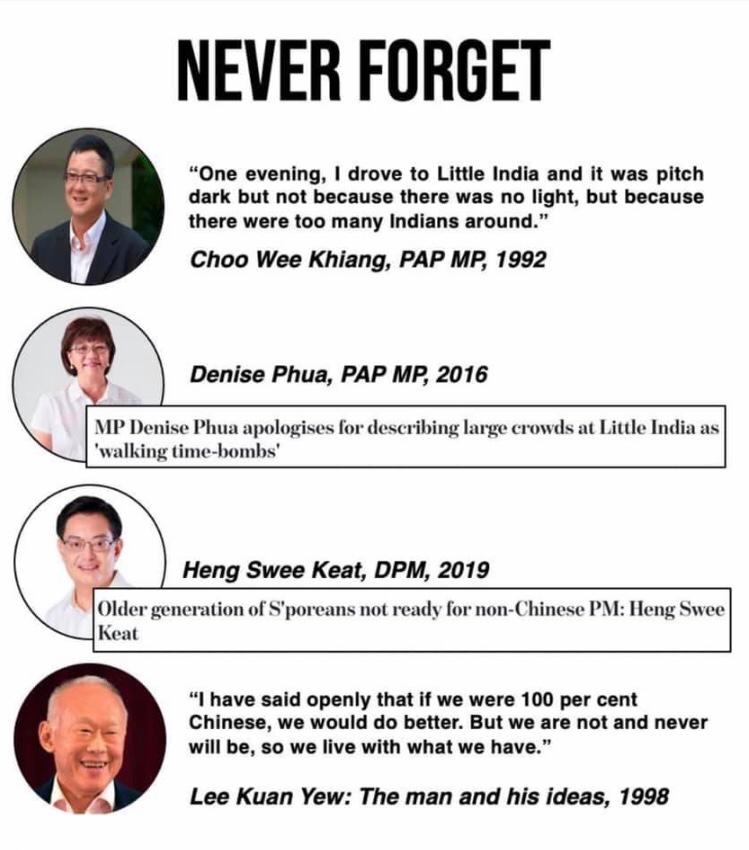
This argument is faulty. It enforces the idea that dark skinned people are less worthy of human treatment and places the profits of companies above that of basic human decency. What’s more shocking is that official attitudes seem to support this. There have been too many cases of senior politicians making blatantly racist statements in the public arena and keeping their jobs as the following illustration shows.


Furthermore, with the explosion of Covid-19 cases in worker dormitories, you’d imagine that people would finally understand that its in the national self interest to ensure the workers get better living conditions. Unfortunately, you have too many like the Fawning Follower aka Critical Spectator, who still insist that the downtrodden need to remain that way for everyone’s benefit.


The foreign worker population like the black population inthe USA have born a disproportionate amount of Covid-19 cases. They are generally law abiding and as stated on many occasions, what they want is to get what is due to them for their labour and some fairness.

To be fair to the Singapore government, its acted quickly to contain the spread of Covid-19 in the dormitories and been generous in giving welfare to the affected workers. However, this is only cosmetic and doesn’t solve the real problem.

Let’s remember that the cause of the 2013 riots came as a result of the police appearing to show more interest in protecting a bus driver who had killed a worker than in the welfare of the worker itself. While mild compared to what is happening in the USA, our system needs to be revamped to such a way where our “anti-racist” rhetoric actually means something and we don’t justify the exploitation of an underclass in economic terms.

Let’s start with this. Politicians who make “racist” remarks in public should pay with their jobs. It would show that we’re actually serious about combating racial discrimination. If our leaders can get away with making “racially insensitive” remarks in public, what type of example does it set for the rest of the population?

We’ve been lucky in our race-relationship management. However, we have underlying problems and let’s not waste a good crisis and use the time to take stock and reform the system for the better. The sooner we do it the better for the rest of us.

© BeautifullyIncoherent
Maira Gall